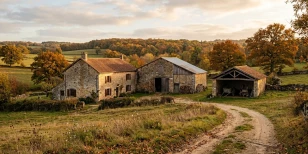

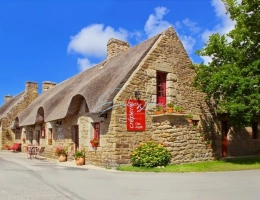
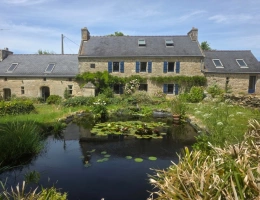
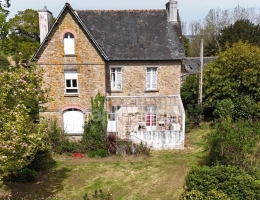
Looking for a mill for sale in Finistère (29) opens the door to a department where water is everywhere: the Elorn, Aulne, Odet and Douron rivers powered hundreds of watermills, and the deeply indented coastline still has a few tide mills, rare anywhere in France, the legacy of a very old local hydraulic tradition sometimes dating back to medieval times and monastic land management. On this page, ma-propriete.fr brings together the mills for sale in Finistère: watermills to renovate, former tide mills, converted flour mills or millers' houses with water rights.
You will also find price benchmarks based on actual sales, an overview of the areas where these properties are concentrated, and the specific points to check before buying a mill, especially for properties close to the coastline. To prepare your project, read our white paper on setting up a rural gîte, whose advice on outbuildings and financing applies fully to a Finistère mill, whether a watermill, a tide mill or a windmill, and whatever its intended use after purchase, from a family home to a holiday-rental business.
There are no official statistics dedicated to mills: sales are too rare and too varied (a ruin to restore, a habitable mill, a flour mill with a turbine). The most reliable market benchmark remains the price of country houses, which a habitable mill resembles, with a premium for the water, the character and the water rights, and a discount for the work required.
How much does a country house cost in Finistère (29)? According to DVF data (notarised sales) analysed by the ma-propriete.fr observatory, the median price of a country house in Finistère (29) stood at €215,000 in 2025, with an average price of €225,485 and a median price of €2,072/m² of living space (3,530 house sales in rural municipalities over the year). The price range is wide: 10% of houses sold for less than €118,655 (floor price, 1st decile) and 10% for more than €350,000 (ceiling price, 9th decile). The typical country house here offers 108 m² of living space on an average plot of 2,708 m², i.e. around 0.3 ha.
This market is close to the regional median (Brittany: €210,000) and above the national median (€189,200). Since the second half of 2020, the median price has risen from €167,000 to €215,000, i.e. +28.7%; over one year (2024-2025) the change is +2.4%.
| 2025 indicator | Finistère | Brittany | France |
|---|---|---|---|
| Median price | €215,000 | €210,000 | €189,200 |
| Average price | €225,485 | €223,474 | €207,100 |
| Floor price (1st decile) | €118,655 | €110,000 | €90,000 |
| Ceiling price (9th decile) | €350,000 | €355,291 | €340,000 |
| Median price per m² of living space | €2,072/m² | €2,027/m² | €1,830/m² |
| Average living space | 108 m² | 107 m² | 108 m² |
| Average plot size | 2,708 m² | 3,041 m² | 3,181 m² |
| Number of sales in 2025 | 3,530 | 13,579 | 150,313 |
A departmental average hides large gaps. A smallholding to renovate, a restored longère with its outbuildings, a farmhouse on several hectares of land or a manor house with parkland do not sell at the same price, and the location matters as much as the building: coastline, tourist area, peri-urban countryside close to a job market or deep countryside. The table below shows the median price of country houses in Finistère (29) by type of municipality (cumulative sales from mid-2020 to 2025) and its change between 2021 and 2025.
| Type of municipality | Median price 2020-2025 | Median price per m² | Change 2021-2025 | Sales 2020-2025 |
|---|---|---|---|---|
| Tourist coastline | €243,500 | €2,407/m² | +13.0% | 4,259 |
| Residential coastline | €219,000 | €2,110/m² | +13.6% | 7,796 |
| Inland tourist areas (hinterland, mountains) | €112,500 | €1,184/m² | +14.3% | 209 |
| Peri-urban countryside (city catchment area) | €195,600 | €1,873/m² | +16.7% | 6,973 |
| Deep countryside (outside urban influence) | €152,000 | €1,500/m² | +13.9% | 4,999 |
These benchmarks help you assess a listing, estimate a property before putting it up for sale, or set your budget for a holiday home or a permanent move to the French countryside. To go further, see our observatory of country house prices in France (national, regional and departmental analysis, downloadable annual report) and work out the full cost of your purchase, including French notary fees, with our notary fees calculator.
Finistère combines all three families of Breton mills. Watermills are the most numerous, on the Elorn between Landerneau and Sizun, the Aulne around Châteaulin and Pleyben, the Odet near Quimper, and the Ellé and Douron rivers on the edge of Côtes-d'Armor. Many were converted into flour mills in the 19th century before becoming homes in the second half of the 20th century, often keeping their water wheel in good condition and a granite structure typical of Finistère.
Tide mills, using the strong tidal range of the Iroise Sea and the Brest roadstead, are a rare feature of the Finistère coastline, with a few examples still visible on the estuaries of southern Finistère and Douarnenez bay. Windmills are mainly found on peninsulas, particularly the Crozon peninsula and the Bigouden country, where sea winds made up for the lack of powerful rivers, a technical choice dictated by local geography, prevailing winds and centuries of maritime experience.
The Elorn valley, between Landerneau and Sizun, and the Aulne valley, around Châteaulin and Pleyben, offer the best potential for a habitable mill with land, close to Brest and its TGV station. The Bigouden country around Pont-l'Abbé and the Glazik area near Quimper round out the offer for buyers seeking a more coastal setting, between coastal ponds and sheltered coves, in the hedgerow landscape typical of southern Finistère and its traditional costume villages.
Mills near Brest, Quimper and the coast, particularly around Douarnenez bay, are clearly above the department average, driven by strong demand for seaside second homes and long-term investment properties. Central Finistère, around Carhaix-Plouguer and the Monts d'Arrée, remains the most accessible area for a mill to restore, in a more inland and less touristic landscape.
Check the existence of the water rights (a mill fondé en titre or holding an authorisation), the condition of the millrace, weir and sluice gates, and the ecological-continuity obligations on Finistère's salmon rivers, closely monitored by local fishing and river-protection associations along protected estuaries. For a tide mill, maintaining the dyke and checking mechanisms exposed to salt requires specific and costly expertise, often best entrusted to craftsmen specialised in maritime heritage.
The building, in granite under slate, is often close to the water's edge: check for damp, flood zoning and access, sometimes tricky at high tide. Outbuildings (miller's house, bread oven, barn) lend themselves well to a gîte project, an activity firmly established in touristic Finistère, especially near protected coastal sites and popular coastal footpaths that draw visitors most of the year, from spring through to early autumn.
On ma-propriete.fr, mill listings in Finistère are published by private sellers, estate agents and notaries across the whole department. Filter by budget, living space and land area, set up an email alert to be told of new listings, and browse all mills for sale in Brittany if your search extends beyond the department, for instance towards Côtes-d'Armor or Morbihan, both rich in similar rural, riverside and maritime heritage.