Looking for a country house for sale in Grand Est? From the Alsace wine route to the Lorraine plateaus and the Champagne vineyards, the region brings together strongly contrasting styles: Alsatian half-timbered houses, Lorraine farmhouses in dressed stone, Champagne winegrowers' houses, and Ardennes farmhouses in schist. This page brings together the country houses for sale in Grand Est published on ma-propriete.fr by private sellers, estate agents and notaries.
To help you decide, we present the actual prices of country houses in Grand Est by department (recent notarised sales), the areas worth knowing from Alsace to the Ardennes, and the criteria that determine the value of a house in the countryside. Our complete guide to buying a country house in France completes these benchmarks, from surveying an old building to financing.
How much does a country house cost in Grand Est? According to DVF data (notarised sales) analysed by the ma-propriete.fr observatory, the median price of a country house in Grand Est stood at €150,000 in 2025, with an average price of €156,757 and a median price of €1,400/m² of living space (7,886 house sales in rural municipalities over the year). 10% of houses sold for less than €70,000 (floor price, 1st decile) and 10% for more than €255,000 (ceiling price, 9th decile). The typical country house offers 112 m² of living space on an average plot of 2,025 m², i.e. around 0.2 ha.
The region is well below the national median (€189,200). Since the second half of 2020, the regional median price has risen from €136,400 to €150,000, i.e. +10.0%; over one year (2024-2025) the change is +4.2%.
| 2025 indicator | Grand Est | France |
|---|---|---|
| Median price | €150,000 | €189,200 |
| Average price | €156,757 | €207,100 |
| Floor price (1st decile) | €70,000 | €90,000 |
| Ceiling price (9th decile) | €255,000 | €340,000 |
| Median price per m² of living space | €1,400/m² | €1,830/m² |
| Average living space | 112 m² | 108 m² |
| Average plot size | 2,025 m² | 3,181 m² |
| Number of sales in 2025 | 7,886 | 150,313 |
Differences between departments are significant: the median ranges from €105,000 in Haute-Marne (52) to €186,000 in Meurthe-et-Moselle (54). The table below compares 2025 prices and their change since 2020.
| Department | Median price 2025 | Average price 2025 | Median price per m² | Change 2020-2025 | Sales 2025 |
|---|---|---|---|---|---|
| Ardennes (08) | €146,000 | €148,310 | €1,402/m² | +14.0% | 901 |
| Aube (10) | €140,000 | €145,120 | €1,360/m² | +2.9% | 1,043 |
| Marne (51) | €180,000 | €191,161 | €1,675/m² | +6.5% | 1,380 |
| Haute-Marne (52) | €105,000 | €107,545 | €968/m² | +13.5% | 803 |
| Meurthe-et-Moselle (54) | €186,000 | €194,026 | €1,685/m² | +9.9% | 1,219 |
| Meuse (55) | €125,750 | €128,849 | €1,121/m² | +9.8% | 886 |
| Vosges (88) | €147,900 | €151,368 | €1,411/m² | +16.5% | 1,654 |
A regional average also hides large gaps between municipalities. A smallholding to renovate, a restored longère with its outbuildings, a farmhouse on several hectares of land or a manor house with parkland do not sell at the same price, and the location matters as much as the building: coastline, tourist area, peri-urban countryside close to a job market or deep countryside. The table below shows the median price of country houses in Grand Est by type of municipality (cumulative sales from mid-2020 to 2025) and its change between 2021 and 2025.
| Type of municipality | Median price 2020-2025 | Median price per m² | Change 2021-2025 | Sales 2020-2025 |
|---|---|---|---|---|
| Tourist coastline * | €145,000 | €1,282/m² | -23.7% | 32 |
| Residential coastline | €140,000 | €1,354/m² | -17.9% | 565 |
| Inland tourist areas (hinterland, mountains) | €137,462 | €1,350/m² | +14.6% | 1,622 |
| Peri-urban countryside (city catchment area) | €165,000 | €1,529/m² | +6.2% | 22,855 |
| Deep countryside (outside urban influence) | €125,500 | €1,178/m² | +7.4% | 23,366 |
* Between 30 and 99 sales: indicative value.
Note: in Grand Est, the municipalities classified as "coastline" have no access to the sea. They are municipalities bordering lakes of more than 1,000 hectares (or, in Eure, the Seine estuary) covered by the 1986 Loi Littoral, which also applies to such inland lakes and estuaries.
These benchmarks help you assess a listing, estimate a property before putting it up for sale, or set your budget, whether you are looking for a holiday home, a permanent move to the French countryside or a property to turn into a rural gîte. To go further, see our observatory of country house prices in France (national, regional and departmental analysis, downloadable annual report) and work out the full cost of your purchase, including French notary fees, with our notary fees calculator.
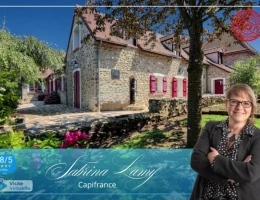
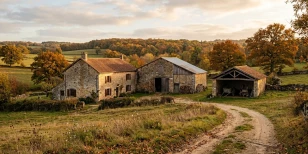
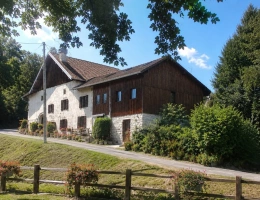
In Alsace (Bas-Rhin, Haut-Rhin), the typical country house is the half-timbered house, with painted timber frames and a flat-tile roof, found both in the villages along the wine route and further off the main roads. In Lorraine (Meurthe-et-Moselle, Meuse, Moselle, Vosges), the farmhouse built of dressed stone or Vosges sandstone dominates, often arranged around an enclosed courtyard with outbuildings. In Champagne (Marne, Aube, Haute-Marne), you find limestone winegrowers' houses close to the vineyard, and towards the Ardennes, more modest schist smallholdings in need of renovation. In the Bas-Rhin, wine-route villages such as Ribeauvillé, Riquewihr and Eguisheim (Haut-Rhin) hold the finest examples of half-timbering, while further north in Alsace, towards Wissembourg, the buildings are plainer and less geared to tourism. In Moselle and the Vosges, the combined farmhouse-and-barn under one roof remains typical of mid-mountain villages.
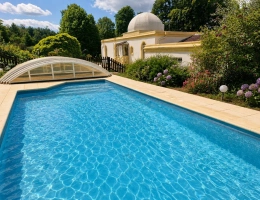
The land attached to these houses varies considerably: an enclosed garden and small plot in the Alsatian or Champagne wine-growing areas, but often several hectares with woodland and pasture around the Lorraine or Ardennes farmhouses. Agricultural outbuildings (barn, shed, bread oven) are common and can be converted into a gîte or a workshop. In the Meuse and the Ardennes, some farmhouses still have a dovecote or a communal bread oven, reminders of a collective farming past still visible in how the villages are laid out.
Around Strasbourg, Colmar and Mulhouse, the Alsatian country house benefits from proximity to the city and to the vineyard, which makes it sought after. The Vosges massif (around Gérardmer and Épinal) offers mid-mountain hamlets, peaceful and with open views, popular for a holiday home. Towards Nancy and Metz, the villages along the Moselle and Meurthe rivers combine characterful buildings with easy access to urban employment. In Champagne, the area around Reims, Châlons-en-Champagne and Troyes offers houses close to the vineyard and to the Marne or Aube valley. The Moselle valley corridor between Metz and Thionville benefits from a dense regional train service and cross-border jobs in Luxembourg, which supports demand for surrounding village houses. In the Vosges, the Val d'Argent and the Bruche valley offer an affordable mid-mountain setting less than an hour from Strasbourg.
The most sought-after areas remain the immediate surroundings of the Alsatian and Champagne vineyards, and the outskirts of Strasbourg, Nancy, Metz or Reims. Rural Haute-Marne, Meuse and the Ardennes, further from the main cities, offer noticeably more affordable prices for comparable buildings, notably around Chaumont, Bar-le-Duc, Verdun or Charleville-Mézières. Around Troyes in the Aube, the edge of the Champagne vineyard sits alongside still-accessible rural property, while Haute-Marne, towards Chaumont and Langres, remains one of the most affordable departments in France for a stone house with a large plot.
The TGV connection weighs heavily on prices: Strasbourg, Reims, Nancy and Metz are served by the LGV Est européenne high-speed line, which makes rural communes near these TGV stations more sought after, notably for remote working. The condition of the old building matters just as much: a poorly insulated half-timbered house or stone farmhouse, with an unfavourable energy rating (class F or G), often needs substantial roof, timber-frame and insulation work before it can serve as a main home. In the Vosges and the Ardennes massif, granite or schist bedrock makes it worth checking radon levels, particularly for a main home used through long winter stays.
Also check the drainage system, the availability of fibre for remote working, and local planning rules (local plan) if you intend to convert a barn or farm shed into living space. In the Vosges mountain areas, aspect and winter snowfall also need to be taken into account. Clay-related ground movement, common on the Champagne and Lorraine plains, also deserves attention on old houses with shallow foundations, as does rising damp in Alsatian vaulted cellars.
On ma-propriete.fr, filter Grand Est country houses by budget, living space and land area, set up an email alert so you never miss a new listing, and if needed widen your search to all rural properties for sale.