
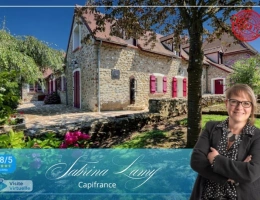

Looking for a country house for sale in Bas-Rhin (67)? Between the Rhine plain, the Alsace wine route and the hills of the Vosges foothills, the department retains a very recognisable rural architecture: an Alsatian half-timbered house under a flat-tile roof, a closed-courtyard farmhouse from the Kochersberg, a winegrower's house with a vaulted cellar. This page brings together the country houses for sale in Bas-Rhin published on ma-propriete.fr by private sellers, estate agents and notaries. This rural market, strongly structured around the vineyards and the Strasbourg conurbation, remains one of the most active in the Grand Est region. Buyers relocating from the Paris region or from Germany often appreciate the combination of rural charm and easy access to a major economic hub.
To help you decide, we present the actual prices of country houses in Bas-Rhin (notarised sales 2020-2025), the areas worth knowing from the wine route to the Vosges foothills, and the criteria that determine the value of a house in the countryside. Our complete guide to buying a country house in France completes these benchmarks, from surveying an old building to financing. The region's strong architectural identity, protected in many villages, makes this a market where built heritage often counts as much as living space.
DVF statistics (the French land-value database) do not cover Bas-Rhin: in Alsace-Moselle, sales are recorded in the Livre foncier and are not published in the DVF database. The benchmarks below are therefore those of the Grand Est region.
How much does a country house cost in Grand Est? According to DVF data (notarised sales) analysed by the ma-propriete.fr observatory, the median price of a country house in Grand Est stood at €150,000 in 2025, with an average price of €156,757 and a median price of €1,400/m² of living space (7,886 house sales in rural municipalities over the year). 10% of houses sold for less than €70,000 (floor price, 1st decile) and 10% for more than €255,000 (ceiling price, 9th decile). The typical country house offers 112 m² of living space on an average plot of 2,025 m², i.e. around 0.2 ha.
The region is well below the national median (€189,200). Since the second half of 2020, the regional median price has risen from €136,400 to €150,000, i.e. +10.0%; over one year (2024-2025) the change is +4.2%.
| 2025 indicator | Grand Est | France |
|---|---|---|
| Median price | €150,000 | €189,200 |
| Average price | €156,757 | €207,100 |
| Floor price (1st decile) | €70,000 | €90,000 |
| Ceiling price (9th decile) | €255,000 | €340,000 |
| Median price per m² of living space | €1,400/m² | €1,830/m² |
| Average living space | 112 m² | 108 m² |
| Average plot size | 2,025 m² | 3,181 m² |
| Number of sales in 2025 | 7,886 | 150,313 |
A regional average also hides large gaps between municipalities. A smallholding to renovate, a restored longère with its outbuildings, a farmhouse on several hectares of land or a manor house with parkland do not sell at the same price, and the location matters as much as the building: coastline, tourist area, peri-urban countryside close to a job market or deep countryside. The table below shows the median price of country houses in Grand Est by type of municipality (cumulative sales from mid-2020 to 2025) and its change between 2021 and 2025.
| Type of municipality | Median price 2020-2025 | Median price per m² | Change 2021-2025 | Sales 2020-2025 |
|---|---|---|---|---|
| Tourist coastline * | €145,000 | €1,282/m² | -23.7% | 32 |
| Residential coastline | €140,000 | €1,354/m² | -17.9% | 565 |
| Inland tourist areas (hinterland, mountains) | €137,462 | €1,350/m² | +14.6% | 1,622 |
| Peri-urban countryside (city catchment area) | €165,000 | €1,529/m² | +6.2% | 22,855 |
| Deep countryside (outside urban influence) | €125,500 | €1,178/m² | +7.4% | 23,366 |
* Between 30 and 99 sales: indicative value.
Note: in Grand Est, the municipalities classified as "coastline" have no access to the sea. They are municipalities bordering lakes of more than 1,000 hectares (or, in Eure, the Seine estuary) covered by the 1986 Loi Littoral, which also applies to such inland lakes and estuaries.
These benchmarks help you assess a listing, estimate a property before putting it up for sale, or set your budget, whether you are looking for a holiday home, a permanent move to the French countryside or a property to turn into a rural gîte. To go further, see our observatory of country house prices in France (national, regional and departmental analysis, downloadable annual report) and work out the full cost of your purchase, including French notary fees, with our notary fees calculator.
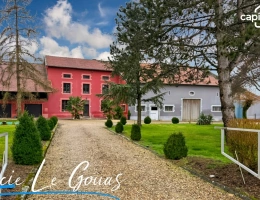
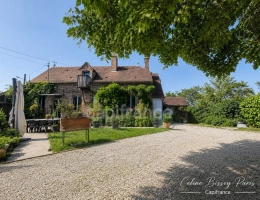
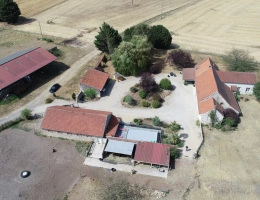
The rural Bas-Rhin house is above all half-timbered: a timber-frame structure filled with wattle-and-daub or brick, often painted in bright colours, under a steep-pitched flat-tile roof. In the Kochersberg and Outre-Forêt areas, you find the closed-courtyard farmhouse, where the dwelling, barn and cowshed surround a central yard, typical of Alsatian and Lorraine farms. On the wine route, the winegrower's house, with its vaulted cellar and press, completes this built landscape.
The land attached varies by area: garden and orchard in the Kochersberg, a small vineyard plot on the sub-Vosges hills, meadow or woodland towards the northern Vosges. Outbuildings (barn, farm shed) are common and lend themselves to conversion into a gîte. The outbuildings of a courtyard farm, such as the former cowshed or bakehouse, are sometimes converted into guest rooms or independent living units.
Close to Strasbourg, served by TGV, and in the Kochersberg (Truchtersheim, Marlenheim), country houses benefit from a metropolitan job market that sustains strong demand, whether as a main home or for remote working. The wine route, from Marlenheim to Barr via Obernai and Molsheim, combines flower-decked villages with vineyards, with sought-after winegrower's houses. Saverne and the Vosges foothills open onto quieter, wooded hills. Christmas markets and grape-harvest festivals bring the most sought-after Alsatian villages to life every year.
The northern Vosges, around Wissembourg and La Petite-Pierre, and the northern part of Alsace bossue, remain the most affordable areas for a half-timbered house with a large plot, further from the Strasbourg conurbation. Numerous cycle paths along the Rhine and its canals add a further attraction for buyers who enjoy an active countryside lifestyle.
Proximity to Strasbourg and to the wine route significantly raises prices, while the condition of the timber frame and infill (damp, wood-boring insects) remains the central technical issue for this old building stock. The energy rating is often poor on uninsulated half-timbered houses, which affects negotiations. Flood-prone areas of the Rhine plain, worth checking through the local risk-prevention plan, affect certain sectors close to watercourses.
Check the local planning rules (a protected or listed sector is common in Alsatian villages), the drainage system, fibre-optic coverage and the condition of the joinery before any renovation or extension project involving a barn. A termite survey is also frequently required in Bas-Rhin, a department classified as at risk for this wood-boring insect.
On ma-propriete.fr, filter Bas-Rhin country houses by budget, living space and land area, set up an email alert so you never miss a new listing, and if needed widen your search to all country houses for sale in Grand Est. It is also worth comparing the maintenance costs of a listed half-timbered house, which are often higher than for a more recent building. It is also worth noting that a number of Bas-Rhin villages fall within protected heritage zones, which can affect the scope of future renovation work.