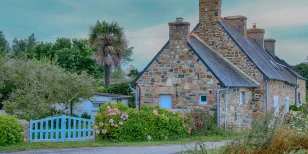

Looking for a country house for sale in Moselle (57)? Between the Pays messin, the Saulnois, the Pays des Étangs and the Warndt, the department offers a wide range of rural buildings: a four-wing Lorraine farmhouse built around an enclosed courtyard, a manor-style house built in Jaumont stone on the outskirts of Metz, a timber-framed farm near the Alsace border around Sarreguemines and Bitche, a village house with garden, orchard and outbuildings waiting to be renovated. This page brings together the country houses for sale in Moselle published on ma-propriete.fr by private sellers, estate agents and notaries, from the Saulnois to the former coal-mining basin.
To help you decide, we present price benchmarks for the wider Grand Est region, the areas worth knowing from Metz to Sarrebourg and the Sierck-les-Bains vineyard, and the criteria that determine the value of a house in the Moselle countryside. Our complete guide to buying a country house in France completes these benchmarks, from surveying an old building to financing, including the specific features of Alsace-Moselle local law.
DVF statistics (the French land-value database) do not cover Moselle: in Alsace-Moselle, sales are recorded in the Livre foncier and are not published in the DVF database. The benchmarks below are therefore those of the Grand Est region.
How much does a country house cost in Grand Est? According to DVF data (notarised sales) analysed by the ma-propriete.fr observatory, the median price of a country house in Grand Est stood at €150,000 in 2025, with an average price of €156,757 and a median price of €1,400/m² of living space (7,886 house sales in rural municipalities over the year). 10% of houses sold for less than €70,000 (floor price, 1st decile) and 10% for more than €255,000 (ceiling price, 9th decile). The typical country house offers 112 m² of living space on an average plot of 2,025 m², i.e. around 0.2 ha.
The region is well below the national median (€189,200). Since the second half of 2020, the regional median price has risen from €136,400 to €150,000, i.e. +10.0%; over one year (2024-2025) the change is +4.2%.
| 2025 indicator | Grand Est | France |
|---|---|---|
| Median price | €150,000 | €189,200 |
| Average price | €156,757 | €207,100 |
| Floor price (1st decile) | €70,000 | €90,000 |
| Ceiling price (9th decile) | €255,000 | €340,000 |
| Median price per m² of living space | €1,400/m² | €1,830/m² |
| Average living space | 112 m² | 108 m² |
| Average plot size | 2,025 m² | 3,181 m² |
| Number of sales in 2025 | 7,886 | 150,313 |
A regional average also hides large gaps between municipalities. A smallholding to renovate, a restored longère with its outbuildings, a farmhouse on several hectares of land or a manor house with parkland do not sell at the same price, and the location matters as much as the building: coastline, tourist area, peri-urban countryside close to a job market or deep countryside. The table below shows the median price of country houses in Grand Est by type of municipality (cumulative sales from mid-2020 to 2025) and its change between 2021 and 2025.
| Type of municipality | Median price 2020-2025 | Median price per m² | Change 2021-2025 | Sales 2020-2025 |
|---|---|---|---|---|
| Tourist coastline * | €145,000 | €1,282/m² | -23.7% | 32 |
| Residential coastline | €140,000 | €1,354/m² | -17.9% | 565 |
| Inland tourist areas (hinterland, mountains) | €137,462 | €1,350/m² | +14.6% | 1,622 |
| Peri-urban countryside (city catchment area) | €165,000 | €1,529/m² | +6.2% | 22,855 |
| Deep countryside (outside urban influence) | €125,500 | €1,178/m² | +7.4% | 23,366 |
* Between 30 and 99 sales: indicative value.
Note: in Grand Est, the municipalities classified as "coastline" have no access to the sea. They are municipalities bordering lakes of more than 1,000 hectares (or, in Eure, the Seine estuary) covered by the 1986 Loi Littoral, which also applies to such inland lakes and estuaries.
These benchmarks help you assess a listing, estimate a property before putting it up for sale, or set your budget, whether you are looking for a holiday home, a permanent move to the French countryside or a property to turn into a rural gîte. To go further, see our observatory of country house prices in France (national, regional and departmental analysis, downloadable annual report) and work out the full cost of your purchase, including French notary fees, with our notary fees calculator.
The traditional Lorraine farmhouse is recognisable by its U-shaped or square layout around a courtyard closed to the street by a large cart gate, its rendered limestone-rubble walls and its low-pitched mechanical flat-tile roof, typical of the Pays messin and the Saulnois. In the Pays messin, bourgeois manor-style houses built of Jaumont stone, the yellow limestone typical of Metz facades and monuments, can still be found, while further east, around Sarreguemines and Bitche, timber-framed farms and brick houses closer to the neighbouring Alsace style remain.
The land often comes with these properties: an enclosed garden, an orchard of mirabelle or quetsche plum trees, sometimes a pond inherited from the fish-farming tradition of the Pays des Étangs around Dieuze and Rechicourt, and outbuildings (barn, shed, bread oven, former stable) that can be converted into a workshop, an extra bedroom or a rural gîte. Many houses sit in a quiet hamlet or village away from main roads, yet still close to a school and a bakery.
Around Metz and the Moselle valley, a country house benefits from the proximity of the city and its station, served by the TGV Est line to Paris and Strasbourg, an asset for anyone doing part-time remote working. The Saulnois, around Château-Salins, Dieuze and Vic-sur-Seille, keeps a more affordable rural housing stock, shaped by its former salt industry and numerous ponds well suited to fishing. Towards Sarrebourg and the Pays des Étangs, the rolling countryside already announces the northern Vosges and its coniferous forests.
The former coal-mining basin around Forbach, Saint-Avold and Freyming-Merlebach offers noticeably cheaper village houses, being redeveloped since the mines closed, while the Moselle vineyard area around Sierck-les-Bains and Contz-les-Bains remains sought after for its south-facing slopes and open views over the Moselle valley.
Three factors weigh on the price: proximity to Metz or Sarrebourg and their stations, the condition of the building (roof, damp in old limestone walls, energy rating, often poor for uninsulated farmhouses rated F or G) and the size of the plot with its farm outbuildings. A renovated manor-style house in Jaumont stone near Metz and a timber-framed farm to restore in the Saulnois can therefore show very different price levels, even for a comparable living area. An original bread oven, well or dovecote can also add value for buyers drawn to period features.
Always check the energy rating, the mandatory private drainage system in unconnected rural areas, fibre-optic coverage for remote working and, in former mining areas around Forbach, any easements linked to ground-movement risk before buying or converting a barn into living space.
On ma-propriete.fr, filter Moselle country houses by budget, living space and land area, narrow your search by area (Pays messin, Saulnois, former mining basin), set up an email alert so you never miss a new listing, compare listings published by private sellers, estate agents and notaries, and if needed widen your search to all country houses for sale in Grand Est.