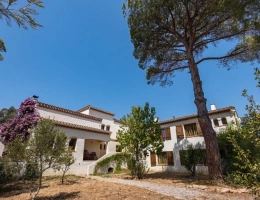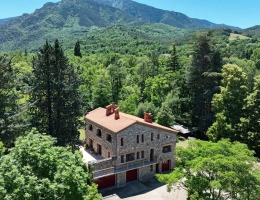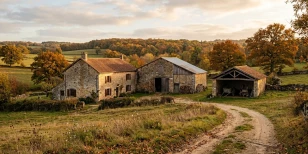
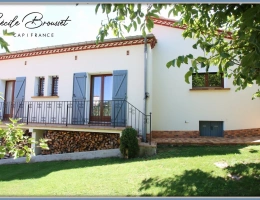
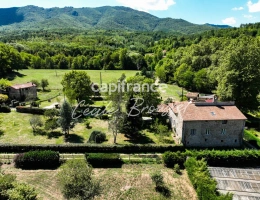
Looking for a country house for sale in Pyrénées-Orientales (66)? Between the Roussillon plain and the Catalan valleys of Conflent, Vallespir and Cerdagne, the department has a rural building stock strongly marked by Catalan culture: a mas of river cobblestones and brick under canal-tile roofing, a tightly-built Catalan village house clustered around its bell tower, a wine-growing farmhouse with a cellar and outbuildings. This page brings together the country houses for sale in Pyrénées-Orientales published on ma-propriete.fr by private sellers, estate agents and notaries. The Catalan market stands out for its strong share of holiday homes that have belonged to Roussillon families for several generations.
To help you decide, we present the actual prices of Catalan country houses (notarised sales 2020-2025), the areas worth knowing from the plain to the mountains, and the criteria that determine the value of a house in the countryside. Our complete guide to buying a country house in France completes these benchmarks, from surveying an old building to financing. The Mediterranean light and the mild Catalan climate also weigh heavily in the choice of many buyers coming from other regions of France.
How much does a country house cost in Pyrénées-Orientales (66)? According to DVF data (notarised sales) analysed by the ma-propriete.fr observatory, the median price of a country house in Pyrénées-Orientales (66) stood at €295,000 in 2025, with an average price of €309,953 and a median price of €2,732/m² of living space (464 house sales in rural municipalities over the year). The price range is wide: 10% of houses sold for less than €160,000 (floor price, 1st decile) and 10% for more than €474,850 (ceiling price, 9th decile). The typical country house here offers 113 m² of living space on an average plot of 3,744 m², i.e. around 0.4 ha.
This market is well above the regional median (Occitanie: €210,000) and well above the national median (€189,200). Since the second half of 2020, the median price has risen from €250,000 to €295,000, i.e. +18.0%; over one year (2024-2025) the change is +1.7%.
| 2025 indicator | Pyrénées-Orientales | Occitanie | France |
|---|---|---|---|
| Median price | €295,000 | €210,000 | €189,200 |
| Average price | €309,953 | €220,462 | €207,100 |
| Floor price (1st decile) | €160,000 | €107,500 | €90,000 |
| Ceiling price (9th decile) | €474,850 | €347,000 | €340,000 |
| Median price per m² of living space | €2,732/m² | €1,987/m² | €1,830/m² |
| Average living space | 113 m² | 111 m² | 108 m² |
| Average plot size | 3,744 m² | 4,162 m² | 3,181 m² |
| Number of sales in 2025 | 464 | 14,163 | 150,313 |
A departmental average hides large gaps. A smallholding to renovate, a restored longère with its outbuildings, a farmhouse on several hectares of land or a manor house with parkland do not sell at the same price, and the location matters as much as the building: coastline, tourist area, peri-urban countryside close to a job market or deep countryside. The table below shows the median price of country houses in Pyrénées-Orientales (66) by type of municipality (cumulative sales from mid-2020 to 2025) and its change between 2021 and 2025.
| Type of municipality | Median price 2020-2025 | Median price per m² | Change 2021-2025 | Sales 2020-2025 |
|---|---|---|---|---|
| Tourist coastline | €361,875 | €3,463/m² | +1.6% | 136 |
| Residential coastline * | €263,150 | €2,500/m² | +35.3% | 63 |
| Inland tourist areas (hinterland, mountains) | €245,250 | €2,319/m² | +15.2% | 986 |
| Peri-urban countryside (city catchment area) | €298,250 | €2,612/m² | +4.0% | 1,664 |
| Deep countryside (outside urban influence) | €265,000 | €2,500/m² | +7.1% | 169 |
* Between 30 and 99 sales: indicative value.
These benchmarks help you assess a listing, estimate a property before putting it up for sale, or set your budget for a holiday home or a permanent move to the French countryside. To go further, see our observatory of country house prices in France (national, regional and departmental analysis, downloadable annual report) and work out the full cost of your purchase, including French notary fees, with our notary fees calculator.
The Catalan mas is the department's emblematic country house: walls of rounded river cobblestones from the Tech or Têt rivers, sometimes combined with brick and schist, under a low-pitched canal-tile roof. It is found both on the plain, surrounded by apricot and peach orchards, and in the hills of Vallespir and Aspres. Catalan village houses, tall and narrow, are arranged in compact hamlets around the bell tower, often with a small outbuilding or a terraced garden.
In Conflent and Cerdagne, the building style becomes more mountainous: heavier stone, roofs of schist slabs or slate, barns attached to the house. The land that comes with these houses often includes a former orchard, a terraced vineyard plot or a stepped garden. Old farm outbuildings, such as a bread oven or a fig-drying shed, add extra character much appreciated by lovers of rural heritage.
Around Perpignan, which has a TGV station, and towards Céret and the Vallespir, country houses close to the sea or close to the city reach the highest levels in the department, driven by holiday-home demand towards Collioure and Argelès. Conflent, around Prades and Villefranche-de-Conflent, appeals through its characterful villages at the foot of Mont Canigou. Cerdagne, a high-altitude plateau around Font-Romeu and Saillagouse, offers mountain houses sought for skiing and fresh air. Provençal-style markets and local patron-saint festivals punctuate life in many villages of the Vallespir and the Aspres.
The inland Vallespir and the Aspres, further from the coast, remain markedly more affordable for a stone house with a large plot, while the coastal and peri-urban belt around Perpignan concentrates the highest prices. Proximity to the Spanish border and to Andorra, reachable within one to two hours, also boosts the appeal of certain areas of the Vallespir and Cerdagne.
Distance to the sea and to Perpignan, aspect (the Tramontane wind is a significant local factor) and the condition of the building - canal-tile roof, damp in cobblestone walls, insulation and energy rating - dominate price formation. The size of the plot, especially a former orchard or terraced vineyard, adds significant value. The risk of forest fire, real in the Catalan mountains in summer, means checking the mandatory vegetation-clearing rules around the house.
Check the private drainage system, the presence of a well or a traditional irrigation channel, fibre-optic coverage for remote working, and the local planning rules before converting a barn or a former wine cellar into living space. An asbestos and lead survey is also advisable on older buildings that were renovated before the 2000s.
On ma-propriete.fr, filter Pyrénées-Orientales country houses by budget, living space and land area, set up an email alert so you never miss a new listing, and if needed widen your search to all country houses for sale in Occitanie. It is also worth comparing listings by exposure to the Tramontane, a strong and frequent wind that directly affects comfort and local buyers' choices. It is also worth noting that many Catalan villages combine a country house purchase with a small vineyard plot, a distinctive feature of this market.