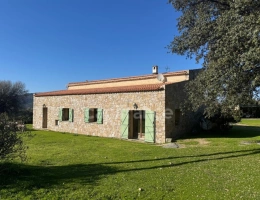
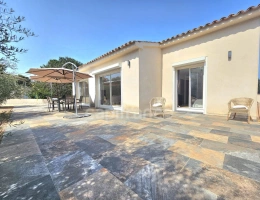
Looking for a country house for sale in Haute-Corse (2B)? Between Cap Corse, the Balagne and the Castagniccia, the department offers a stone-built style that varies sharply from one valley to another: Balagne houses under tile roofs, perched hamlets on Cap Corse, old Castagniccia farmhouses amid chestnut groves. This page brings together the country houses for sale in Haute-Corse published on ma-propriete.fr by private sellers, estate agents and notaries.
To help you decide, we present the actual prices of country houses in Haute-Corse, the areas worth knowing from Bastia to Corte, and the criteria that determine the value of a house in the countryside. Our complete guide to buying a country house in France completes these benchmarks, from surveying an old building to financing.
How much does a country house cost in Haute-Corse (2B)? According to DVF data (notarised sales) analysed by the ma-propriete.fr observatory, the median price of a country house in Haute-Corse (2B) stood at €341,000 in 2025, with an average price of €368,987 and a median price of €3,221/m² of living space (229 house sales in rural municipalities over the year). The price range is wide: 10% of houses sold for less than €164,436 (floor price, 1st decile) and 10% for more than €600,680 (ceiling price, 9th decile). The typical country house here offers 111 m² of living space on an average plot of 2,269 m², i.e. around 0.2 ha.
This market is below the regional median (Corsica: €398,800) and well above the national median (€189,200). Since the second half of 2020, the median price has risen from €270,108 to €341,000, i.e. +26.2%; over one year (2024-2025) the change is +0.9%.
| 2025 indicator | Haute-Corse | Corsica | France |
|---|---|---|---|
| Median price | €341,000 | €398,800 | €189,200 |
| Average price | €368,987 | €461,933 | €207,100 |
| Floor price (1st decile) | €164,436 | €200,000 | €90,000 |
| Ceiling price (9th decile) | €600,680 | €811,266 | €340,000 |
| Median price per m² of living space | €3,221/m² | €3,688/m² | €1,830/m² |
| Average living space | 111 m² | 116 m² | 108 m² |
| Average plot size | 2,269 m² | 2,413 m² | 3,181 m² |
| Number of sales in 2025 | 229 | 448 | 150,313 |
A departmental average hides large gaps. A smallholding to renovate, a restored longère with its outbuildings, a farmhouse on several hectares of land or a manor house with parkland do not sell at the same price, and the location matters as much as the building: coastline, tourist area, peri-urban countryside close to a job market or deep countryside. The table below shows the median price of country houses in Haute-Corse (2B) by type of municipality (cumulative sales from mid-2020 to 2025) and its change between 2021 and 2025.
| Type of municipality | Median price 2020-2025 | Median price per m² | Change 2021-2025 | Sales 2020-2025 |
|---|---|---|---|---|
| Tourist coastline | €357,130 | €3,296/m² | +8.1% | 834 |
| Residential coastline | €306,432 | €2,903/m² | +26.3% | 336 |
| Inland tourist areas (hinterland, mountains) | €272,960 | €2,648/m² | +18.3% | 344 |
These benchmarks help you assess a listing, estimate a property before putting it up for sale, or set your budget for a holiday home or a permanent move to the French countryside. To go further, see our observatory of country house prices in France (national, regional and departmental analysis, downloadable annual report) and work out the full cost of your purchase, including French notary fees, with our notary fees calculator.
The Haute-Corse country house varies greatly from one valley to another. In the Balagne, around Calvi and Île-Rousse, manor-style houses built in light stone dominate, under tile roofs with overhanging genoese eaves, in perched villages such as Sant'Antonino, Pigna, Belgodère or Feliceto. On Cap Corse, from Nonza to Rogliano via Pino and Centuri, granite sailors' houses cluster tightly into hamlets clinging to maquis-covered hillsides overlooking the Mediterranean, often reached by steps rather than by car. In the Castagniccia, around Piedicroce, La Porta and Valle-d'Alesani, the centuries-old chestnut forest shelters old, tall and narrow schist farmhouses under lauze slab roofs, often in need of renovation after decades of rural exodus. Traditional roof frames in chestnut wood, a rot-resistant local species, often support floors of the same timber, a vernacular know-how specific to the Castagniccia.
The land frequently includes stone terraces planted with olive, citrus or vine in the Balagne, centuries-old chestnut trees in the Castagniccia, and sometimes a holm-oak or dense maquis woodland on the Cap. Stone outbuildings (sheepfold, olive or chestnut mill, bread oven) reflect a past agricultural activity and can often be converted into a gîte, subject to planning rules. In granite areas, particularly on Cap Corse, watch for radon, a naturally occurring gas in this type of bedrock, and for the cost of maintaining a lauze slab roof. A narrow access track, sometimes passable only in summer in the most remote hamlets, should be checked before any major renovation project.
Around Bastia and the Gulf of Saint-Florent, in the Nebbio and its Patrimonio AOC vineyard, the country house benefits from quick access to Bastia-Poretta airport and the port, and prices remain firm near the coast. The Balagne, between Calvi, with its own airport, and Île-Rousse, ranks among the most sought-after areas on the island for its villages of character, beaches and closeness to the sea; a narrow-gauge line links Calvi to Île-Rousse for local travel, with no TGV equivalent anywhere on the island. The village of Saint-Florent, with its marina and wine-growers' houses, illustrates this balance between village life and sea access particularly well.
The mountainous interior, around Corte, a university town at the foot of the Monte Rotondo massif, and in the Castagniccia (Piedicroce, La Porta), offers notably more affordable prices for a stone house with a large plot, suited to a move to the countryside, remote working or a gîte project geared to hikers, especially near the GR20 trail and wooded valleys. The hamlets of the Castagniccia, long deserted by rural exodus, are now seeing renewed interest from buyers seeking authenticity and quiet.
Three factors dominate: proximity to the coast and to Bastia airport, the condition of the stone or schist building (lauze or tile roof, damp, insulation and energy rating, often a weak point on old farmhouses) and the size of the plot. A renovated house in the Balagne and a farmhouse to renovate in the Castagniccia can show a considerable price gap for a comparable size. Older family properties are frequently held in joint inheritance among heirs, which can lengthen a sale. The island's classification as a moderate seismic-risk zone should also be factored into any structural renovation project on an old building.
Check the private drainage system, year-round access, fibre-optic coverage for remote working, radon risk in the granite areas of Cap Corse, and the local plan rules — including the coastal protection law, which strictly limits building near the sea — before converting a sheepfold or a mill into living space. A termite survey is also advisable in the dampest wooded areas of Cap Corse and the Castagniccia.
On ma-propriete.fr, filter Haute-Corse country houses by budget, living space and land area, set up an email alert so you never miss a new listing, and if needed widen your search to all country houses for sale in Corsica.