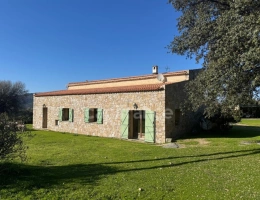
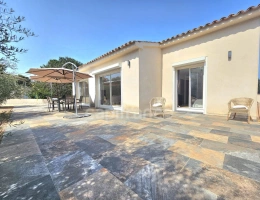
Looking for a country house for sale in Corsica? From the coastal maquis to the perched villages of the interior, the island offers rural buildings full of character: granite houses in the south, schist hamlets on Cap Corse, dry-stone shepherds' huts in the mountains, gardens planted with olive and citrus trees. This page brings together the country houses for sale in Corsica published on ma-propriete.fr by private sellers, estate agents and notaries.
To help you decide, we present the actual prices of country houses by department (notarised sales 2020-2025), the areas worth knowing from the Balagne to the Alta Rocca, and the criteria that determine the value of a house in the countryside. Our complete guide to buying a country house in France completes these benchmarks, from surveying an old building to financing.
How much does a country house cost in Corsica? According to DVF data (notarised sales) analysed by the ma-propriete.fr observatory, the median price of a country house in Corsica stood at €398,800 in 2025, with an average price of €461,933 and a median price of €3,688/m² of living space (448 house sales in rural municipalities over the year). 10% of houses sold for less than €200,000 (floor price, 1st decile) and 10% for more than €811,266 (ceiling price, 9th decile). The typical country house offers 116 m² of living space on an average plot of 2,413 m², i.e. around 0.2 ha.
The region is well above the national median (€189,200). Since the second half of 2020, the regional median price has risen from €328,600 to €398,800, i.e. +21.4%; over one year (2024-2025) the change is +3.2%.
| 2025 indicator | Corsica | France |
|---|---|---|
| Median price | €398,800 | €189,200 |
| Average price | €461,933 | €207,100 |
| Floor price (1st decile) | €200,000 | €90,000 |
| Ceiling price (9th decile) | €811,266 | €340,000 |
| Median price per m² of living space | €3,688/m² | €1,830/m² |
| Average living space | 116 m² | 108 m² |
| Average plot size | 2,413 m² | 3,181 m² |
| Number of sales in 2025 | 448 | 150,313 |
Differences between departments are significant: the median ranges from €341,000 in Haute-Corse (2B) to €500,000 in Corse-du-Sud (2A). The table below compares 2025 prices and their change since 2020.
| Department | Median price 2025 | Average price 2025 | Median price per m² | Change 2020-2025 | Sales 2025 |
|---|---|---|---|---|---|
| Corse-du-Sud (2A) | €500,000 | €559,123 | €4,444/m² | +28.5% | 219 |
| Haute-Corse (2B) | €341,000 | €368,987 | €3,221/m² | +26.2% | 229 |
A regional average also hides large gaps between municipalities. A smallholding to renovate, a restored longère with its outbuildings, a farmhouse on several hectares of land or a manor house with parkland do not sell at the same price, and the location matters as much as the building: coastline, tourist area, peri-urban countryside close to a job market or deep countryside. The table below shows the median price of country houses in Corsica by type of municipality (cumulative sales from mid-2020 to 2025) and its change between 2021 and 2025.
| Type of municipality | Median price 2020-2025 | Median price per m² | Change 2021-2025 | Sales 2020-2025 |
|---|---|---|---|---|
| Tourist coastline | €430,000 | €3,933/m² | +6.9% | 1,549 |
| Residential coastline | €320,000 | €2,950/m² | +19.8% | 383 |
| Inland tourist areas (hinterland, mountains) | €297,495 | €2,955/m² | +31.9% | 650 |
| Peri-urban countryside (city catchment area) | €415,000 | €3,851/m² | +6.2% | 215 |
These benchmarks help you assess a listing, estimate a property before putting it up for sale, or set your budget, whether you are looking for a holiday home, a permanent move to the French countryside or a property to turn into a rural gîte. To go further, see our observatory of country house prices in France (national, regional and departmental analysis, downloadable annual report) and work out the full cost of your purchase, including French notary fees, with our notary fees calculator.
In Corse-du-Sud, country houses are traditionally built of pink or grey granite, under a tiled roof or sometimes stone slabs in the mountain villages of the Alta Rocca. In Haute-Corse, the schist of Cap Corse and the Castagniccia gives darker hamlet houses, with roofs covered in characteristic schist slabs. Inland, dry-stone shepherds' huts, once tied to sheep and goat farming, are increasingly sought after for renovation as a holiday home or gîte, often without direct road access. In the Sartenais and Alta Rocca, pink granite takes on warm tones that are especially sought after, while in the Balagne, around Sant'Antonino and Pigna, perched hamlets combine local granite with traditional lime render. Some high-altitude shepherds' huts, reachable only on foot or by 4x4, appeal to buyers seeking absolute quiet despite the lack of a mains electricity connection.
The land around these houses combines maquis scrubland, centuries-old olive trees, vines and sometimes a citrus orchard on the eastern plain. Stone outbuildings (bread oven, chestnut-drying floor in the Castagniccia) form part of the typical rural heritage, as do the perched hamlets that guarantee peace and clear views over the sea or the mountains. Dry-stone terraced gardens, known as restanques, shape the Corsican rural landscape and often allow olives, citrus and vines to be grown on land that would otherwise be too steep to farm.
In Haute-Corse, the Balagne, around Calvi and l'Île-Rousse, and Cap Corse hold the most expensive country houses, driven by coastal proximity and strong demand for holiday homes. In Corse-du-Sud, the Sartenais and the Alta Rocca, around Sartène, Zonza and Levie, offer an unspoilt mountain setting, with granite houses at more affordable prices than on the coast. The Castagniccia, in Haute-Corse, remains one of the most affordable areas on the island for a hamlet house to renovate. The Niolu and Fiumorbu areas, more remote in the heart of the mountains, remain largely untouched by mass tourism, with stone houses among the cheapest on the island, at the cost of access sometimes limited in winter by snow on the passes.
Around Ajaccio and Bastia, each with an airport and regular ferry links, peri-urban country houses remain sought after for use as a main home, at a price clearly above the average for inland villages. Around Porto-Vecchio, demand for holiday homes stays very strong for country houses near the coast and the beaches of Palombaggia or Santa Giulia, at prices clearly above those found inland in Corse-du-Sud.
Three factors dominate: distance to the coast and to the Ajaccio and Bastia airports (the island has no TGV station), road access to mountain hamlets, sometimes served only by a narrow track, and the condition of the old building, particularly for uninsulated dry-stone shepherds' huts and houses. A renovated granite house in the Balagne and a shepherd's hut to renovate in the Alta Rocca can show a very large price gap for a comparable floor area. Access to drinking water can be uneven in the most isolated hamlets, fed by a private spring, so checking the flow rate and water quality before buying matters, especially in summer.
Also check the wildfire risk in maquis areas, the private drainage system, fibre-optic coverage for remote working, and the land status, sometimes complex in Corsica due to family joint ownership of inherited land. Finally, with no train station on the island, ferry links to Nice, Toulon or Marseille from Bastia and Ajaccio offer an alternative to flying for second-home owners, worth weighing up depending on how often you plan to travel to the mainland.
On ma-propriete.fr, filter Corsica country houses by budget, living space and land area, set up an email alert so you never miss a new listing, and if needed widen your search to all rural properties for sale on ma-propriete.fr.