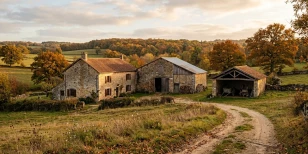
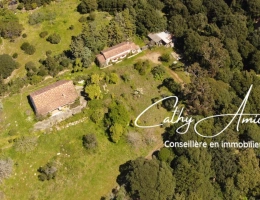
Looking for a country house for sale in Corse-du-Sud (2A)? Between the Gulf of Ajaccio, the Alta Rocca and the Sanguinaires coastline, the department keeps a distinctive island building style: stone houses in granite or schist under lauze slab roofs or tile, perched hamlets of character, old sheepfolds to renovate. This page brings together the country houses for sale in Corse-du-Sud published on ma-propriete.fr by private sellers, estate agents and notaries.
To help you decide, we present the actual prices of country houses in Corse-du-Sud, the areas worth knowing from Ajaccio to Sartène, and the criteria that determine the value of a house in the countryside. Our complete guide to buying a country house in France completes these benchmarks, from surveying an old building to financing.
How much does a country house cost in Corse-du-Sud (2A)? According to DVF data (notarised sales) analysed by the ma-propriete.fr observatory, the median price of a country house in Corse-du-Sud (2A) stood at €500,000 in 2025, with an average price of €559,123 and a median price of €4,444/m² of living space (219 house sales in rural municipalities over the year). The price range is wide: 10% of houses sold for less than €215,980 (floor price, 1st decile) and 10% for more than €1,052,448 (ceiling price, 9th decile). The typical country house here offers 121 m² of living space on an average plot of 2,563 m², i.e. around 0.3 ha.
This market is well above the regional median (Corsica: €398,800) and well above the national median (€189,200). Since the second half of 2020, the median price has risen from €389,250 to €500,000, i.e. +28.5%; over one year (2024-2025) the change is +7.2%.
| 2025 indicator | Corse-du-Sud | Corsica | France |
|---|---|---|---|
| Median price | €500,000 | €398,800 | €189,200 |
| Average price | €559,123 | €461,933 | €207,100 |
| Floor price (1st decile) | €215,980 | €200,000 | €90,000 |
| Ceiling price (9th decile) | €1,052,448 | €811,266 | €340,000 |
| Median price per m² of living space | €4,444/m² | €3,688/m² | €1,830/m² |
| Average living space | 121 m² | 116 m² | 108 m² |
| Average plot size | 2,563 m² | 2,413 m² | 3,181 m² |
| Number of sales in 2025 | 219 | 448 | 150,313 |
A departmental average hides large gaps. A smallholding to renovate, a restored longère with its outbuildings, a farmhouse on several hectares of land or a manor house with parkland do not sell at the same price, and the location matters as much as the building: coastline, tourist area, peri-urban countryside close to a job market or deep countryside. The table below shows the median price of country houses in Corse-du-Sud (2A) by type of municipality (cumulative sales from mid-2020 to 2025) and its change between 2021 and 2025.
| Type of municipality | Median price 2020-2025 | Median price per m² | Change 2021-2025 | Sales 2020-2025 |
|---|---|---|---|---|
| Tourist coastline | €550,000 | €5,030/m² | +6.0% | 715 |
| Residential coastline * | €420,000 | €3,660/m² | -16.5% | 47 |
| Inland tourist areas (hinterland, mountains) | €320,055 | €3,374/m² | +51.5% | 306 |
| Peri-urban countryside (city catchment area) | €430,000 | €3,920/m² | +7.0% | 201 |
* Between 30 and 99 sales: indicative value.
These benchmarks help you assess a listing, estimate a property before putting it up for sale, or set your budget for a holiday home or a permanent move to the French countryside. To go further, see our observatory of country house prices in France (national, regional and departmental analysis, downloadable annual report) and work out the full cost of your purchase, including French notary fees, with our notary fees calculator.
The Corse-du-Sud country house is organised around the perched hamlet: a tight stone village on its rocky spur, overlooking the valleys of the Alta Rocca or the Sartenais. Traditional buildings favour exposed granitestone, sometimes rendered, under a lauze slab roof in the mountain areas or canal tile in the plains. You also find old sheepfolds and notables' manor-style houses, to convert into a holiday home or a gîte. Schist, found especially around the Sartenais, gives buildings a greyer tone, while genoise cornices — overlapping rows of roof tiles under the eaves — remain an architectural signature from the Genoese era worth preserving during any renovation project. Many of these buildings still have an underground cistern for collecting rainwater, a traditional feature still useful where the mains water network remains limited.
The land that comes with them is often planted with olive trees, cork oaks or maquis scrub, sometimes a citrus orchard in the coastal valleys. The stone outbuildings (sheepfold, bread oven) and the absence of overlooking neighbours offer open views over the maquis or the sea. Access to water, whether by borehole or mains connection, deserves particular attention in these often-isolated areas, as does the electricity supply, sometimes limited in the more remote inland hamlets far from the main coastal towns and their built-up infrastructure.
Around the Gulf of Ajaccio, Porto-Vecchio and Bonifacio, the country house close to the coast is among the most sought-after property on the island, driven by holiday homes and tourism. The Sartène area and the Sartenais-Valinco, around Propriano, combine villages of character with sea access. Further north, the Taravo valley and the Bastelica area, between mountain and sea, offer a more low-key setting still largely untouched by mass tourism. Perched villages in this area, such as Ocana or Bastelica, appeal for their authenticity and their sweeping views over the surrounding mountains, often at a fraction of coastal prices.
The Alta Rocca, around Zonza, Levie and Sainte-Lucie-de-Tallano, along with the mountainous interior towards the Taravo, offers notably more moderate prices for stone houses with a large plot, away from coastal land pressure. No conventional railway station serves these inland areas, access being by road only, often winding through the mountains, which partly explains the price gap with the coast and the longer journey to Ajaccio airport, particularly in poor winter road conditions.
Three factors dominate: distance to the sea and to the resorts of the Gulf of Ajaccio or Porto-Vecchio, the condition of the stone building (lauze or tile roof, damp, insulation and energy rating, often needing work on old buildings) and the size of the plot. A renovated house near the Gulf of Ajaccio and a sheepfold to renovate in the Alta Rocca can show a considerable price gap for a comparable size. A swimming pool and easy, direct access to a beach or a quiet cove remain decisive criteria for buyers looking for a second home along the Corsican coast, well ahead of the size of the plot itself.
Check the private drainage system, fibre-optic coverage for remote working, year-round access and the local plan rules before converting a sheepfold into living space. The risk of forest fire, high in summer across the maquis, also requires mandatory scrub-clearing around buildings, while the rugged inland terrain can complicate access for emergency services during the driest months.
On ma-propriete.fr, filter Corse-du-Sud country houses by budget, living space and land area, set up an email alert so you never miss a new listing, and if needed widen your search to all country houses for sale in Corsica.