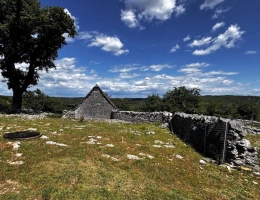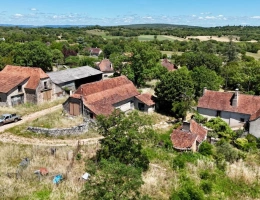
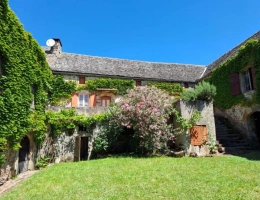
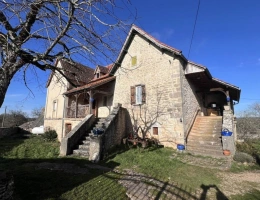
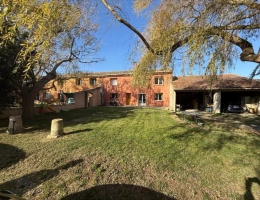
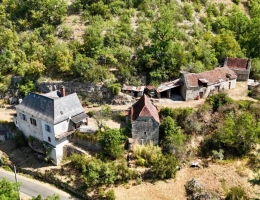
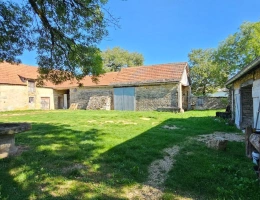
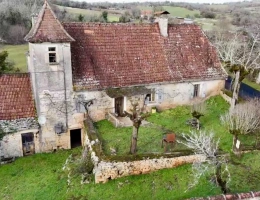
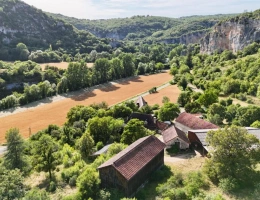
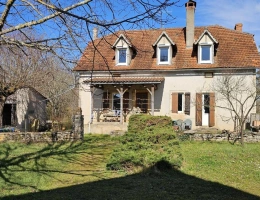
A mas for sale in Occitanie, a Causses stone farmhouse or a terraced Cévennes mas: between the Mediterranean, the limestone Causses and the Pyrenees, the region brings together the widest variety of farm buildings in the south of France. This page brings together the farmhouses, barns and mas for sale in Occitanie listed on ma-propriete.fr: a Languedoc mas with land, a timber-frame Gascon farmhouse from the Gers, a Causses barn to renovate, and a former Pyrenean sheepfold with mountain pasture rights.
Below you will find the actual prices of the rural market across the region's thirteen departments, an overview of where the choice is widest, from the Gers to the Cévennes, and the points to watch on each local building type. For a tourism project, our white paper on setting up a rural gîte will help you cost it.
There are no statistics dedicated to farmhouses and barns: a renovated farmhouse sells like a country house with outbuildings and land, whereas a bare barn or a farm to renovate often sells well below. The most useful benchmark therefore remains the price of country houses.
How much does a country house cost in Occitanie? According to DVF data (notarised sales) analysed by the ma-propriete.fr observatory, the median price of a country house in Occitanie stood at €210,000 in 2025, with an average price of €220,462 and a median price of €1,987/m² of living space (14,163 house sales in rural municipalities over the year). 10% of houses sold for less than €107,500 (floor price, 1st decile) and 10% for more than €347,000 (ceiling price, 9th decile). The typical country house offers 111 m² of living space on an average plot of 4,162 m², i.e. around 0.4 ha.
The region is above the national median (€189,200). Since the second half of 2020, the regional median price has risen from €189,000 to €210,000, i.e. +11.1%; over one year (2024-2025) the change is +1.4%.
| 2025 indicator | Occitanie | France |
|---|---|---|
| Median price | €210,000 | €189,200 |
| Average price | €220,462 | €207,100 |
| Floor price (1st decile) | €107,500 | €90,000 |
| Ceiling price (9th decile) | €347,000 | €340,000 |
| Median price per m² of living space | €1,987/m² | €1,830/m² |
| Average living space | 111 m² | 108 m² |
| Average plot size | 4,162 m² | 3,181 m² |
| Number of sales in 2025 | 14,163 | 150,313 |
Differences between departments are significant: the median ranges from €160,000 in Ariège (09) to €295,000 in Pyrénées-Orientales (66). The table below compares 2025 prices and their change since 2020.
| Department | Median price 2025 | Average price 2025 | Median price per m² | Change 2020-2025 | Sales 2025 |
|---|---|---|---|---|---|
| Ariège (09) | €160,000 | €167,339 | €1,650/m² | +5.3% | 663 |
| Aude (11) | €210,000 | €213,564 | €1,973/m² | +12.6% | 1,112 |
| Aveyron (12) | €162,300 | €169,155 | €1,606/m² | +16.0% | 1,149 |
| Gard (30) | €265,000 | €279,110 | €2,584/m² | +10.4% | 1,532 |
| Haute-Garonne (31) | €242,000 | €246,017 | €2,219/m² | +5.2% | 2,104 |
| Gers (32) | €176,800 | €190,399 | €1,672/m² | +8.0% | 1,272 |
| Hérault (34) | €294,425 | €304,890 | €2,726/m² | +10.2% | 1,144 |
| Lot (46) | €168,508 | €179,607 | €1,685/m² | +12.3% | 1,295 |
| Lozère (48) | €166,850 | €174,916 | €1,726/m² | +25.5% | 326 |
| Hautes-Pyrénées (65) | €187,000 | €194,927 | €1,750/m² | +20.6% | 897 |
| Pyrénées-Orientales (66) | €295,000 | €309,953 | €2,732/m² | +18.0% | 464 |
| Tarn (81) | €193,000 | €194,538 | €1,799/m² | +10.3% | 1,018 |
| Tarn-et-Garonne (82) | €200,000 | €199,749 | €1,857/m² | +11.1% | 1,187 |
A regional average also hides large gaps between municipalities. A smallholding to renovate, a restored longère with its outbuildings, a farmhouse on several hectares of land or a manor house with parkland do not sell at the same price, and the location matters as much as the building: coastline, tourist area, peri-urban countryside close to a job market or deep countryside. The table below shows the median price of country houses in Occitanie by type of municipality (cumulative sales from mid-2020 to 2025) and its change between 2021 and 2025.
| Type of municipality | Median price 2020-2025 | Median price per m² | Change 2021-2025 | Sales 2020-2025 |
|---|---|---|---|---|
| Tourist coastline | €267,000 | €2,579/m² | -7.0% | 693 |
| Residential coastline | €277,750 | €2,686/m² | +12.0% | 326 |
| Inland tourist areas (hinterland, mountains) | €169,000 | €1,742/m² | +8.2% | 11,987 |
| Peri-urban countryside (city catchment area) | €234,951 | €2,163/m² | +2.2% | 42,813 |
| Deep countryside (outside urban influence) | €179,000 | €1,688/m² | +4.8% | 31,306 |
These benchmarks help you assess a listing, estimate a property before putting it up for sale, or set your budget, whether you are looking for a holiday home, a permanent move to the French countryside or a property to turn into a rural gîte. To go further, see our observatory of country house prices in France (national, regional and departmental analysis, downloadable annual report) and work out the full cost of your purchase, including French notary fees, with our notary fees calculator.
In the Gard, Hérault and Pyrénées-Orientales, the Languedoc or Catalan mas, built in limestone or river pebbles under canal tile, is arranged around a courtyard with a cowshed and farm shed; in the Cévennes of the Gard and Lozère, the Cévennes mas, often in schist, clings to cultivated terraces (bancels) planted with chestnut trees. On the Causses (Aveyron, Lot, Lozère), the dry-stone Causses farmhouse includes a sheepfold and a bread oven. In the Gers and Tarn-et-Garonne, the Gascon farmhouse combines stone and timber framing. In Ariège and the Hautes-Pyrénées, isolated mountain summer-pasture barns complete the picture.
These often sizeable buildings convert into homes or gîtes, subject to local planning zoning and a change of use. The surrounding hectares of farmland, pasture or scrubland suit keeping horses, growing olives, or a permaculture project, particularly on the Cévennes terraces.
In the Gard, around Alès and Uzès, and in the Lozère near Florac, Cévennes and Causses mas remain plentiful. In the Aveyron and the Lot, the area around Rodez, Millau and Cahors keeps an affordable choice of Causses farmhouses. In the Gers, around Auch and Condom, Gascon farms remain accessible. In Ariège and the Hautes-Pyrénées, the foothills around Foix and Tarbes offer barns and sheepfolds to renovate. The Tarn, around Albi and Castres, rounds out the choice.
Areas close to Montpellier, Toulouse, the Aude coast and the Côte Vermeille in the Pyrénées-Orientales remain well above the regional average. By contrast, the Lozère, northern Aveyron and the inland Gers offer far more affordable mas and farmhouses.
Check the permitted use of the buildings against the local plan: in an agricultural zone A, a barn or sheepfold can only become housing if it is expressly identified as eligible for a change of use — a sensitive point in protected areas of the Cévennes or the Causses. Examine the roof (canal tile, stone lauze or schist, but also asbestos-cement sheets on sheds), the timber frame, and the drainage, often tricky on the sloping land of the Cévennes.
If farmland or grazing rights come with the property, ask about any current farm lease and about the pre-emption right of the Safer, very active on the Causses. Finally, cost the renovation precisely, often high on dry-stone mas and terraces needing consolidation.
On ma-propriete.fr, filter Occitanie farms, barns and mas by budget, built area and land area, set up an email alert to follow new listings, and widen your search to all rural properties for sale in neighbouring regions.