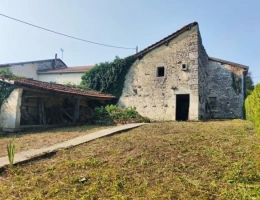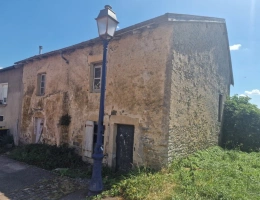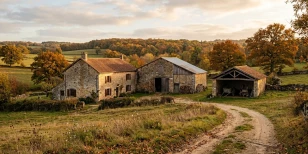
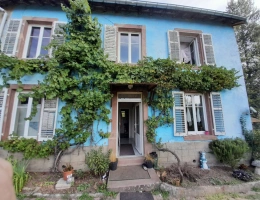
A farmhouse for sale in Grand Est, a Lorraine farm building complex or an Alsatian half-timbered farmhouse waiting to be restored: shaped by mixed farming and Champagne viticulture, the region still holds a varied stock of rural buildings, from the Lorraine plateau to the Vosges hills. This page brings together the farmhouses, barns and mas for sale in Grand Est listed on ma-propriete.fr: farm buildings arranged around a courtyard, stone or timber-frame barns to renovate, Vosges farm-blocks, and outbuildings with adjoining land.
Below you will find the actual prices of the rural market across the region's ten departments, an overview of where to look, from the Champagne vineyards to the Vosges massif, and the points to watch on old buildings often built in timber frame or limestone. For a tourism project, our white paper on setting up a rural gîte will help you assess whether it stacks up.
There are no statistics dedicated to farmhouses and barns: a renovated farmhouse sells like a country house with outbuildings and land, whereas a bare barn or a farm to renovate often sells well below. The most useful benchmark therefore remains the price of country houses.
How much does a country house cost in Grand Est? According to DVF data (notarised sales) analysed by the ma-propriete.fr observatory, the median price of a country house in Grand Est stood at €150,000 in 2025, with an average price of €156,757 and a median price of €1,400/m² of living space (7,886 house sales in rural municipalities over the year). 10% of houses sold for less than €70,000 (floor price, 1st decile) and 10% for more than €255,000 (ceiling price, 9th decile). The typical country house offers 112 m² of living space on an average plot of 2,025 m², i.e. around 0.2 ha.
The region is well below the national median (€189,200). Since the second half of 2020, the regional median price has risen from €136,400 to €150,000, i.e. +10.0%; over one year (2024-2025) the change is +4.2%.
| 2025 indicator | Grand Est | France |
|---|---|---|
| Median price | €150,000 | €189,200 |
| Average price | €156,757 | €207,100 |
| Floor price (1st decile) | €70,000 | €90,000 |
| Ceiling price (9th decile) | €255,000 | €340,000 |
| Median price per m² of living space | €1,400/m² | €1,830/m² |
| Average living space | 112 m² | 108 m² |
| Average plot size | 2,025 m² | 3,181 m² |
| Number of sales in 2025 | 7,886 | 150,313 |
Differences between departments are significant: the median ranges from €105,000 in Haute-Marne (52) to €186,000 in Meurthe-et-Moselle (54). The table below compares 2025 prices and their change since 2020.
| Department | Median price 2025 | Average price 2025 | Median price per m² | Change 2020-2025 | Sales 2025 |
|---|---|---|---|---|---|
| Ardennes (08) | €146,000 | €148,310 | €1,402/m² | +14.0% | 901 |
| Aube (10) | €140,000 | €145,120 | €1,360/m² | +2.9% | 1,043 |
| Marne (51) | €180,000 | €191,161 | €1,675/m² | +6.5% | 1,380 |
| Haute-Marne (52) | €105,000 | €107,545 | €968/m² | +13.5% | 803 |
| Meurthe-et-Moselle (54) | €186,000 | €194,026 | €1,685/m² | +9.9% | 1,219 |
| Meuse (55) | €125,750 | €128,849 | €1,121/m² | +9.8% | 886 |
| Vosges (88) | €147,900 | €151,368 | €1,411/m² | +16.5% | 1,654 |
A regional average also hides large gaps between municipalities. A smallholding to renovate, a restored longère with its outbuildings, a farmhouse on several hectares of land or a manor house with parkland do not sell at the same price, and the location matters as much as the building: coastline, tourist area, peri-urban countryside close to a job market or deep countryside. The table below shows the median price of country houses in Grand Est by type of municipality (cumulative sales from mid-2020 to 2025) and its change between 2021 and 2025.
| Type of municipality | Median price 2020-2025 | Median price per m² | Change 2021-2025 | Sales 2020-2025 |
|---|---|---|---|---|
| Tourist coastline * | €145,000 | €1,282/m² | -23.7% | 32 |
| Residential coastline | €140,000 | €1,354/m² | -17.9% | 565 |
| Inland tourist areas (hinterland, mountains) | €137,462 | €1,350/m² | +14.6% | 1,622 |
| Peri-urban countryside (city catchment area) | €165,000 | €1,529/m² | +6.2% | 22,855 |
| Deep countryside (outside urban influence) | €125,500 | €1,178/m² | +7.4% | 23,366 |
* Between 30 and 99 sales: indicative value.
Note: in Grand Est, the municipalities classified as "coastline" have no access to the sea. They are municipalities bordering lakes of more than 1,000 hectares (or, in Eure, the Seine estuary) covered by the 1986 Loi Littoral, which also applies to such inland lakes and estuaries.
These benchmarks help you assess a listing, estimate a property before putting it up for sale, or set your budget, whether you are looking for a holiday home, a permanent move to the French countryside or a property to turn into a rural gîte. To go further, see our observatory of country house prices in France (national, regional and departmental analysis, downloadable annual report) and work out the full cost of your purchase, including French notary fees, with our notary fees calculator.
The Lorraine farmhouse is typically arranged in a square or a U around a courtyard, with the dwelling, cowshed, stables and barn either under one roofline or in separate wings, built in limestone rubble or Vosges sandstone. In Alsace, the timber-frame farmhouse combines wattle-and-daub infill with a steeply pitched roof; in the Vosges mountains, the farm-block gathers house and farm buildings under a single roof to cope with snow. There is no mas in Grand Est; listings using the word usually mean a large converted farm building.
These volumes lend themselves to conversion into a main home, several dwellings or gîtes, subject to local planning zoning and a change of use. The adjoining hectares of pasture or farmland can accommodate horses or a permaculture project, particularly in the Vosges valleys or on the Lorraine plateau, where land is still available.
In Champagne, around Reims, Épernay and Châlons-en-Champagne, farm buildings sit alongside the vineyards and are scarce. The Haute-Marne plateau and the Meuse, between Saint-Dizier, Bar-le-Duc and Commercy, offer the widest and most affordable choice of barns to renovate. In Lorraine, Nancy, Metz and the surrounding countryside still hold a few peri-urban farms, while the Ardennes, around Sedan, Charleville-Mézières and the Meuse valley, keep a still-accessible rural stock. In Alsace, Sélestat, Molsheim and the vineyard strip between Colmar and Strasbourg concentrate sought-after half-timbered farmhouses.
Areas close to Strasbourg, Colmar and the Alsace vineyards, along with the Champagne wine country, remain well above the regional average. By contrast, Haute-Marne, the Meuse and the deep Vosges, around Saint-Dié-des-Vosges or Remiremont, offer noticeably more affordable farmhouses and barns, often with more land attached.
Check the permitted use of the buildings against the local plan: in an agricultural zone A, a farm barn can only be converted into housing if it is expressly identified as eligible for a change of use. Examine the roof (mechanical tile, Vosges slate, but also asbestos-cement sheets on more recent sheds), the timber frame, the condition of any half-timbering in Alsace, and the drainage, which often needs upgrading on an old farm.
If farmland comes with the property, ask about any current farm lease and the pre-emption right of the Safer. Finally, cost the renovation precisely: restoring a timber-frame barn or a stone farmhouse frequently costs more than the purchase price itself.
On ma-propriete.fr, filter Grand Est farms and barns by budget, built area and land area, set up an email alert to follow new listings, and widen your search to all rural properties for sale in neighbouring regions.