

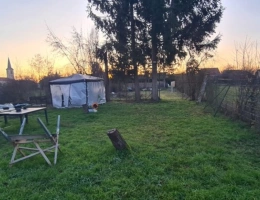
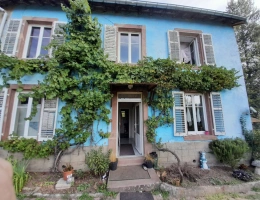
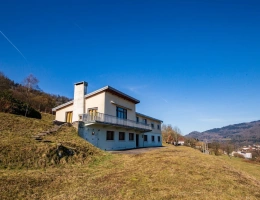
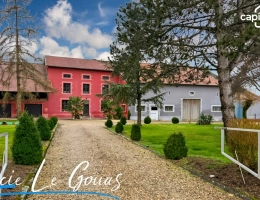
A farmhouse & barn for sale in Bas-Rhin (67), an Alsatian timber-frame farmhouse or a half-timbered barn to renovate: this department, shaped by mixed farming and viticulture, keeps a distinctive stock of farm buildings between the Rhine plain, the wine route and the Vosges du Nord. This page brings together the farmhouses, barns and mas for sale in Bas-Rhin published on ma-propriete.fr: Alsatian timber-frame farmhouses with an enclosed courtyard, half-timbered barns, vineyard farmhouses with outbuildings.
Below you will find the actual prices of the Bas-Rhin rural market, an overview of where to look, from the Alsace plain to the Bruche valley, and the points to check before buying a former farm building. For a tourism project, our white paper on setting up a rural gîte will help you cost it.
There are no statistics dedicated to farmhouses and barns: a renovated farmhouse sells like a country house with outbuildings and land, whereas a bare barn or a farm to renovate often sells well below. The most useful benchmark therefore remains the price of country houses.
DVF statistics (the French land-value database) do not cover Bas-Rhin: in Alsace-Moselle, sales are recorded in the Livre foncier and are not published in the DVF database. The benchmarks below are therefore those of the Grand Est region.
How much does a country house cost in Grand Est? According to DVF data (notarised sales) analysed by the ma-propriete.fr observatory, the median price of a country house in Grand Est stood at €150,000 in 2025, with an average price of €156,757 and a median price of €1,400/m² of living space (7,886 house sales in rural municipalities over the year). 10% of houses sold for less than €70,000 (floor price, 1st decile) and 10% for more than €255,000 (ceiling price, 9th decile). The typical country house offers 112 m² of living space on an average plot of 2,025 m², i.e. around 0.2 ha.
The region is well below the national median (€189,200). Since the second half of 2020, the regional median price has risen from €136,400 to €150,000, i.e. +10.0%; over one year (2024-2025) the change is +4.2%.
| 2025 indicator | Grand Est | France |
|---|---|---|
| Median price | €150,000 | €189,200 |
| Average price | €156,757 | €207,100 |
| Floor price (1st decile) | €70,000 | €90,000 |
| Ceiling price (9th decile) | €255,000 | €340,000 |
| Median price per m² of living space | €1,400/m² | €1,830/m² |
| Average living space | 112 m² | 108 m² |
| Average plot size | 2,025 m² | 3,181 m² |
| Number of sales in 2025 | 7,886 | 150,313 |
A regional average also hides large gaps between municipalities. A smallholding to renovate, a restored longère with its outbuildings, a farmhouse on several hectares of land or a manor house with parkland do not sell at the same price, and the location matters as much as the building: coastline, tourist area, peri-urban countryside close to a job market or deep countryside. The table below shows the median price of country houses in Grand Est by type of municipality (cumulative sales from mid-2020 to 2025) and its change between 2021 and 2025.
| Type of municipality | Median price 2020-2025 | Median price per m² | Change 2021-2025 | Sales 2020-2025 |
|---|---|---|---|---|
| Tourist coastline * | €145,000 | €1,282/m² | -23.7% | 32 |
| Residential coastline | €140,000 | €1,354/m² | -17.9% | 565 |
| Inland tourist areas (hinterland, mountains) | €137,462 | €1,350/m² | +14.6% | 1,622 |
| Peri-urban countryside (city catchment area) | €165,000 | €1,529/m² | +6.2% | 22,855 |
| Deep countryside (outside urban influence) | €125,500 | €1,178/m² | +7.4% | 23,366 |
* Between 30 and 99 sales: indicative value.
Note: in Grand Est, the municipalities classified as "coastline" have no access to the sea. They are municipalities bordering lakes of more than 1,000 hectares (or, in Eure, the Seine estuary) covered by the 1986 Loi Littoral, which also applies to such inland lakes and estuaries.
These benchmarks help you assess a listing, estimate a property before putting it up for sale, or set your budget, whether you are looking for a holiday home, a permanent move to the French countryside or a property to turn into a rural gîte. To go further, see our observatory of country house prices in France (national, regional and departmental analysis, downloadable annual report) and work out the full cost of your purchase, including French notary fees, with our notary fees calculator.
The typical Bas-Rhin farmhouse stands out for its exposed timber frame, its steeply pitched roof covered in flat tiles, and a courtyard often closed by a large cart gate. The dwelling, the cowshed, the hay barn and sometimes an equipment shed are arranged around this central space, typical of the region's wine and grain villages. There are no mas in Alsace, a term kept for Mediterranean regions.
These timber-frame buildings need specific technical restoration, but offer generous floor area for a family home or several gîtes, subject to planning zoning and a change of use. The land, often limited to the courtyard and a garden, sometimes extends over hectares of farmland or pasture towards the Vosges du Nord, suitable for horses.
The Alsace plain, around Haguenau, Brumath and Bischwiller, has the widest choice of farmhouses and barns to renovate, in a landscape of large-scale arable farming. Along the wine route, towards Molsheim, Obernai and Barr, timber-frame vineyard farmhouses are sought after but more expensive. The Bruche valley, towards Schirmeck, and the Vosges du Nord, towards Wissembourg and Niederbronn-les-Bains, offer more affordable foothill farms.
Around Strasbourg and its metropolitan area, renovated farmhouses become scarce and sell well above the departmental average. Towards Saverne and the Saverne pass, the transition between the plain and the Vosges du Nord offers a compromise between accessibility and more moderate prices.
Check the permitted use of the building under the agricultural zone of the local plan: a timber-frame farm barn can only become a home if it is listed as eligible for a change of use. Have the timber frame examined by a specialist, check the roof (flat tile, but also asbestos-cement on adjoining sheds) and the drainage, often needing upgrading.
If farmland is included, ask about any current farm lease and about the pre-emption right of the Safer, active on Bas-Rhin's wine and grain land. Finally, cost the renovation carefully: restoring a timber-frame structure is an expense often underestimated.
On ma-propriete.fr, filter Bas-Rhin farms and barns by budget, built area and land area, set up an email alert to be told of new listings, and extend your search to all farmhouses, barns and mas for sale in Grand Est.