

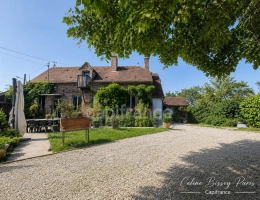
A farmhouse for sale in Aube (10), a smallholding or a barn to convert: this Champagne department, split between arable farming, vineyards and the wetlands of the Champagne humide, has kept a varied farm heritage, from timber-frame farmhouses to large lowland barns. This page brings together the farmhouses, barns and mas for sale in Aube published on ma-propriete.fr: former arable farms with sheds, timber-frame Der farmhouses awaiting restoration, farm buildings with outbuildings near the lakes.
Below you will find the actual prices of the Aube rural market, an overview of where to look, from the chalky Champagne to the Champagne humide wetlands, and the points to check before buying a former farm building. If your project includes a tourism venture, our white paper on setting up a rural gîte will help you cost it. This market appeals both to farmers looking for a working base and to people planning a tourism diversification project in the Champagne humide wetlands.
There are no statistics dedicated to farmhouses and barns: a renovated farmhouse sells like a country house with outbuildings and land, whereas a bare barn or a farm to renovate often sells well below. The most useful benchmark therefore remains the price of country houses.
How much does a country house cost in Aube (10)? According to DVF data (notarised sales) analysed by the ma-propriete.fr observatory, the median price of a country house in Aube (10) stood at €140,000 in 2025, with an average price of €145,120 and a median price of €1,360/m² of living space (1,043 house sales in rural municipalities over the year). The price range is wide: 10% of houses sold for less than €70,000 (floor price, 1st decile) and 10% for more than €228,960 (ceiling price, 9th decile). The typical country house here offers 107 m² of living space on an average plot of 2,136 m², i.e. around 0.2 ha.
This market is below the regional median (Grand Est: €150,000) and well below the national median (€189,200). Since the second half of 2020, the median price has risen from €136,000 to €140,000, i.e. +2.9%; over one year (2024-2025) the change is +0.0%.
| 2025 indicator | Aube | Grand Est | France |
|---|---|---|---|
| Median price | €140,000 | €150,000 | €189,200 |
| Average price | €145,120 | €156,757 | €207,100 |
| Floor price (1st decile) | €70,000 | €70,000 | €90,000 |
| Ceiling price (9th decile) | €228,960 | €255,000 | €340,000 |
| Median price per m² of living space | €1,360/m² | €1,400/m² | €1,830/m² |
| Average living space | 107 m² | 112 m² | 108 m² |
| Average plot size | 2,136 m² | 2,025 m² | 3,181 m² |
| Number of sales in 2025 | 1,043 | 7,886 | 150,313 |
A departmental average hides large gaps. A smallholding to renovate, a restored longère with its outbuildings, a farmhouse on several hectares of land or a manor house with parkland do not sell at the same price, and the location matters as much as the building: coastline, tourist area, peri-urban countryside close to a job market or deep countryside. The table below shows the median price of country houses in Aube (10) by type of municipality (cumulative sales from mid-2020 to 2025) and its change between 2021 and 2025.
| Type of municipality | Median price 2020-2025 | Median price per m² | Change 2021-2025 | Sales 2020-2025 |
|---|---|---|---|---|
| Residential coastline | €163,000 | €1,500/m² | -19.6% | 287 |
| Inland tourist areas (hinterland, mountains) * | €135,000 | €1,370/m² | -13.5% | 63 |
| Peri-urban countryside (city catchment area) | €158,550 | €1,511/m² | +6.2% | 3,647 |
| Deep countryside (outside urban influence) | €123,000 | €1,176/m² | +0.0% | 2,887 |
* Between 30 and 99 sales: indicative value.
Note: in Aube (10), the municipalities classified as "coastline" have no access to the sea. They are municipalities bordering lakes of more than 1,000 hectares (or, in Eure, the Seine estuary) covered by the 1986 Loi Littoral, which also applies to such inland lakes and estuaries.
These benchmarks help you assess a listing, estimate a property before putting it up for sale, or set your budget for a holiday home or a permanent move to the French countryside. To go further, see our observatory of country house prices in France (national, regional and departmental analysis, downloadable annual report) and work out the full cost of your purchase, including French notary fees, with our notary fees calculator.
In the Champagne humide, around the Der lake, the traditional farmhouse is recognisable by its timber frame walls filled with cob, topped with flat tiles, with a barn and a cowshed arranged around a courtyard. Further north, in the chalky Champagne, farm buildings tend to be more massive, built in stone or brick, with large sheds linked to large-scale arable farming. There is no mas in Aube; people speak of a Champagne farmhouse or farm complex.
These particularly large lowland barns offer strong potential for conversion into a home or several gîtes, subject to zoning. The smaller Der farmhouses often come with farmland or wet pasture suited to livestock or permaculture projects. Some lowland barns, once linked to intensive arable farming, offer unusually tall roof spaces that appeal to workshop or artist-residence projects.
Around Troyes and along the Seine valley, the supply of farmhouses and barns stays steady, with easy access to the town. Towards Nogent-sur-Seine, in the north of the department, the large farms of the chalky Champagne dominate. The Der lake area and the Champagne humide, around Arcis-sur-Aube and Brienne-le-Château, offer more rustic timber-frame farmhouses. Towards Bar-sur-Aube and Bar-sur-Seine, in vineyard country, farm buildings sit among the vines. The nearby Champagne-Ardenne TGV station at Bezannes, near Reims, is an advantage for buyers in the north of the department wanting fast access to Paris.
The most affordable farms are found in the Champagne humide and the isolated villages in the south-east of the department. Around Troyes and along the routes towards Paris, well-located farmhouses reach levels noticeably above the department's rural average.
Check the permitted use of the building under the local planning zoning: in an agricultural zone, only a barn identified as eligible for a change of use can become a home. Examine the roof (flat tiles, but also asbestos-cement on recent farm sheds), the timber frame of the half-timbering and the drainage, often not connected to mains in rural areas.
Where farmland is included, ask about any current farm lease and about the pre-emption right of the Safer. Finally, cost the restoration of the timber frame precisely, an item that can weigh as heavily as the purchase itself. The Der half-timbered farmhouses in particular need a specialist carpenter's opinion before any commitment, as structural issues are common on these century-old buildings.
On ma-propriete.fr, filter Aube farms and barns by budget, built area and land area, set up an email alert to follow new listings, and extend your search to all farmhouses, barns and mas for sale in Grand Est. Local agencies specialising in Champagne's rural buildings usefully complement listings from private sellers, particularly for properties sold with attached farmland.