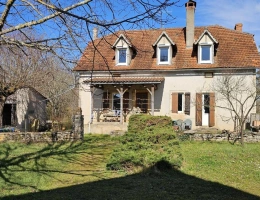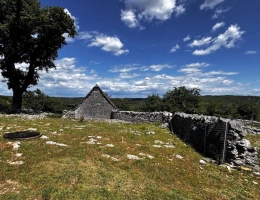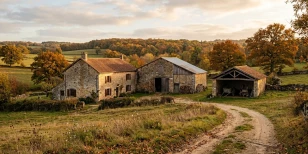
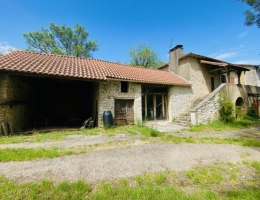
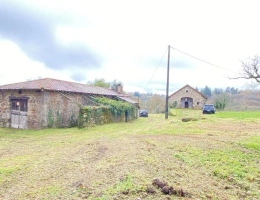
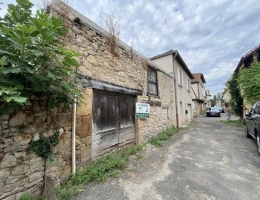
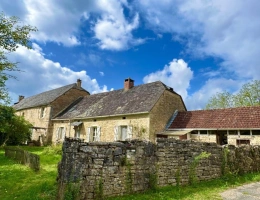
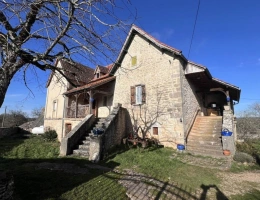
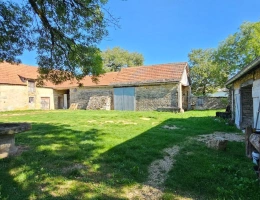
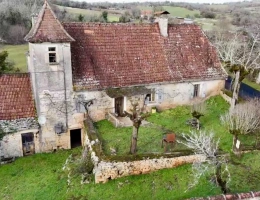
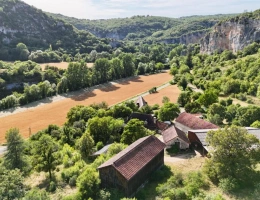
A farmhouse for sale in Lot (46), a Quercy farm building or a barn to renovate on the causses: this dry-stone department, between steep valleys and limestone plateaux, keeps an old farm-building stock that is particularly sought after. This page brings together the farmhouses, barns and mas for sale in Lot published on ma-propriete.fr: a Quercy farmhouse with a dovecote, a dry-stone causse barn to restore, a Lot-valley farm building, a former holding with a cowshed and land. Proximity to the Lot valley, the condition of the stonework and road access to the causse are among the criteria that most set listings apart from one another.
Below you will find the actual prices of the Lot rural market, an overview of where to look, from Quercy Blanc to the Bouriane, and the points to check before buying a former farm building. If your project is tourism-related, our white paper on setting up a rural gîte will help you cost it. Notaries and agents in Lot are well used to files combining characterful buildings and low-yield causse plots.
There are no statistics dedicated to farmhouses and barns: a renovated farmhouse sells like a country house with outbuildings and land, whereas a bare barn or a farm to renovate often sells well below. The most useful benchmark therefore remains the price of country houses.
How much does a country house cost in Lot (46)? According to DVF data (notarised sales) analysed by the ma-propriete.fr observatory, the median price of a country house in Lot (46) stood at €168,508 in 2025, with an average price of €179,607 and a median price of €1,685/m² of living space (1,295 house sales in rural municipalities over the year). The price range is wide: 10% of houses sold for less than €90,000 (floor price, 1st decile) and 10% for more than €285,081 (ceiling price, 9th decile). The typical country house here offers 108 m² of living space on an average plot of 5,857 m², i.e. around 0.6 ha.
This market is well below the regional median (Occitanie: €210,000) and below the national median (€189,200). Since the second half of 2020, the median price has risen from €150,000 to €168,508, i.e. +12.3%; over one year (2024-2025) the change is -2.9%.
| 2025 indicator | Lot | Occitanie | France |
|---|---|---|---|
| Median price | €168,508 | €210,000 | €189,200 |
| Average price | €179,607 | €220,462 | €207,100 |
| Floor price (1st decile) | €90,000 | €107,500 | €90,000 |
| Ceiling price (9th decile) | €285,081 | €347,000 | €340,000 |
| Median price per m² of living space | €1,685/m² | €1,987/m² | €1,830/m² |
| Average living space | 108 m² | 111 m² | 108 m² |
| Average plot size | 5,857 m² | 4,162 m² | 3,181 m² |
| Number of sales in 2025 | 1,295 | 14,163 | 150,313 |
A departmental average hides large gaps. A smallholding to renovate, a restored longère with its outbuildings, a farmhouse on several hectares of land or a manor house with parkland do not sell at the same price, and the location matters as much as the building: coastline, tourist area, peri-urban countryside close to a job market or deep countryside. The table below shows the median price of country houses in Lot (46) by type of municipality (cumulative sales from mid-2020 to 2025) and its change between 2021 and 2025.
| Type of municipality | Median price 2020-2025 | Median price per m² | Change 2021-2025 | Sales 2020-2025 |
|---|---|---|---|---|
| Inland tourist areas (hinterland, mountains) | €180,000 | €1,723/m² | -1.5% | 1,407 |
| Peri-urban countryside (city catchment area) | €178,000 | €1,723/m² | +4.8% | 1,714 |
| Deep countryside (outside urban influence) | €165,000 | €1,643/m² | +1.3% | 4,621 |
These benchmarks help you assess a listing, estimate a property before putting it up for sale, or set your budget for a holiday home or a permanent move to the French countryside. To go further, see our observatory of country house prices in France (national, regional and departmental analysis, downloadable annual report) and work out the full cost of your purchase, including French notary fees, with our notary fees calculator.
The Quercy farmhouse stands out for its golden limestone walls, its low-pitched canal-tile roofs and, on some properties, a dovecote that reflects a once-prosperous farming past. On the causses, arid limestone plateaux, dry-stone barns, sometimes vaulted, once sheltered livestock and fodder; semi-buried cowsheds suited to the local climate are also found there. Mas remain uncommon in Lot, the term being mostly tied to departments further south such as Gard or Bouches-du-Rhône, though some large agricultural estates borrow the name by extension.
These characterful barns convert into a home or rural gîtes, subject to an approved change of use. The surrounding farmland, often thin causse pasture rather than rich grazing land, suits extensive livestock farming or horses; some better-irrigated valley-floor plots suit a permaculture project. Some barns still have an attached bread oven and a rainwater cistern, essential on these porous limestone soils.
In Quercy Blanc, to the south, around Montcuq and Castelnau-Montratier, and in the Bouriane, towards Gourdon and Salviac, the choice of farms and barns to renovate remains the widest, in a scattered and still-affordable rural settlement pattern. The Ségala area, to the east, around Lacapelle-Marival, completes this zone of abundant supply.
Along the Lot valley, between Cahors and Puy-l'Évêque, and in the Célé valley towards Figeac, farm buildings with views over the river meanders and the Cahors vineyard trade clearly above the causse average, especially near listed villages. Between the two, the Labastide-Murat area, on the central causse, offers a compromise between authenticity and road access.
Check the building's permitted use under the local zoning plan: in an agricultural zone, a causse barn can only become a home if it is identified as eligible for a change of use. Check the roof (canal tile, old limestone slabs that are costly to restore, or asbestos-cement sheets on more recent sheds), the timber frame and the drainage, tricky to install on the karstic limestone soils of the causse. An asbestos survey and a check on the stability of the dry-stone vaults are recommended before buying on the causse.
If farmland comes with the property, ask about any current farm lease and the pre-emption right of the Safer. Finally, cost the renovation carefully: the dry stone and traditional vaults of Quercy require specific skills that push up the cost of works.
On ma-propriete.fr, filter Lot farms and barns by budget, built area and land area, set up an email alert to be told of new listings, and extend your search to all farmhouses, barns and mas for sale in Occitanie. It is also worth comparing exposure and soil quality, which varies greatly from one causse plot to another in this karstic landscape.