

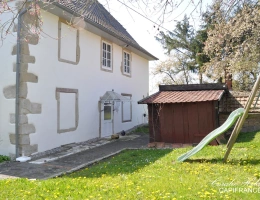
An historic monument for sale in Haut-Rhin can be found in Colmar, in the Petite Venise and Krutenau districts, but also along the Alsace wine road, from Eguisheim to Riquewihr and Kaysersberg, where half-timbered winegrowers' houses and merchants' townhouses follow one another for mile after mile. In Mulhouse, an industrial heritage of textiles and engineering complements manager's residences built for the city's leading families, while the Vosges valleys of Munster and the Thur retain old farms and spinning mills. Browse the historic monuments for sale listed by private owners, agencies and notaries across the department.
This page sets out the protected building types found across Haut-Rhin, the areas where they cluster most, the obligations tied to classification or registration, the grants that may apply and the checks worth making carefully before buying, without ever mentioning figures. To widen the thinking to the whole project and the steps that follow a viewing, read our guide to buying prestige property in France.
The Alsace wine road keeps, in Eguisheim, Riquewihr and Kaysersberg, colourful half-timbered winegrowers' houses with carved oriel windows and dated doorways above the entrance, while nearby Colmar lines its Petite Venise district with stone-and-timber merchants' houses along the canals. In Mulhouse, textile-industry heritage has left grand manager's villas and partly protected workers' housing estates built around the former factories. In the Munster and Thur valleys, farms with broad sweeping roofs and former spinning mills converted into residences survive alongside working farmland.
The outbuildings include wine presses, vaulted cellars and enclosed courtyards for wine-growing houses, or workshops and workers' dwellings for Mulhouse's industrial heritage still standing today across several districts. Many of these buildings have kept their original structure but call for repair to the timber frames, treatment against wood-boring insects and an update of electrical wiring respectful of the old materials and finishes.
The Alsace wine road, from Guebwiller to Ribeauvillé by way of Eguisheim and Riquewihr, holds most of the protected winegrowers' houses and remains by far the most sought-after part of the department. Colmar and its surrounding area offer urban townhouses within walking distance of the old town, while Mulhouse and its wider region, more affordable, keep a still little-known industrial heritage worth exploring. The Vosges valleys of Munster, the Thur and the Doller, more secluded, offer farms and master's houses at markedly more accessible levels for comparable living space.
Colmar and Mulhouse both have TGV stations serving Paris, Strasbourg and Switzerland; the A35 motorway runs along the Rhine and eases access to the Vosges valleys via a network of secondary roads. The most sought-after areas remain the wine road and Colmar itself, while the Munster and Thur valleys, more remote, stay noticeably more accessible for a comparable property in similar condition.
Haut-Rhin applies the local law of Alsace-Moselle, notably the land register, which replaces the standard land registry system used elsewhere in France; have the notary verify these particulars before any financial commitment. Then distinguish a classified building, requiring the prior approval of the Architecte des Bâtiments de France for any intervention, from a registered building, where exterior works require prior notice to the DRAC; the historic-monument tax regime remains subject to conditions that must always be confirmed in advance.
Selling a classified building always requires informing the buyer of its exact status and, depending on the works planned, notifying the relevant administration before signature is completed. On the technical side, check the condition of timber frames, the possible presence of dry rot in damp wine cellars, and the stability of foundations in flood-prone areas near the Ill river; entrust any restoration to a qualified contractor experienced with historic monuments and their upkeep.
Historic monument listings across Haut-Rhin are published by private owners, agencies specialising in Alsatian heritage and notarial offices; filter them carefully by area, building type and outbuildings, and set an e-mail alert to follow new listings as they appear. To compare it further still with Bas-Rhin and Lorraine, browse the historic monuments for sale in Grand Est.