

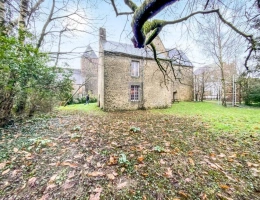

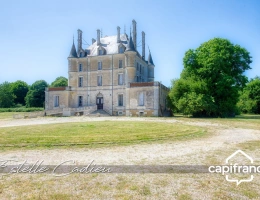
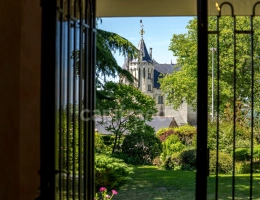

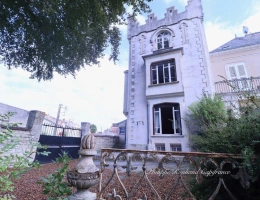


A chateau for sale in Sarthe points to a department of bocage countryside and river valleys, between Le Mans, La Flèche and Sablé-sur-Sarthe, where Renaissance residences and classical mansions multiplied along the Sarthe, the Huisne and the Loir. The former Maine region kept a dense fabric of small seigneurial estates converted into residences, some with moats and service wings, on the edge of the Sarthe Perche. Browse every chateau for sale listed by the private owners, agencies and notaries active across this territory.
This page brings together real price benchmarks recorded in the department, the areas where chateaux cluster, the character of local buildings and the checks worth making before a visit. To plan a full heritage purchase, read our guide to buying prestige property in France. Buyers here range from families seeking a residence to occupy year-round to those taking on a restoration project, with guest rooms or event hosting envisaged for the largest estates.
DVF land registry data does not identify chateaux as such: the benchmarks below cover sales of houses over 300 m² of living space on 0.05 to 10 ha, above €1,000/m², tracked by our observatory. They frame the market for large residences without describing it entirely: an estate with 30 ha of parkland or a listed monument sold with its farmland falls outside this scope.
In Sarthe, 58 sales were recorded from 2021 to 2025, with a median price of €575,000*, a floor/ceiling range (P10–P90) of €407,000 to €909,300 and a median of €1,647/m² of living space, for an average of 368 m² of living space and 17,849 m² of land. Across the Pays de la Loire region, the 2025 median stands at €750,000* (57 sales), against €822,000 in France in 2025 (981 sales).
| Scope | Sales | Median price | Floor – ceiling (P10–P90) | €/m² living space (median) |
|---|---|---|---|---|
| Sarthe (2021-2025) | 58 | €575,000* | €407,000 – €909,300 | 1,647 |
| Pays de la Loire (2025) | 57 | €750,000* | €442,000 – €1,355,600 | 2,006 |
| France (2025) | 981 | €822,000 | €428,000 – €3,100,000 | 2,308 |
The breakdown by stratum (coastal, rural tourist, ordinary rural) and the five-year trend are in our observatory of prestige property prices in France (in French). Before making an offer, work out purchase costs and borrowing capacity with our financial tools and calculators.
Source: DVF (DGFiP), transactions from 1 January 2021 to 31 December 2025, processed by ma-propriete.fr; prices rounded to the nearest €100. * Fewer than 100 sales: read as an indication only.
Sarthe's heritage combines Renaissance residences with turreted staircases, tuffeau façades near the Loir valley, and buildings in roussard sandstone or rendered rubble stone further north. Roofs are mostly steep slate, with pedimented dormers and ridge finials. On the edge of the Sarthe Perche, around Bonnétable and Mamers, timber framing and brick mix with stone. The market clearly distinguishes a chateau with a courtyard of honour and service wings from a more modest manor house, often of agricultural origin. Stone gateways, sometimes topped with a pediment, mark the entrance of the most complete estates, while more modest residences rely on a simple boundary wall.
Properties often include substantial outbuildings: service wings, a dovecote, a private chapel, an ice house and sometimes an attached farm still under tenancy. Moats, dry or filled, survive on several fortified residences remodelled during the Renaissance. Roof timber condition and slate quality, along with damp in tuffeau foundations, are the technical points that weigh most heavily on the value of a property needing renovation. A dovecote or ice house, where one survives, points to the age of the estate and often calls for restoration work separate from that of the main building.
Chateaux are found first along the Sarthe valley, between Le Mans, Fresnay-sur-Sarthe and Sablé-sur-Sarthe, then in the quieter Loir valley around La Chartre-sur-le-Loir. To the west, the La Flèche and Baugeois area benefits from its proximity to Anjou, while to the east the Sarthe Perche, around Bonnétable, Mamers and Saint-Calais, keeps a more scattered, wooded settlement pattern. The southern part of the department, toward La Ferté-Bernard and the Perche-Gouët, completes this landscape of bocage and state forests. Between these two poles, the area around Beaumont-sur-Sarthe and Conlie keeps a scattered rural settlement pattern, well suited to isolated properties surrounded by farmland.
Le Mans has a TGV station that puts Paris under an hour away, an advantage for buyers wanting an accessible second home, and the A11 and A28 motorways complete the network. The immediate surroundings of Le Mans and the Loir valley remain the most sought-after areas, while the northern Sarthe Perche and the southern part of the department offer more affordable properties of comparable character. Communes within a short drive of Le Mans account for most transactions, while more remote areas attract buyers seeking quiet surroundings and larger grounds.
Several Sarthe residences and chateaux are listed or registered historic monuments, particularly in the Loir valley and around the Perche; work on façades, roofs and sometimes interiors then requires the opinion of the Architecte des Bâtiments de France. Listed status can open the door to specific tax deductions under strict conditions of public access and conservation, which should be verified before committing. Rights of way tied to former service wings or an attached farm are also worth clarifying with the notary. It is also worth checking with the municipal planning office whether the property lies within the protected surroundings of another listed building nearby.
On the technical side, rising damp in tuffeau or roussard sandstone foundations, roof timber condition and the heating cost of large volumes deserve close attention. The drainage system, often non-mains in rural areas, and flood zoning along the Sarthe and the Loir should be checked before making an offer. A survey by a heritage professional before the purchase remains the best protection against unpleasant surprises. Insulation of the roof space and the performance of older joinery deserve close attention before planning year-round occupation of the residence.
Chateaux for sale in Sarthe are listed by private owners, specialist agencies and notaries; you can filter listings by price, living space, land area and outbuildings, then set up an e-mail alert to track new properties coming to market. To widen your search across the whole region, browse the chateaux for sale in Pays de la Loire. Detailed listings generally state whether outbuildings are habitable, which makes it easier to compare several properties before arranging a viewing.


