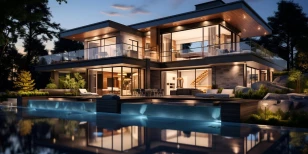


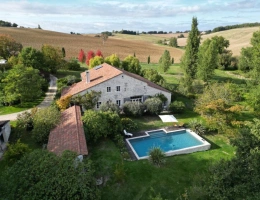
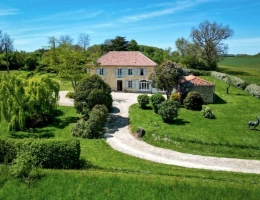


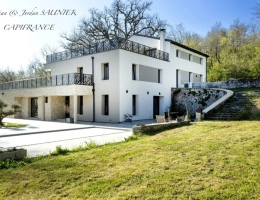
A chateau for sale in Lozère sits in mainland France's least populated department, between the limestone Causses, the granite Margeride and the high Cévennes valleys around Mont Lozère. Residences here are scarce and usually modest in size, shaped by an agropastoral history built on sheep and cattle farming: granite manor houses from the Margeride, limestone Causses halls and a few small chateaux or gentlemen's residences around Mende and Marvejols, in a wide-open landscape that still feels remarkably untouched. Browse every chateau for sale listed by the private owners, agencies and notaries who know this mid-mountain territory.
This page gathers real price benchmarks for these residences, the areas where they are found, the particularities of Lozère building and the checks that matter in a remote department, where upkeep and heating weigh heavily. It also outlines uses that suit this kind of property, from a second home to a mountain gîte or a continued farming activity, depending on the area chosen. To plan a full heritage purchase, read our guide to buying prestige property in France.
DVF land registry data does not identify chateaux as such: the benchmarks below cover sales of houses over 300 m² of living space on 0.05 to 10 ha, above €1,000/m², tracked by our observatory. They frame the market for large residences without describing it entirely: an estate with 30 ha of parkland or a listed monument sold with its farmland falls outside this scope.
The local market is too thin to publish a reliable department-level benchmark (0 sales in five years): we give the figures for the Occitanie region. Across the Occitanie region, the 2025 median stands at €662,500 (126 sales), against €822,000 in France in 2025 (981 sales).
| Scope | Sales | Median price | Floor – ceiling (P10–P90) | €/m² living space (median) |
|---|---|---|---|---|
| Occitanie (2025) | 126 | €662,500 | €430,000 – €1,477,000 | 1,804 |
| France (2025) | 981 | €822,000 | €428,000 – €3,100,000 | 2,308 |
The breakdown by stratum (coastal, rural tourist, ordinary rural) and the five-year trend are in our observatory of prestige property prices in France (in French). Before making an offer, work out purchase costs and borrowing capacity with our financial tools and calculators.
Source: DVF (DGFiP), transactions from 1 January 2021 to 31 December 2025, processed by ma-propriete.fr; prices rounded to the nearest €100.
Lozère buildings change in character with the terrain: grey granite and lauze-stone or slate roofs in the Margeride and on Mont Lozère, paler limestone and limestone lauze roofs on the Causses, notably around Sainte-Enimie and Florac. Large residences are few; the offer is mostly nineteenth-century farming manor houses, a handful of small chateaux around Mende and Marvejols, and fortified Causses halls once tied to transhumant sheep farming that moved flocks up to summer pastures each year.
Properties often include imposing farm outbuildings: a hay barn, a vaulted sheepfold, sometimes a bread oven or an old ice house. The weight of winter snow calls for sturdy roof timbers, whose condition should be checked carefully, as should that of the lauze stones, a heavy material that is costly to restore once cracked. These vast barns, once used for fodder storage, sometimes lend themselves to conversion into a gîte or a workshop, provided heavy machinery can reach the site.
The Causses, around Florac, Sainte-Enimie and Meyrueis, offer remote properties in a landscape of gorges and limestone plateaus, listed as a UNESCO World Heritage site under the Causses and Cévennes designation, where sheep farming still shapes the open landscape. The Margeride, to the north, around Saint-Chély-d'Apcher and Saint-Alban-sur-Limagnole, has granite buildings set in a landscape of forests and pasture. Around Mende, the department's prefecture, and Marvejols, the building stock is more clustered. Mont Lozère and the Lozère side of the Aubrac, to the west, remain high-altitude areas with few large residences.
The department has no TGV station; access runs through Intercités and TER rail links, notably from Clermont-Ferrand or Nîmes, complemented by road via the A75, known as the Méridienne, which crosses the department from north to south. Areas close to Mende and the Tarn gorges remain the most sought-after; the Margeride and the Aubrac, more remote, offer markedly more measured prices for land holdings that are often far larger.
Some Lozère residences, notably on the Causses, are listed historic monuments or lie within the Causses and Cévennes UNESCO perimeter, which imposes rules for conserving the landscape and traditional buildings. Mountain-zone classification can also limit certain extensions or changes of use for farm buildings, and this should be confirmed with the town hall before finalising any renovation plan.
On the technical side, insulation and heating deserve particular attention given the harsh winters and often high altitude; heating costs for old, poorly insulated volumes can be significant. Also check winter access, sometimes complicated by snow, and the drainage system, almost always a private arrangement in this rural department, along with the reliability of the water supply on isolated properties fed by a spring rather than mains water.
Chateau listings in Lozère are published by private owners, local agencies and notaries; you can filter them by price, living space, land area and outbuildings, with an e-mail alert for new properties as they are listed. To widen the search across the whole region, browse the chateaux for sale in Occitanie.