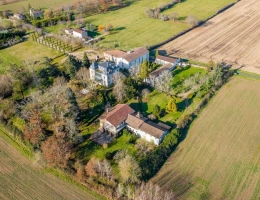
A chateau for sale in Tarn is found between the hillsides of the Gaillac wine country, the Aveyron gorges and the foothills of the Monts de Lacaune, in a department known for the pink brick of the Albi area and for one of south-west France's oldest vineyards. Properties on the market range from stone-and-brick manor houses overlooking a vine-covered slope to reworked medieval strongholds on the edge of the Segala plateau, alongside grand houses once tied to the textile mills of the Castres area or to farming estates in the Vaurais plain. Browse every chateau for sale listed by the private owners, agencies and notaries active in the department.
This page brings together real price benchmarks for large residences in Tarn, the areas where they stand, the particularities of local building materials and the checks worth making before an offer. It also covers the uses owners put these houses to today, from a family home to a guest house or a working vineyard estate. To plan a wider heritage purchase, also read our guide to buying prestige property in France.
DVF land registry data does not identify chateaux as such: the benchmarks below cover sales of houses over 300 m² of living space on 0.05 to 10 ha, above €1,000/m², tracked by our observatory. They frame the market for large residences without describing it entirely: an estate with 30 ha of parkland or a listed monument sold with its farmland falls outside this scope.
In Tarn, 88 sales were recorded from 2021 to 2025, with a median price of €568,900*, a floor/ceiling range (P10–P90) of €407,100 to €744,400 and a median of €1,611/m² of living space, for an average of 357 m² of living space and 15,196 m² of land. Across the Occitanie region, the 2025 median stands at €662,500 (126 sales), against €822,000 in France in 2025 (981 sales).
| Scope | Sales | Median price | Floor – ceiling (P10–P90) | €/m² living space (median) |
|---|---|---|---|---|
| Tarn (2021-2025) | 88 | €568,900* | €407,100 – €744,400 | 1,611 |
| Occitanie (2025) | 126 | €662,500 | €430,000 – €1,477,000 | 1,804 |
| France (2025) | 981 | €822,000 | €428,000 – €3,100,000 | 2,308 |
The breakdown by stratum (coastal, rural tourist, ordinary rural) and the five-year trend are in our observatory of prestige property prices in France (in French). Before making an offer, work out purchase costs and borrowing capacity with our financial tools and calculators.
Source: DVF (DGFiP), transactions from 1 January 2021 to 31 December 2025, processed by ma-propriete.fr; prices rounded to the nearest €100. * Fewer than 100 sales: read as an indication only.
Tarn is best known for its flat pink or orange local brick, fired nearby, which covers façades across the Albi and Castres areas and is often paired with limestone quoins. Roofs are low-pitched canal-tile, typical of southern France. In the Sidobre area east of Castres, local granite has long been used for building and gives rural houses a more massive look. The department has vine-growing manor houses around Gaillac, nineteenth-century grand houses linked to the former textile mills of Castres, and medieval strongholds reworked over the centuries toward the Segala and Cordes areas.
Properties for sale often include farm outbuildings: timber-framed barns, a winery where the estate still holds vines, square or octagonal dovecotes, and occasionally a stand-alone pigeon tower set among the fields. Service wings arranged around a closed courtyard remain common on the larger estates of the Vaurais plain and the Albi area, sometimes alongside a small chapel or a walled kitchen garden. The condition of the brick quoins, ventilation of the vaulted cellars and the timber frame of the large barns weigh heavily on the renovation budget after purchase.
The Gaillac area, around Gaillac, Lisle-sur-Tarn and Cordes-sur-Ciel, holds most of the wine-related estates, with characterful buildings and views over the Tarn valley. The Albi area, around the episcopal city of Albi, and the Castres area, along the Agout river, gather grand houses close to local employment centres. Further north and east, the Segala and Cordes districts offer more secluded farming properties amid woodland and pasture, while the Monts de Lacaune, to the south, stay wooded and discreet on the edge of the Haut-Languedoc uplands.
The department has no TGV station: rail links to Paris run through Albi-Ville and Castres stations, connected to Toulouse-Matabiau by Intercités and regional TER trains, and the A68 motorway runs the length of the territory from north to south. The most sought-after properties sit on the vine-covered slopes of the Gaillac area and near Cordes-sur-Ciel; the Segala and the Monts de Lacaune remain more affordable for comparable character, for lack of such direct access.
The protected historic quarter of Albi, a World Heritage site, carries strict planning rules for anything nearby; some chateaux in the department are also listed or registered historic monuments, which places exterior works under the authority of the Architecte des Bâtiments de France. Before committing, it is worth confirming the exact heritage status of the property and, where relevant, any easements tied to the protected surroundings around it.
On the technical side, have the winery and cellars checked where the estate still leases out vines, along with the timber frame of the barns and the often ageing canal-tile roofs. Wildfire risk deserves attention for wooded properties in the Segala and the Monts de Lacaune, as does the drainage system, which is very often a private setup outside the towns, and the water supply for any land still under vine.
Chateau listings in Tarn are published by private owners, specialist agencies and notaries; you can narrow the search by price, living space, land area and outbuildings, then set up an e-mail alert to follow new properties the moment they come to market. To widen the search across the region, browse the chateaux for sale in Occitanie.