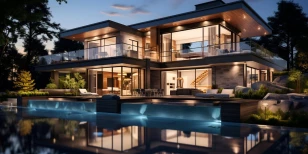

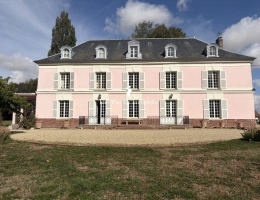
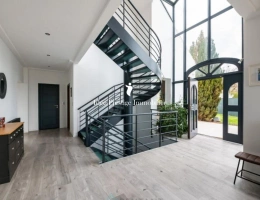
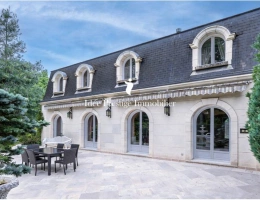
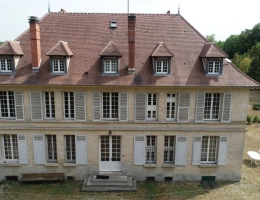
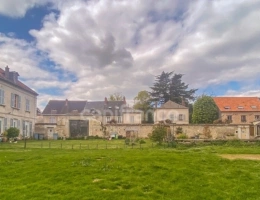
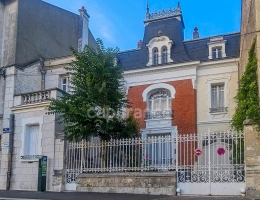
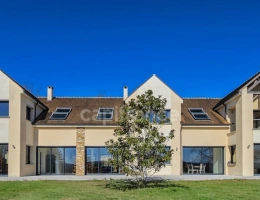
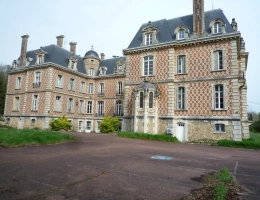
Finding a chateau for sale in Hauts-de-Seine is the exception rather than the rule: this inner-suburb department, almost entirely built up around La Défense, Boulogne-Billancourt and Nanterre, retains only a handful of older parks and residences, often absorbed into the urban fabric or converted into public facilities. A few nineteenth-century bourgeois properties survive along the Seine or in the most wooded municipalities, but they are few and far between. Browse the available chateau for sale listings, along with comparable properties listed by private owners, agencies and notaries in the area.
This page gives an honest picture of the scarcity of supply in Hauts-de-Seine and points towards neighbouring outer departments, where properties of this kind remain more numerous and more affordable for a comparable size. It also outlines the features of the older buildings that do survive locally and the precautions worth taking should an opportunity arise. To plan a wider heritage purchase, read our guide to buying prestige property in France.
DVF land registry data does not identify chateaux as such: the benchmarks below cover sales of houses over 300 m² of living space on 0.05 to 10 ha, above €1,000/m², tracked by our observatory. They frame the market for large residences without describing it entirely: an estate with 30 ha of parkland or a listed monument sold with its farmland falls outside this scope.
This inner-suburb department has no rural municipalities: the benchmarks below are those of the Île-de-France region. Across the Île-de-France region, the 2025 median stands at €1,445,000* (90 sales), against €822,000 in France in 2025 (981 sales).
| Scope | Sales | Median price | Floor – ceiling (P10–P90) | €/m² living space (median) |
|---|---|---|---|---|
| Île-de-France (2025) | 90 | €1,445,000* | €700,000 – €3,496,500 | 4,247 |
| France (2025) | 981 | €822,000 | €428,000 – €3,100,000 | 2,308 |
The breakdown by stratum (coastal, rural tourist, ordinary rural) and the five-year trend are in our observatory of prestige property prices in France (in French). Before making an offer, work out purchase costs and borrowing capacity with our financial tools and calculators.
Source: DVF (DGFiP), transactions from 1 January 2021 to 31 December 2025, processed by ma-propriete.fr; prices rounded to the nearest €100. * Fewer than 100 sales: read as an indication only.
The few historic residences still privately owned in Hauts-de-Seine mostly date from the nineteenth-century bourgeois period: manor houses in meulière rubblestone or cut stone, sometimes extended over generations, with grounds reduced by successive land subdivisions as the surrounding city grew. The great parks and former estates that once marked the department's history, notably around Saint-Cloud and Sceaux, now belong for the most part to the public domain or to institutions, which explains the persistent scarcity of private supply for sale on the open market.
When a property with outbuildings does come to market, it is usually smaller in scale than elsewhere in the Paris region, with a converted outbuilding or coach house serving as an annexe rather than a full set of farm buildings. The condition of the roof, façades and period joinery should be checked just as rigorously as on a more rural property, despite the surrounding urban setting and the modest plot size that usually comes with it.
The rare opportunities lie mainly in the most tree-lined municipalities of the western part of the department, around Marnes-la-Coquette, Vaucresson and Garches, near the Fausses-Reposes forest, or along the Seine around Meudon and Sèvres, areas that keep a more residential and greener character than the rest of the department and its denser, more built-up centre. Given how scarce this type of property is across Hauts-de-Seine, it is worth widening the search towards Yvelines, Essonne, Seine-et-Marne or Val-d'Oise, where the supply of chateaux and large residences remains considerably broader, steadier and more varied throughout the year.
The department has no TGV station of its own; it does, however, benefit from dense RER, Transilien and metro coverage, which makes it easy to reach Paris and the neighbouring TGV stations at Massy, in Essonne, or Versailles-Chantiers, in Yvelines, both within a short onward journey. The few properties available here rank among the most expensive in the whole Paris region, regardless of their size or condition, purely because of their location so close to the capital.
An older property in Hauts-de-Seine is frequently located within the protected surroundings of a listed historic monument or a designated site, which requires the opinion of the Architecte des Bâtiments de France for any change to a façade, roof, window, door or garden wall, including on existing outbuildings. Planning rules here are generally strict, with height and footprint limits closely controlled by the local plan, which restricts the scope for extending the existing building or adding a further storey on top.
On the technical side, check the condition of the foundations and basements, sometimes affected by the density of the surrounding buildings and by the area's underground infrastructure. The cost of maintaining an older property in a dense urban setting, including connection to utility networks, should be budgeted precisely before any offer, as should local property tax, generally higher than in a rural area.
Given how scarce privately owned older buildings are in Hauts-de-Seine, the few listings that do appear mostly come from notaries handling a succession and from specialist agencies, more rarely from private owners; filtering by price, living space and land area, plus an e-mail alert, helps you stay informed. For a wider search covering the whole Paris region, browse the chateaux for sale in Île-de-France.