

To find a hunting property for sale in Jura, you first need to choose an altitude. In the lowlands to the north, the Forêt de Chaux, a vast oak forest east of Dole, and the woods of the Val d’Amour and the Finage hold red deer, roe deer and wild boar; to the west, the Bresse jurassienne, between Bletterans and Chaussin, mixes hedged farmland, ponds and woods suited to wildfowl as well as wild boar. Further east, the Revermont, the Petite Montagne and the Champagnole plateaus lead up to the fir forests of the High Jura, chamois and conifer country. Properties for sale range from a small plateau wood to a Bresse estate with a pond, by way of a fir forest with a chalet or a traditional Comtois farmhouse. Every offer published by private sellers, estate agents and notaires can be found among our sporting properties and hunting woods on the market.
The data block below this introduction gives the forest prices recorded in Jura and the official game bag figures, led by wild boar and roe deer, with red deer in a significant place. You will then find a description of lowland and mountain ground, followed by the points to watch in this department: ACCA rules, red deer and forest regeneration, lynx, capercaillie and fencing.
A hunting estate is rarely valued with a single figure: its price adds up the value of the woodland, the ponds, the buildings and the shooting facilities. The statistics below give benchmarks for wooded land and ponds, based on sales actually recorded.
According to the ma-propriete.fr forest price observatory, built from sales recorded in the French DVF land registry database, the median price of a hectare of forest in Jura was €4,003/ha in 2025*, across 71 sales, with an average of €4,440/ha. That puts the department below the Bourgogne-Franche-Comté median (€4,715/ha) and below the national median (€4,936/ha). Compared with 2024, the median changed by −21.6%, a movement to interpret with care given the number of sales. Over the more robust 2020-2025 period, 360 sales give a median of €5,309/ha for a median plot size of 2.9 ha.
| Indicator | Jura (39) | Bourgogne-Franche-Comté | France |
|---|---|---|---|
| Median price 2025 | €4,003/ha* | €4,715/ha | €4,936/ha |
| Average price 2025 | €4,440/ha* | €6,151/ha | €6,214/ha |
| Number of sales 2025 | 71 | 650 | 6,329 |
| Change in median 2024 → 2025 | −21.6%* | −3.0% | +1.9% |
| Median price 2020-2025 | €5,309/ha | €4,775/ha | €4,778/ha |
| Number of sales 2020-2025 | 360 | 3,408 | 35,100 |
Nationally, the price per hectare rises with size: the large properties that appeal to hunters sell for more per hectare than medium-sized woods.
| Size of forest sold (France, 2020-2025) | Median price | Number of sales |
|---|---|---|
| 10 to 20 ha | €4,010/ha | 3,161 |
| 20 to 50 ha | €5,330/ha | 1,850 |
| 50 to 100 ha | €6,810/ha | 581 |
| Over 100 ha | €7,361/ha | 320 |
Ponds trade at a very different level: a median of €15,267/ha for the 10 ponds sold without buildings in Jura between 2020 and 2025†, a sample too small to be representative; regionally, the median reaches €26,357/ha.
On the listings side, 18 hunting properties are offered on ma-propriete.fr across France as of 2 October 2026, 1 of them in Bourgogne-Franche-Comté. Their median asking price is €888,000 for a median size of about 68 ha. These asking prices apply to complete properties, often with buildings, a pond or hunting rights: they cannot be compared directly with DVF medians per hectare.
* 30 to 99 sales: indicative value. † 10 to 29 sales: sample too small to be representative of the local market. Source: DVF (French tax authority), processed by ma-propriete.fr; forests of 1 ha or more, cadastral type woodland; ponds without buildings of at least 2,000 m²; July 2020 to December 2025; Moselle, Bas-Rhin and Haut-Rhin are not covered by DVF. Listings recorded on ma-propriete.fr on 2 October 2026.
The game bag records published by the French Biodiversity Agency (OFB) measure hunting pressure and, indirectly, the presence of big game. In Jura, 983 red deer were taken in the 2024-2025 season, about 1.1% of the national total, alongside 4,578 roe deer and 5,134 wild boar.
| Species | 2021-2022 season | 2024-2025 season | Change |
|---|---|---|---|
| Red deer | 727 | 983 | +35% |
| Roe deer | 4,701 | 4,578 | −3% |
| Wild boar | 5,811 | 5,134 | −12% |
| Chamois | 155 | 150 | −3% |
Source: OFB, wild ungulates network, departmental big game bags (total culls, data published on data.gouv.fr).
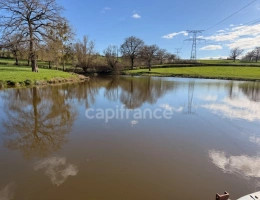
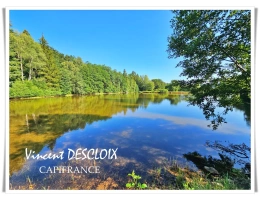
In the north of the department, the Forêt de Chaux ranks among France’s large broadleaved forests; it is largely state-owned and its hunting is leased out by the National Forests Office (ONF), so private properties for sale lie along its edges and in the woods of the Val d’Amour, beside the river Loue. Red deer have long been established there and are hunted in driven days alongside wild boar and roe deer. The Bresse jurassienne looks quite different: ponds created in the Middle Ages, hedges, wet meadows and oak woods make up medium-sized properties combining evening duck flighting, driven boar hunts and the autumn draining and fish harvest of the ponds. The Bresse plain continues westwards, where our hunting estates in Saône-et-Loire offer further examples. If water matters as much as game, browse our ponds and lakes in the Jura as well.
From the Revermont, the plateaus rise in steps towards the east: the Forêt de la Joux and the fir forests around Champagnole, then the valleys and ridges of the High Jura around Saint-Claude, Morez and Les Rousses, within the Haut-Jura regional nature park. Chamois occupy the cliffs and ridges, roe deer and wild boar the mixed forests, and red deer are spreading through the range from several cores monitored by the federation. To the south-west, the Petite Montagne around Arinthod, drier and more rugged, offers broadleaved woods where wild boar dominate. Sales mostly involve fir and spruce plots of a few hectares, wooded pastures and occasionally a mountain farm; a hunting ground in a single block large enough to be hunted separately is the exception.
In Jura, ACCAs cover most of the land: most communes have their municipal or inter-municipal hunting association, and any resident holding a validated licence becomes a member as of right; the owner of a second home qualifies after four consecutive years on the roll of a direct local tax such as property tax. A wood below the opt-out threshold, at least 20 ha in one block by law, remains hunted by the ACCA; above it, withdrawal can be requested at the end of one of the association’s five-year periods, and you then take back the hunting on your land, along with responsibility for controlling game and for any damage. Ask for the association’s rules, the cull plan allocations for red deer and chamois, and the history of damage claims. In the lowland oak forests, the balance between red deer and oak regeneration is a matter of close negotiation between foresters and hunters, as in the Forêt de Chaux.
Two protected species weigh on the management of upland forests: the lynx, whose relationship with roe deer and chamois populations has been the subject of scientific study, and the capercaillie, now rare, whose need for quiet calls for precautions in some High Jura forests. If the property is fenced, the act of 2 February 2023 requires wire raised 30 cm off the ground, capped at 1.20 m and passable by wildlife, with a deadline of 1 January 2027 for enclosures built from 1993 onwards; our article on what the law requires of fences sets out its scope.
Private sellers, estate agents and notaires publish Jura hunting properties on ma-propriete.fr; sort them by size or price, save an email alert to follow new arrivals, or put your own listing online if you are selling. For a forestry-led project, see our woods and fir forests for sale in Jura; to widen your search to Côte-d’Or or Doubs, look at the shoots and estates in Bourgogne-Franche-Comté.