
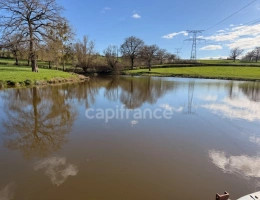
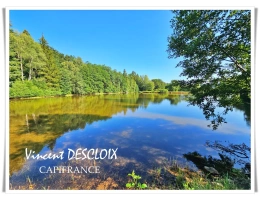

Looking for hunting property for sale in Haute-Saône? You are in one of the most heavily wooded departments of eastern France, where oak rules the limestone plateaus and the communes own more than half of the forests. In the north-east, the Vosges saônoises, from the Ballon de Servance to the Plateau des Mille Étangs (the “thousand ponds” plateau), offer fir and beech woods on steep ground, home to red deer, roe deer and wild boar. In the centre and west, around Vesoul, Gray and Champlitte, the plateaus alternate oak forests with arable land, and the Saône and Ognon valleys add flood meadows and backwaters. Properties range from a hunting wood on the plateau to a farm with its own land or a house with a pond at the foot of the Vosges; you will find them among our hunting properties listed nationwide.
The data section below shows the forest and pond prices recorded in the department, then the game bag figures of the French Biodiversity Agency (OFB). After that come the two main types of hunting country in Haute-Saône and what to check before signing: the ACCA system, the opt-out threshold, wild boar damage and fencing.
A hunting estate is rarely valued with a single figure: its price adds up the value of the woodland, the ponds, the buildings and the shooting facilities. The statistics below give benchmarks for wooded land and ponds, based on sales actually recorded.
According to the ma-propriete.fr forest price observatory, built from sales recorded in the French DVF land registry database, the median price of a hectare of forest in Haute-Saône was €3,504/ha in 2025*, across 83 sales, with an average of €4,620/ha. That puts the department below the Bourgogne-Franche-Comté median (€4,715/ha) and below the national median (€4,936/ha). Year on year, the departmental median moved by −17.5%: a change to read with caution on fewer than a hundred sales, where a few large estates can shift the median. Over the more robust 2020-2025 period, 389 sales give a median of €3,889/ha for a median plot size of 3.0 ha.
| Indicator | Haute-Saône (70) | Bourgogne-Franche-Comté | France |
|---|---|---|---|
| Median price 2025 | €3,504/ha* | €4,715/ha | €4,936/ha |
| Average price 2025 | €4,620/ha* | €6,151/ha | €6,214/ha |
| Number of sales 2025 | 83 | 650 | 6,329 |
| Change in median 2024 → 2025 | −17.5%* | −3.0% | +1.9% |
| Median price 2020-2025 | €3,889/ha | €4,775/ha | €4,778/ha |
| Number of sales 2020-2025 | 389 | 3,408 | 35,100 |
Nationally, the price per hectare rises with size: the large properties that appeal to hunters sell for more per hectare than medium-sized woods.
| Size of forest sold (France, 2020-2025) | Median price | Number of sales |
|---|---|---|
| 10 to 20 ha | €4,010/ha | 3,161 |
| 20 to 50 ha | €5,330/ha | 1,850 |
| 50 to 100 ha | €6,810/ha | 581 |
| Over 100 ha | €7,361/ha | 320 |
Ponds, which often make much of a shoot’s value, trade at a very different level: a median of €27,480/ha for the 66 ponds sold without buildings in Haute-Saône between 2020 and 2025*.
On the listings side, 18 hunting properties are offered on ma-propriete.fr across France as of 2 October 2026, 1 of them in Bourgogne-Franche-Comté. Their median asking price is €888,000 for a median size of about 68 ha. These are advertised prices for whole properties, sometimes with a house or a pond, not recorded sale prices per hectare like those in the DVF database.
* 30 to 99 sales: indicative value. Source: DVF (French tax authority), processed by ma-propriete.fr; forests of 1 ha or more, cadastral type woodland; ponds without buildings of at least 2,000 m²; July 2020 to December 2025; Moselle, Bas-Rhin and Haut-Rhin are not covered by DVF. Listings recorded on ma-propriete.fr on 2 October 2026.
The game bag records published by the French Biodiversity Agency (OFB) measure hunting pressure and, indirectly, the presence of big game. In Haute-Saône, 830 red deer were taken in the 2024-2025 season, about 0.9% of the national total, alongside 6,927 roe deer and 8,425 wild boar.
| Species | 2021-2022 season | 2024-2025 season | Change |
|---|---|---|---|
| Red deer | 654 | 830 | +27% |
| Roe deer | 8,183 | 6,927 | −15% |
| Wild boar | 8,565 | 8,425 | −2% |
Source: OFB, wild ungulates network, departmental big game bags (total culls, data published on data.gouv.fr).
Between Lure, Faucogney-et-la-Mer and Plancher-les-Mines, the land climbs towards the ballons, the rounded summits of the southern Vosges, inside the Ballons des Vosges regional nature park. Shaped by a retreating glacier, the Plateau des Mille Étangs is a patchwork of peat bogs, ponds, hay meadows and small woods; higher up, the slopes are clothed in silver fir, beech and spruce. Red deer here belong to the wider Vosges population and are hunted on driven days alongside wild boar, while roe deer keep to woodland edges and clearings. Land in these valleys is often split into many small plots: a coherent shoot is rarely put together in a single purchase, and winter access matters as much as acreage. The same massif runs on towards the Ballon d’Alsace, where the hunting properties of Territoire de Belfort tend to be smaller.
The Breuchin valley, upstream of Luxeuil-les-Bains, shows the other side of this abundance: wild boar root up the hay meadows, and where damage is concentrated the authorities can require hunters to step up their culls, sows included.
The heart of the department is plateau country, where large forests alternate with cereals and grassland. These oak woods, a good share of them owned by the communes, hold plenty of wild boar, roe deer everywhere and, in several forests, groups of red deer whose cull is set by the hunting plan (plan de chasse). To the west, around Gray and Port-sur-Saône, the Saône unrolls its flood meadows, willow stands and backwaters: a hunting ground there combines riverside woods, evening duck flighting and boar coming up from the maize. To the south, the Ognon valley, from Villersexel to Marnay, offers a similar but narrower landscape. If water matters to you as much as game, see our lakes and ponds for sale in Haute-Saône.
In Haute-Saône, approved municipal hunting associations (ACCA) set up under the 1964 Verdeille Act cover most of the land. Where the commune has one, a wood below the opt-out threshold, a legal minimum of 20 ha in one block that an order may raise, is hunted by the ACCA. As a buyer, you can ask to become a member by right if your land reaches at least a tenth of that threshold, but you will not decide how the drives are run. Above the threshold you can withdraw your land, but the procedure and its deadlines are strict: check them with the departmental hunters’ federation, which handles such requests, and ask whether the property has already been taken out of the ACCA.
Wild boar damage is the second issue. Compensation is paid through the departmental hunters’ federation, which can pass part of the bill to grounds where culls fall short: ask for the damage history around the property and the cull plan allocations for recent seasons. If the property is fenced, check it against the act of 2 February 2023: in natural areas, wire netting must now start 30 cm off the ground, top out at 1.20 m and remain passable for animals, and any installed since 1993 has until 1 January 2027 to be altered. Our guide to upgrading the fence of a hunting enclosure will help you cost the work.
Hunting properties in Haute-Saône listed on ma-propriete.fr come from private sellers, estate agents and notaires’ offices. Sort them by size or budget, receive new listings through an e-mail alert, or publish your own listing if you are selling. If timber comes first, browse our forests for sale in Haute-Saône; to compare with Doubs, Jura or Côte-d’Or, see the hunting estates of Bourgogne-Franche-Comté.