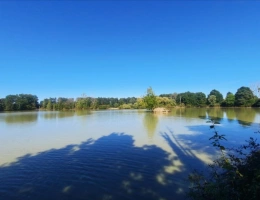
The market for hunting property for sale in Indre revolves around one name: the Brenne. In the south-west of the department, this country of chained ponds, heath (brandes) and woods, protected as a regional nature park, brings waterfowl and big game together on the same estates. Around it, the Boischaut Nord and Boischaut Sud unfold wooded hedgerow country suited to roe deer and wild boar, while the Champagne berrichonne to the north-east remains open plain for small game. Here you will find estates with ponds and a lodge, hunting woods and shooting grounds listed by private sellers, agents and notaires, along with a link to all our sporting estates for sale in France.
Further down, the data panel brings together the prices of forests and ponds sold in Indre and the big game bag figures published by the French Biodiversity Agency (OFB). The sections that follow describe the department’s two main kinds of ground and the checks to make, from pond management to the status of fences. Because water often makes the value of a Brenne shoot, look also at our lakes and ponds for sale in Indre.
A hunting estate is rarely valued with a single figure: its price adds up the value of the woodland, the ponds, the buildings and the shooting facilities. The statistics below give benchmarks for wooded land and ponds, based on sales actually recorded.
According to the ma-propriete.fr forest price observatory, built from sales recorded in the French DVF land registry database, the median price of a hectare of forest in Indre was €5,058/ha in 2025*, across 36 sales, with an average of €5,801/ha. That puts the department below the Centre-Val de Loire median (€5,803/ha) and above the national median (€4,936/ha). Compared with 2024, the median changed by +8.2%, a movement to interpret with care given the number of sales. Over the more robust 2020-2025 period, 190 sales give a median of €4,577/ha for a median plot size of 3.8 ha.
| Indicator | Indre (36) | Centre-Val de Loire | France |
|---|---|---|---|
| Median price 2025 | €5,058/ha* | €5,803/ha | €4,936/ha |
| Average price 2025 | €5,801/ha* | €6,714/ha | €6,214/ha |
| Number of sales 2025 | 36 | 342 | 6,329 |
| Change in median 2024 → 2025 | +8.2%* | −3.3% | +1.9% |
| Median price 2020-2025 | €4,577/ha | €5,588/ha | €4,778/ha |
| Number of sales 2020-2025 | 190 | 1,867 | 35,100 |
Nationally, the price per hectare rises with size: the large properties that appeal to hunters sell for more per hectare than medium-sized woods.
| Size of forest sold (France, 2020-2025) | Median price | Number of sales |
|---|---|---|
| 10 to 20 ha | €4,010/ha | 3,161 |
| 20 to 50 ha | €5,330/ha | 1,850 |
| 50 to 100 ha | €6,810/ha | 581 |
| Over 100 ha | €7,361/ha | 320 |
Ponds, which often make much of a shoot’s value, trade at a very different level: a median of €18,363/ha for the 130 ponds sold without buildings in Indre between 2020 and 2025.
On the listings side, 12 hunting properties are offered on ma-propriete.fr in Centre-Val de Loire as of 2 October 2026, 2 of them in Indre. Their median asking price is €1,362,500 for a median size of about 98 ha. These are asking prices for complete properties: they describe the supply on offer more than the average price of a wooded hectare.
* 30 to 99 sales: indicative value. Source: DVF (French tax authority), processed by ma-propriete.fr; forests of 1 ha or more, cadastral type woodland; ponds without buildings of at least 2,000 m²; July 2020 to December 2025; Moselle, Bas-Rhin and Haut-Rhin are not covered by DVF. Listings recorded on ma-propriete.fr on 2 October 2026.
The game bag records published by the French Biodiversity Agency (OFB) measure hunting pressure and, indirectly, the presence of big game. In Indre, 2,569 red deer were taken in the 2024-2025 season, about 3% of the national total, alongside 9,196 roe deer and 11,711 wild boar.
| Species | 2021-2022 season | 2024-2025 season | Change |
|---|---|---|---|
| Red deer | 2,526 | 2,569 | +2% |
| Roe deer | 10,392 | 9,196 | −12% |
| Wild boar | 11,438 | 11,711 | +2% |
Source: OFB, wild ungulates network, departmental big game bags (total culls, data published on data.gouv.fr).
The Brenne’s ponds were created by monks who, from the 12th century onwards, held back the water of marshy land that could not be farmed. The Grande Brenne, north of the river Creuse, is a patchwork of water, woodland, heath and meadow; the Petite Brenne lies south of the river. The park holds very large populations of red deer, roe deer and wild boar, and in winter its ponds host thousands of ducks and teal. A Brenne hunting estate therefore combines driven days in the woods and heath, evening flighting at the water’s edge and walked-up wildfowling.
This natural heritage comes with rules. The Brenne has been listed since 1991 as a wetland of international importance under the Ramsar Convention and lies largely within the Natura 2000 network: drying out, draining, reed-bed management and bank works are all regulated. A neglected pond, a weak dam or a broken sluice (moine) soon weighs on a shoot’s budget; our guide to buying a pond covers these checks.
Outside the Brenne, Indre is hunted differently. The Boischaut Sud, around La Châtre and up to the borders of Creuse, is rolling hedgerow country of pasture and small woods where roe deer and boar are plentiful; properties there often come as a hunting wood of a few dozen hectares attached to a farm. The Boischaut Nord, in the north-west, is gently undulating, between hedgerows and woods. The Champagne berrichonne, around Issoudun, is a limestone plateau of large arable fields given over to partridge and hare. In the centre, the state-owned Châteauroux forest, managed by the ONF, shares its wildlife with the private woods on its edges, which are sought after for that reason.
Indre is not one of the departments where ACCAs (communal hunting associations) are compulsory, and few communes have set one up: hunting rights normally go with the land, and the owner may keep, sell or lease them. Ask whether a hunting lease is running and whether it will be transferred or ended on sale, and get a list of the guns sold for the season. Individual cull plan allocations for red and roe deer matter as much as acreage: ask for those of the last three seasons. Near the Champagne berrichonne, also ask the seller about boar damage to crops, as compensation is funded by hunters.
Then there is the fencing. As in Sologne, part of the Brenne has been wired off, to the point that people sometimes speak of its “Sologne-isation”. If the estate is enclosed, the act of 2 February 2023 applies: in natural areas the mesh must leave 30 cm clear above the ground and stay below 1.20 m, and fences erected in the thirty years before the act must comply by 1 January 2027. Our article on fencing of rural estates sets out the exceptions and procedures.
On ma-propriete.fr, shooting grounds in Indre are offered by private sellers, agents and notaires’ practices. Size and price filters, email alerts and the option to post your own listing let you follow this narrow market or sell into it. If woodland comes first, see our forests and woods for sale in Indre; for shoots in Cher and Sologne, widen your search to hunting land for sale throughout Centre-Val de Loire.