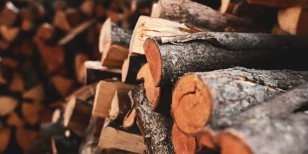

Looking for a forest for sale in Meurthe-et-Moselle? The first thing to know is that most of the department’s woodland never reaches the market: the State and, above all, the communes own the larger share of its forests. Private sales therefore involve smaller areas, often scattered between the big public blocks. Three markets sit side by side: damp oak woods on the clays of the Woëvre and the Toulois in the west, limestone plateaux dominated by beech around Nancy, and in the east the woods of the Lunévillois, which climb towards the Vosges sandstone around Badonviller and Cirey-sur-Vezouze. Buyers come for Lorraine woodland plots to cut firewood, to hunt big game or to assemble a productive forest estate one parcel at a time.
This page brings together the woods and forests offered for sale in the department by private sellers, estate agents and notaires. It also sets out the prices recorded in recent sales, followed by a reading of the ground: which species dominate in each area, what kind of property actually changes hands, and which pitfalls specific to Lorraine you should check before signing, from shell fragments in the timber to former iron-mining districts.
According to the ma-propriete.fr forest price observatory, built from sales recorded in the French DVF land registry database, the median price of a hectare of forest in Meurthe-et-Moselle was €4,302/ha in 2025*, across 41 sales, with an average of €4,943/ha. That puts the department below the Grand Est median (€5,498/ha) and below the national median (€4,936/ha). Compared with 2024, the median changed by −22.2%, a movement to interpret with care given the number of sales. Over the more robust 2020-2025 period, 254 sales give a median of €5,015/ha for a median plot size of 2.9 ha.
| Indicator | Meurthe-et-Moselle (54) | Grand Est | France |
|---|---|---|---|
| Median price 2025 | €4,302/ha* | €5,498/ha | €4,936/ha |
| Average price 2025 | €4,943/ha* | €6,545/ha | €6,214/ha |
| Number of sales 2025 | 41 | 527 | 6,329 |
| Change in median 2024 → 2025 | −22.2%* | +10.9% | +1.9% |
| Median price 2020-2025 | €5,015/ha | €4,958/ha | €4,778/ha |
| Number of sales 2020-2025 | 254 | 2,836 | 35,100 |
Prices vary widely: in 2025, one forest in ten sold for less than €2,800/ha in Meurthe-et-Moselle and one in ten for more than €8,177/ha. The bottom of the range is usually small coppice woods or plots with poor access; the top is valuable stands or properties whose price includes hunting rights, a pond or good access.
On the listings side, 59 forests and wooded properties are offered on ma-propriete.fr across France as of 2 October 2026, 3 of them in Grand Est. Their median asking price is €145,750 for a median size of about 17 ha. These are advertised prices for whole properties, sometimes with a house or a pond, not recorded sale prices per hectare like those in the DVF database. To work out the full cost of a purchase, add the conveyancing fees with our notary fee calculator.
* 30 to 99 sales: indicative value. Source: DVF (French tax authority), processed by ma-propriete.fr; forests of 1 ha or more, cadastral type woodland; July 2020 to December 2025; Moselle, Bas-Rhin and Haut-Rhin are not covered by DVF. Listings recorded on ma-propriete.fr on 2 October 2026.
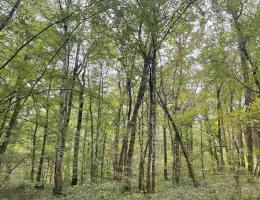
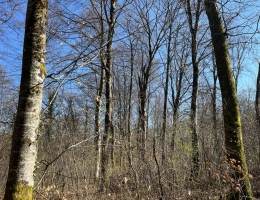
Beech, sessile oak and hornbeam form the backbone of a forest cover that is overwhelmingly broadleaved. On the limestone plateau between Toul and Nancy, the Forêt de Haye is the best-known example: a largely state-owned beech forest, cut through by the motorways around Nancy, badly damaged by storm Lothar and restocked since. To the west, the Forêt domaniale de la Reine, between Toul and the Côtes de Meuse, shows the department’s other face: oak on wet clay, dotted with forest ponds, within the Lorraine regional nature park.
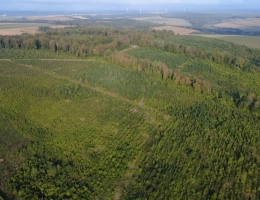
East of Lunéville, the Parroy state forest and the Mondon forest are ringed by private oak and beech woods, often managed as coppice-with-standards or being converted to high forest. Further east, on the fringe of the Vosges around Badonviller, Cirey-sur-Vezouze and the Pierre-Percée lake, the sandstone carries silver fir, spruce and beech: this is the only part of the department where conifers make a real difference to the value of a wood.
Because the State and the communes hold most of the land, the private woods that come up for sale tend to be modest: an inherited firewood lot on the edge of a village in the Saintois, a landlocked woodland plot in the Pays-Haut, a strip of forest edge bought back by the neighbouring farmer. Blocks of several dozen hectares in a single holding do exist, mainly in the Lunévillois and towards the Vezouze valley, but they rarely change hands and their sale usually goes through a forestry consultant or a notaire.
Hunting matters a great deal in the value of these woods: red deer, roe deer and wild boar are well established, and a wood that forms part of a large block holding game fetches more than an isolated copse of the same quality. Properties where the shoot is the main selling point are listed on our page of hunting estates for sale in Meurthe-et-Moselle. Those built around water, found for example along the edges of the Forêt de la Reine, are grouped with our lakes and ponds for sale in Meurthe-et-Moselle.
For a wood of less than 4 ha, two public bodies may take precedence over the neighbours. The commune, when it owns an adjoining forest under the public forestry regime (régime forestier), and the State, when the wood borders a state forest, both hold a right of pre-emption; in a department where communal forests are everywhere, this is far from a theoretical case. Owners of adjoining woodland then enjoy a statutory first refusal right on small forests, which the notaire must clear. From 20 ha upwards, a management plan approved by the regional forest owners’ centre (CRPF) is compulsory: ask for it, together with the felling history.
Two risks peculiar to the department call for a careful site visit. In the north, in the former iron-ore basin around Briey and Jœuf, some communes are covered by a mining risk prevention plan: check it for any plot lying above old galleries. Along the former First World War front, from the Bois-le-Prêtre near Pont-à-Mousson to the outskirts of Badonviller, metal fragments remain lodged in the trunks; sawmills turn down or mark down this shrapnel-laden timber, and the estimate of standing volume must reflect it. Finally, have the health of the stands assessed: beech weakened by recent droughts, ash affected by ash dieback, spruce attacked by bark beetles in the eastern plantations.
The woods and forests of Meurthe-et-Moselle listed on ma-propriete.fr come from private owners, agents and notaires’ offices. Sort them by size or budget, set up an alert to receive new listings by email, or advertise your own wood. If the local choice looks thin, widen your search to forests for sale in the Grand Est, and in particular to the forests of the Vosges department, where conifers play a larger part.