
Looking for a pig farm for sale in Côtes-d'Armor means searching in the very centre of French pig production. The department holds family-scale farrow-to-finish sites, stand-alone finishing units and a handful of holdings run under a quality scheme, nearly all of them tied to a producer group. Mandates reach this page from farmers preparing their retirement, from firms specialising in rural property and from notarial offices in central Brittany; they set out the type of building, batch management, the spreading area available and the contract in force. Each holding also joins our national overview of pig farms for sale.
Beyond the listings, this page supplies what is usually missing before a first viewing: local land values, the areas where sites come free, how to judge the true condition of a pig house and the paperwork to request from the seller. If your plan is still at the idea stage, our white paper « Créer une exploitation agricole » (in French) sets out each stage, from choosing a legal form to the funding plan.
Land value drives much of the asking price for a pig farm. French tax transfer statistics (DVF, vineyards excluded) show, for 2025, a median of €5,584/ha in Côtes-d'Armor (22), an average of €5,872/ha and 371 sales; 80% of transactions settle between €3,914 and €8,226/ha, against a national median of €5,307/ha.
On the SAFER side, the value of vacant land and pasture is set at €5,890/ha for 2025, moving +1.9% over a year and +23.2% over ten, against €6,460/ha nationally; expect an average discount of 17% where a lease is running.
With this kind of holding, acreage never sums up the asking price. What counts first is how modern the farrowing and weaner rooms are, slurry storage capacity, the authorisation attached to the site, the spreading area genuinely under control, the quality of the sow herd and the strength of the commercial outlet. To place the land, use our land price observatory, then put the takeover figures through our financial calculators.
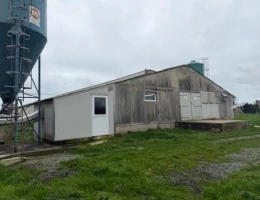
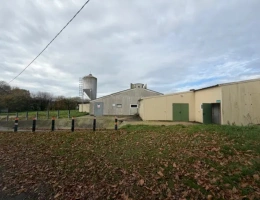
The local building stock was laid down in layers: fully slatted rooms from the big investment waves, houses repartitioned through successive upgrading programmes and, more rarely, straw-based finishing linked to a label rouge or outdoor scheme. View the site room by room. In the farrowing house, look at the crates, temperature control and the state of the under-slat pits; in the weaner rooms, at ventilation, heating and how level the floors are; in finishing, at liquid or dry feeding, automation and alarms. Then come the slurry store and its cover, the loading bay, the biosecurity entry room and, where one exists, the on-farm feed mill.
Neighbouring sites can be worth markedly different sums depending on when work was last carried out, how full the places are and whether group housing for gestating sows complies. Stock is valued separately, on health status, genetics and the average parity of the animals. Where the listing covers a whole holding with a dwelling and land, insist on an item-by-item breakdown: it sharpens the negotiation and eases bank funding for a pig unit whose worth lies chiefly in the production tool.
The centre of the department forms the hard core: around Loudéac, Uzel and the Mené country, units sit close together and a short haul from feed mills and processing plants. The north-east, from Lamballe towards Broons and Dinan, mixes livestock, forage acreage and food industries; it is also at Plérin that the quotation used as a benchmark by the national sector is set. Westwards into the Argoat, around Callac, Rostrenen and Guingamp, mixed holdings prevail, with pigs backed by a dairy herd or by poultry.
The coastal strip, from Lannion to Saint-Brieuc and on towards Erquy, offers few openings: land is contested there, dwellings sit close by and extension projects are hard to get accepted. Most of the supply therefore lies inland, on the central plateaux, where parcel prices stay moderate and spreading agreements are easier to negotiate with neighbouring arable farmers. Inland communes therefore combine available buildings, quick access to downstream facilities and an entry cost a first-time buyer can bear.
Administrative status weighs more here than the number of hectares. Depending on numbers, the site falls under declaration, registration or authorisation as a classified installation, and any change of operator must be notified to the prefecture. Ask for the prefectural order, any supplementary orders and the inspection record. As the department is designated a nitrate vulnerable zone, with reinforced programmes in the bays affected by green algae, the manure spreading plan often becomes the real ceiling on developing the livestock buildings: check the agreements signed with neighbouring farmers and how long they still run.
Biosecurity is checked on site: separation of public and professional zones, a fitted entry room, a compliant loading bay, rendering arrangements, traceability of visits and deliveries. In an area this dense, a health audit before the offer saves later disappointment. Legally, rural leases continue subject to the landlord's agreement, the deal goes through the structures control, the French authorisation regime for taking over farmland, and SAFER, and a GAEC, a joint farming company, may be passed on through a transfer of shares rather than a sale of assets.
Retiring farmers, rural estate agencies and local notaries feed this page as their mandates come in. Narrow the search by type of unit, capacity or attached acreage, then switch on an alert to hear as soon as a new site is published. To widen the scope of your search, browse the pig farms for sale in Brittany.