Brittany accounts for most of France's pig production, and a pig farm for sale in Brittany almost always sits within a dense fabric of abattoirs, feed mills and producer groups. The holdings shown here range from a complete farrow-to-finish site, with farrowing house, weaner rooms and finishing under one roof, to a finishing unit alone or a farm-scale business that processes and sells direct. The listings, entrusted by farmers organising their handover, by rural agencies and by notarial offices, also appear in our national selection of pig farms for sale.
Alongside the listings, this page gathers what helps you decide: land values in the four Breton departments, the areas where sites come free, how to read the true condition of a pig building and the administrative checks to anticipate. To build a setting-up project, our white paper « Créer une exploitation agricole » (in French) describes each stage, from the agricultural qualification to financing.
Land value drives much of the asking price for a pig farm. French tax transfer statistics (DVF, vineyards excluded) show, for 2025, a median of €5,500/ha in Bretagne, an average of €5,803/ha and 1,297 sales; 80% of transactions settle between €3,510 and €8,658/ha, against a national median of €5,307/ha.
On the SAFER side, the value of vacant land and pasture is set at €6,540/ha for 2025, moving +0.3% over a year and +16.8% over ten, against €6,460/ha nationally; expect an average discount of 17% where a lease is running.
Here more than anywhere, acreage does not tell you what a business is worth. What you pay for is the building and how far it has been modernised, effluent storage capacity, the operating authorisation attached to the site, the spreading area under control, the sow herd and the contract that secures an outlet for the animals. Position the land with our land price observatory and test the feasibility of your takeover with our financial calculators.
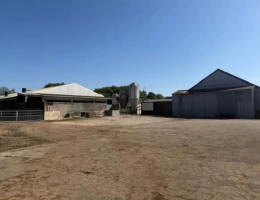
The Breton stock is the country's largest and also its most uneven: fully slatted houses built in successive waves, rooms refurbished through upgrading programmes, and a few straw-bedded or outdoor units tied to specific quality schemes. Buyers inspect the farrowing house, the weaner rooms and the finishing house separately: pens and floors, under-slat pits, drainage, forced ventilation and its control, heating, liquid or dry feeding, automation and alarms. They then assess the slurry store, whether it is covered, any treatment plant, the loading bay, the biosecurity entry room and the on-farm feed mill where one exists.
Compliance with group housing for gestating sows, the date of the last refurbishment and the occupancy rate of the places explain most of the price gap between two neighbouring sites. The sow herd is valued separately, on health status, genetics, average parity of the sows and batch management. Where the holding includes a dwelling house and land, have an item-by-item breakdown drawn up: a buyer who takes a farm as a single block loses negotiating arguments and complicates the funding.
Côtes-d'Armor (22) lies at the heart of the system: the centre of the department, around Loudéac and the Mené hills, and the north-east, around Lamballe, combine a high density of units with slaughtering and processing facilities and feed mills, which shortens every journey. It is also at Plérin that the quotation used as a reference across the sector is set. Finistère (29) spreads its production between the Léon, the Landivisiau area and the surroundings of Châteaulin, with holdings that often combine pigs, poultry and vegetables; land tightens noticeably as you approach the coast and the vegetable-growing belt.
Morbihan (56) forms the second regional pole: the centre of the department, from Pontivy to Locminé and towards Josselin, brings together farrow-to-finish units, producer groups and maize acreage, on land cheaper than in the east of the region. Supply is steady there, with complete holdings including the dwelling house, the buildings and the land used for spreading. Towards the coast and the gulf, pig units thin out, residential pressure limits extensions and land prices become a real obstacle to a livestock project, which pushes buyers back towards the interior.
Ille-et-Vilaine (35) shows the most mixed profile: the Vitré country, the Fougères area and the north of the department hold pig units backed by a dairy herd or by arable crops, while proximity to Rennes pushes land prices up and makes genuinely transferable sites scarce. Across the region as a whole, handovers remain numerous in the centre and far rarer on the coastal and peri-urban fringes. A buyer is therefore better served by thinking at the scale of central Brittany than by confining the search to a single department, even if that means visiting sites either side of an administrative boundary.
Most Breton units work with a producer group that organises collection of the animals, sometimes feed supply and, under an integration contract, ownership of the stock itself. That economic architecture is part of what is being sold: ask about the remaining term, the conditions for transfer to the buyer, volume commitments and the organisation's investment policy. A technically excellent site deprived of a stable outlet loses value fast, whereas an average building well anchored in a supply chain finds a buyer without difficulty.
The density of downstream facilities is the region's lasting advantage: abattoirs, cutting plants, curing houses and feed manufacturers all lie a short distance away, which lightens haulage costs and eases access to slaughter slots for a fattening farm. Quality schemes come on top, whether label rouge, outdoor rearing, organic farming or antibiotic-free chains, and support the price, provided the buyer can shoulder the technical constraints and the record-keeping they involve.
No check matters more here than the administrative status of the site. Depending on numbers, the unit falls under declaration, registration or authorisation as a classified installation, and a change of operator is notified to the prefecture. Ask for the prefectural order, any supplementary orders and the inspection history. Since the region is designated a nitrate vulnerable zone, with reinforced measures in the catchments affected by green algae, spreading capacity often becomes the real limit on developing a unit, well before the places available in the buildings.
Biosecurity deserves equal attention: separation of public and professional zones, entry room, a compliant loading bay, rendering arrangements, visiting and delivery protocols. Being close to other units raises the health risk and justifies an audit before making an offer. Legally, the rural lease continues with the buyer subject to the landlord's agreement, the deal goes through the structures control, the French authorisation regime for taking over farmland, and SAFER, and a GAEC, a joint farming company, may be handed over through a transfer of shares.
Retiring owners, rural estate agencies and Breton notaries entrust their mandates to this page. Select the type of unit, the capacity or the attached acreage, put an alert in place to follow each new listing, and if your search remains broad, browse all the farms for sale in Brittany.