

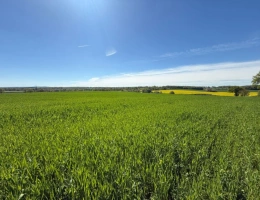
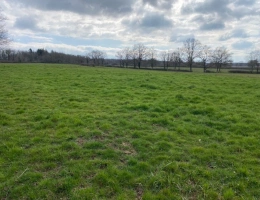
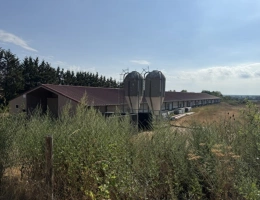
When we list a sheep farm for sale in Allier, we mean a working unit handed over with its ewes, its buildings and its grassland, not a stone fold restored as a house: saying so early saves pointless viewings. The Bourbonnais is grass country first, dominated by suckler cattle, where sheep take the free-draining fields, the slopes and the farms that have added a second enterprise. The properties shown are entrusted to us by farmers arranging their succession, by firms specialising in rural property and by local notaries, with flock numbers, area and management set out. They take their place among the sheep farms for sale we list nationwide.
This page adds what really settles a purchase: the level of land values in the Bourbonnais, the districts still releasing holdings, how to read a building and its handling equipment, and the checks to run before signing. Anyone preparing a setting-up file will find the steps laid out in our white paper « Créer une exploitation agricole » (in French).
Land weighs heavily on the budget for a sheep farm. Transfers published by the French tax authorities (DVF, excluding vineyards) put the median for farmland in Allier (03) at €3,520/ha in 2025, with an average of €4,174/ha over 239 sales. Eight transactions in ten settle between €2,503 and €7,154/ha, where the national median is €5,307/ha.
A second reference, the SAFER land value benchmark, sets vacant land and pasture at €4,220/ha for 2025, +1.2% in a year and +13.1% over a decade; the French average is €6,460/ha, and a sitting tenant costs a plot roughly 17% of its value.
Two farms of identical area rarely fetch the same price. The gap sits in the sheep house and its wintering capacity, in the bedded area available at lambing, in the handling race and loading dock, in the grass harvesting machinery and in the forage held in store. Add the value of the flock and its health status, the network of fences and water points, and how steadily the lambs are sold. Place each item using our land price observatory, then test the plan in our financial calculators.
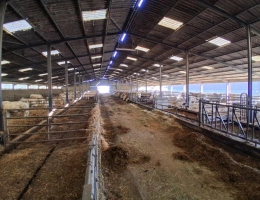
Many sheepfolds here are former cattle byres or bocage barns converted for the purpose, with a storage shed alongside. The first look goes to air volume and ventilation, since winter damp harms ewes far more than cold, then to the height under the roof trusses, which decides whether bedding and mucking out can be done by machine. Check the feed passage, the feed barrier spaces, the area set aside for lambing pens, the turnover and weigh crates, and whether the tracks stay passable once they take up water. Hay and straw kept under cover count as much as hectares do.
The ewe flock is valued in its own right: ewe and ram numbers, lowland meat breeds and terminal crosses, average age, breeding results, how lambing is spread through the year. Ask for a list of the machinery included, shearing gear, feeder wagon, bale handler, electric fencing and the field water system. Where a sheep holding comes with the farmhouse and its outbuildings, ask for an item-by-item breakdown: rural housing sells readily here, and the residential share weighs heavily on the asking price.
The Bourbonnais bocage, from Bourbon-l'Archambault to Cérilly and towards Le Montet, remains the grassiest part of the department: permanent pasture bounded by hedges, complete farmsteads, but direct competition from Charolais suckler herds for the same fields. To the north-east, the Sologne bourbonnaise around Dompierre-sur-Besbre and Le Donjon mixes woodland, ponds and lighter soils where sheep make use of moderate ground. Eastwards, the Montagne bourbonnaise, from Le Mayet-de-Montagne to the edge of the Forez, offers slopes, upland grazing and hay meadows suited to a hardy system, at lower prices per hectare.
The Allier valley and the arable plains from Varennes-sur-Allier to Saint-Pourçain-sur-Sioule leave little room for livestock: ploughable land is sought after and trades at levels grass cannot repay. The Combraille bourbonnaise, south-west of Montluçon, offers the opposite, modest units often sold with a dwelling in a landscape of small valleys. Around Vichy and Moulins, residential demand lifts the price of farmsteads near the towns.
Taking over a working flock starts with the holding register, electronic identification, veterinary reports and the abortion history; as bluetongue circulates regularly in mainland France, ask the seller about the vaccination policy and about any movement restrictions endured. The building normally falls under the departmental health regulations rather than the classified installations regime, but siting, distances to dwellings, manure storage and yard washings remain supervised, especially near villages and catchments.
On land, a large share of the area here is farmed under tenancy: read the rural leases, their remaining term and the landlord's position before making an offer. The sale passes through the structures control, the French authorisation regime for taking over farmland, then through the pre-emption right of SAFER, the rural land agency, very active here. Have the transfer of payment entitlements, the eligibility of each block and the conditions for the ewe premium confirmed, along with the less-favoured-area classification of the eastern communes.
What you see here reaches us from farmers selling for themselves, from rural estate agencies based in the bocage and from notarial offices across the department. Select on grassland area, on budget or on flock size, then ask to be told of new listings. Arranging your own handover? Send us the details. Widen your search afterwards to sheep farms for sale in Auvergne-Rhône-Alpes.


