


A sheep farm for sale in Auvergne-Rhône-Alpes means, on this page, a working livestock unit — buildings, flock and grazing — rather than an old sheepfold converted into a house, a distinction worth making since the same search covers two very different projects. The region carries almost every French sheep system, from alpine transhumance to flocks run on the volcanic plateaux of the Massif Central. Properties reach us from farmers organising their handover, from rural land specialists and from notaries, and they set out flock size, breed, grassland area and how the buildings are equipped. All of them sit within our national listing of sheep farms for sale.
Beyond the listings you will find what actually shapes a purchase: grassland and rough grazing values department by department, the areas where ovine handovers come up most often, how to read a livestock building and its bedded pen, and the checks specific to pastoral farming. If you are setting up, our white paper « Créer une exploitation agricole » (in French) walks through the administrative and financial route.
Land weighs heavily on the budget for a sheep farm. Transfers published by the French tax authorities (DVF, excluding vineyards) put the median for farmland in Auvergne-Rhône-Alpes at €3,887/ha in 2025, with an average of €4,786/ha over 1,230 sales. Eight transactions in ten settle between €2,161 and €8,738/ha, where the national median is €5,307/ha.
A second reference, the SAFER land value benchmark, sets vacant land and pasture at €5,100/ha for 2025, +4.9% in a year and +3.7% over a decade; the French average is €6,460/ha, and a sitting tenant costs a plot roughly 17% of its value.
Past the hectares, what is actually paid for is the coherence of the whole: the size and headroom of the sheepfold, bedded areas and feed passage, handling pens and a loading race, a sheep milking parlour where the unit is dairy, and storage for hay and straw. Then come the ewe flock and its rams, fencing and water points out on the grazing, access to summer pasture and the outlets already in place. Frame those values with our land price observatory, then test your figures with our financial calculators.
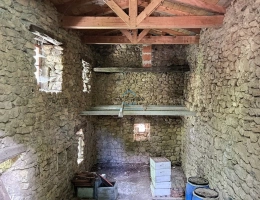
Sheep housing here runs from the small stone sheepfold built against a slope, still common in the mountains, to open timber-and-steel sheds sized for batch lambing. Look at ventilation, the usual weakness of older buildings, at headroom, since it governs how easily bedding is cleared out, at floor bearing and at the width of the feed passage. A complete handling system — drafting race, turnover crate, loading ramp — changes the daily workload more than any other detail. Where the unit milks, the parlour and the bulk tank call for an appraisal of their own.
The animals are valued apart from the land. Ask for the age profile of the ewes, the lambing pattern, prolificacy and mortality figures, the health status of the flock and how rams are replaced. Specialist equipment — feeder wagon, bedding machine, field troughs, electric netting, shearing gear — should be inventoried item by item. Where the sale bundles the farmhouse, the buildings, the land and the stock, insist on a written breakdown: a sheep holding is not assessed like a country house, and lenders apply different rules to each.
Savoie (73) and Haute-Savoie (74) live by the mountain calendar: flocks going up in summer, grazing agreements with communes and pastoral groups, valley sheepfolds standing on land pushed up by housing and tourism. Isère (38) extends the same pattern across the Vercors, the Trièves and the Oisans, with holdings that pair meadows cut for hay with upland grazing. Drôme (26) brings together the Drôme hills, the Diois and the Baronnies, where sheep use slopes no plough could work, often under organic certification. Ardèche (07) sits close to that model, with fragmented holdings and buildings that need work.
Cantal (15) runs its ewes on the planèzes and on summer pasture shared with cattle, and takeovers there remain among the most affordable in the region. Puy-de-Dôme (63) spans the Sancy, the Cézallier and the Combrailles, with the Rava breed tied to the Monts Dore. Haute-Loire (43) is the densest sheep department in the Auvergne: the Noire du Velay and the Blanche du Massif Central carry large flocks over the Velay and Devès plateaux, and holdings change hands regularly. Allier (03) follows a different logic, that of the Bourbonnais bocage: hedged fields, generous grass, large holdings and land still within reach.
Loire (42) keeps its flocks in the Monts du Forez, the Pilat and the high moorland, on steep fields that limit machinery. Rhône (69) retains a few units in the Monts du Lyonnais and the Beaujolais, where vineyards and the Lyon conurbation lift the price per hectare sharply. Ain (01) holds most of its sheep in the Bugey and the Revermont, the Bresse being given over to poultry and dairying. In short, supply is widest in Haute-Loire, Cantal and the mid-altitude country of Drôme and Ardèche, while prices bite hardest in Savoie and around Grenoble.
An ewe flock in this region rarely lives on owned land alone. It leans on rough grazing, communal alpine pasture and multi-year grazing agreements that do not pass automatically to a buyer. Check with the commune, the pastoral group or the land association who holds the use, for how long and under what stocking conditions. Moving up for the summer has its own logistics too: a track a vehicle can use, a hut, a water point, and either a shepherding contract or a seasonal hire.
Predation has become part of daily management in the Alps and is spreading into the Massif Central: guardian dogs, electrified netting and gathering the flock at night reshape the working day and the practical value of remote grazing. Ask the seller about the history of attacks recorded locally, about the dogs in place and whether they come with the farm, and about protective equipment already funded. How lambs are sold — through the long chain, under a quality label or direct to customers — and what becomes of the wool deserve the same scrutiny, as does self-sufficiency in hay.
The status of the grazing governs everything else: much of the grass is rented, the rural lease carries on with the incoming farmer subject to the landlord's agreement, and the deal goes through the structures control, the French authorisation regime for taking over farmland, while remaining open to SAFER's pre-emption right. On the building side, a sheep unit falls under the departmental sanitary regulations and moves into the classified installations regime above a certain headcount: have the classification confirmed, along with distances to dwellings and the handling of manure.
Then ask for a joint inventory of the stock, the forage and the machinery, together with the position on support: the ewe premium, the natural-handicap allowance, basic payment entitlements, agri-environment commitments and any organic certification each transfer under their own rules. Where the farm is held by a GAEC or an EARL, buying shares carries neither the same price nor the same tax treatment as buying the assets outright. The agricultural professional qualification must be secured before signature.
Three routes bring properties here: farmers selling directly, rural estate agencies acting under mandate, and notaries dealing with an estate. Narrow the list by department, by grassland area or flock size, by budget, and turn on an e-mail alert so a new sheepfold and its land reach you the day it appears. You can also open the search to every farm for sale in Auvergne-Rhône-Alpes.


