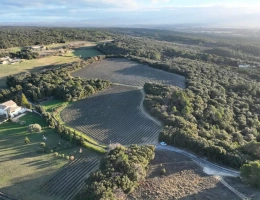
The market for a sheep farm for sale in Drôme splits in two: stone buildings restored as houses on one side and, on the side this page covers, working flocks passed on with their animals, their meadows and their rough grazing. The department sets an intensive valley plain, where land costs dearly, against pre-Alpine ranges on which pastoral farming remains the main use of space. The holdings we show are entrusted to us by shepherds stopping, by local rural agencies and by notaries, and they describe how the flock is run, what the buildings are and how much keep the farm really controls. They appear in our selection of sheep farms for sale.
Here is what the advert leaves out: what land, meadow and rough grazing are worth in the department, which valleys still see holdings change hands, how to judge a building built for Mediterranean summers, and the checks that go with farming dry mountain country. Our white paper « Créer une exploitation agricole » (in French) supports the building of a setting-up project.
Land weighs heavily on the budget for a sheep farm. Transfers published by the French tax authorities (DVF, excluding vineyards) put the median for farmland in Drôme (26) at €8,000/ha in 2025, with an average of €8,181/ha over 63 sales. Eight transactions in ten settle between €4,032 and €11,504/ha, where the national median is €5,307/ha.
A second reference, the SAFER land value benchmark, sets vacant land and pasture at €7,190/ha for 2025, +5.9% in a year and +0.1% over a decade; the French average is €6,460/ha, and a sitting tenant costs a plot roughly 17% of its value.
On a Drôme sheep holding, owned hectares tell only part of the story. What also counts is the fold and its ability to shelter stock through the heat, the water supply and storage, the pens, the fencing and the shearing gear, the genetic and health standing of the flock, the strength of the grazing agreements and of the summer mountain pasture, and the way lambs reach a buyer. Weigh those items with our land price observatory, then cost the takeover in our financial calculators.
Fabric mixes old masonry folds, low and cool but awkward to work with machinery, and open sheds put up more recently for lambing and hay. Climate drives the inspection: ridge height, available shade, air movement, and above all a dependable water source at the buildings and out in the pens, now a central question in the pre-Alpine valleys. Check forage storage capacity, since a dry summer forces reserves to be built, the bedded area that can be opened at lambing, the state of the drafting race and the loading dock, and the room to manoeuvre a stock trailer on mountain tracks.
The animals carry a large share of the value. Hardy pre-Alpine breeds dominate, often crossed for meat, and buyers look at the age of the ewes, how batches are run, how regular lambing is and the health record. Organic management is common in this department and keeping it means taking on the standard without a break. Where a ewe flock is sold with a farmhouse, land and stock, ask for a written breakdown: the residential value of old stone here frequently exceeds that of the working tool.
The Valence plain, the Drôme des Collines towards Romans-sur-Isère and Saint-Donat, and the Tricastin around Grignan leave few openings: orchards, seed crops, market gardening and vines push land beyond what a livestock farmer can follow. Supply concentrates in the hills. The Diois, from Crest to Die and on towards Châtillon-en-Diois, combines valley-floor meadows, slopes and wide rough grazing; the Drôme side of the Vercors, from the Royans to Vassieux-en-Vercors and Lus-la-Croix-Haute, brings summer pasture and hard winters, with farmsteads set lower down.
Southwards, the Baronnies Provençales, from Nyons to Buis-les-Baronnies and the Séderon country, show the most pastoral profile in the department: scrub, garrigue, upland grazing and woodland, mostly used under agreement rather than owned. Areas are wide but the feed they yield is limited, and complementarity with lavender, olives or apricots shapes many holdings. Summer transhumance to neighbouring mountain pastures remains usual: find out which pasture is used and on what terms the place is held.
Before buying, establish what the grazing actually rests on: multi-year agreements, membership of a pastoral group or a pastoral land association, permits over communal or state forest. Those rights do not follow the walls automatically and have to be renegotiated. Predation is the department's second subject: wolves are established here, with the protection measures that are expected, guardian dogs taken on with the flock, night pens, shepherding and the damage assessment procedure after an attack. That side of the job weighs on labour time and equipment.
Add drought and the sharing of water, which govern real stocking rates, the rules of the Vercors and Baronnies Provençales regional nature parks, and the prefectural orders on the use of fire. Buildings usually fall under the departmental health regulations, with distances to dwellings worth checking in tourist villages. On the land side, the sale passes through the structures control, the French authorisation required above certain thresholds, and through SAFER, the rural land agency; upland communes also qualify for the natural handicap allowance, to be confirmed one by one.
Shepherds selling direct, rural property firms and notarial offices from the valley and the Pre-Alps keep this page supplied. Narrow by the area held, by budget or by the way the flock is run, then set an alert, since a holding with solid grazing rights goes quickly. Handing yours on? Send us the listing. Carry on afterwards with sheep farms for sale in Auvergne-Rhône-Alpes.