

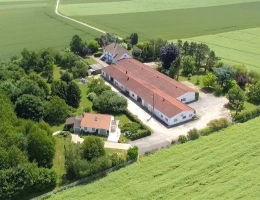
Looking for a market garden for sale in Seine-Saint-Denis means watching for openings that come up seldom: this is one of the most built-up departments in France, and cultivated ground survives only on a few fringes, chiefly in the north-east where Tremblay-en-France, Villepinte and their neighbours still touch the plaine de France. What comes on the market is therefore more often a micro-farm, an urban growing project or a former ornamental nursery than a conventional holding. When a file does reach us, it comes from a grower handing over, from a firm dealing in rural property or from a notary's office, and we publish it alongside the market gardens and nurseries for sale listed across the rest of the country.
Rather than waiting for a listing that may be slow in coming, treat this page as a bearing: land values recorded in the inner suburbs, the communes where growing ground remains, the kind of structures and premises you will actually find, and the checks a plot with an industrial past demands. To shape the project itself, our white paper « Créer une exploitation agricole » (in French) covers legal forms, available support and the working capital needed.
Land value drives much of the asking price for a market garden or nursery. This department has no rural communes in the statistical sense, so the figures below are those of the Île-de-France region. French tax transfer statistics (DVF, vineyards excluded) show, for 2025, a median of €7,465/ha in the region, an average of €7,932/ha and 214 sales; 80% of transactions settle between €5,253 and €10,940/ha, against a national median of €5,307/ha.
The SAFER benchmark is not compiled at this scale; use the national figures instead, €6,460/ha for vacant land and pasture and €5,350/ha for let land.
Land alone almost never makes the price here. What is paid for is secure long-term occupation, covered space in working order, a water connection and its drip lines, a compliant packing room, a modest cold store, sometimes a substrate or compost pad, and genuine goodwill: box-scheme subscribers, restaurants supplied week in week out, agreements signed with social landlords or local authorities. To place the farming element, open our land price observatory, then test your funding plan in our financial calculators.
The equipment you meet is compact. On the vegetable side: cold tunnels, a few multi-span houses, irrigation fed from the mains rather than from a borehole, a small cold store and a room where orders are made up. On the ornamental side, glass houses left over from older businesses survive, along with benching, a thermal screen that may be well past its prime, and container beds serving garden centres and landscaping crews. A plant nursery for sale is judged here on the quality of its watering, on how fast its stock turns over and on delivery access, which the surrounding street network often constrains.
Heating deserves separate scrutiny: the generator, its fuel, the consumption recorded over recent seasons, the tightness of the cover. An unregulated greenhouse business cannot grow the same range as a properly fitted one. Where a dwelling comes with the unit, as it often does on older nursery sites, insist on a written split of the price between house, buildings and equipment: in the inner suburbs residential value dominates, and your bank will not fund the two halves on the same terms.
The north-east of the department holds most of the open ground still capable of being farmed: around Tremblay-en-France and Villepinte a handful of parcels extend the plaine de France, while Coubron, Vaujours and Clichy-sous-Bois keep wooded edges and gardens. Along the Marne, towards Neuilly-sur-Marne and Noisy-le-Grand, managed open spaces leave room for small food-growing projects. The plateau d'Avron, between Neuilly-Plaisance and Rosny-sous-Bois, still carries the memory of the gardens that once fed Paris. Everywhere else the built fabric is continuous and farming has gone.
A buyer who needs acreage, a borehole and real production capacity should look to the outer ring: Val-d'Oise, Seine-et-Marne, Essonne, Yvelines and even southern Oise offer available land and complete holdings while staying within reach of the same markets, the same restaurants and the Rungis wholesale market. A vegetable farm or a smallholding bought there supplies customers in Seine-Saint-Denis without difficulty.
The department's industrial past calls for a precaution taken nowhere else: have the soil analysed before you commit, testing for heavy metals and hydrocarbons, and ask for existing survey reports and for the record of former industrial activity on the site. Made ground can rule out cropping in the soil altogether and push you towards growing in substrate, in raised beds or under cover. Then check the zoning in the local plan, whether permanent structures may lawfully be erected, and whether the greenhouses, sheds and sales rooms already standing were properly consented.
Tenure deserves the same care. Many urban sites run on a precarious occupation agreement, a long lease granted by a public body or a loan for use, all of them weaker than a French rural lease: read the remaining term, the renewal conditions and what happens to your investment at the end. The structures control, the French authorisation regime for taking over farmland, and SAFER's pre-emption right both apply despite the urban setting. Finally, if goodwill is being sold, have it itemised: subscriber list, market pitches, trading name, commitments to buyers.
Private vendors, rural property firms and local notaries feed this section; in a department this heavily built up, entries appear only now and then. The sensible move is to set an alert and widen the search area straight away instead of watching a single commune. Carry on, then, to market gardens for sale in Île-de-France, where the genuinely workable holdings are to be found.