

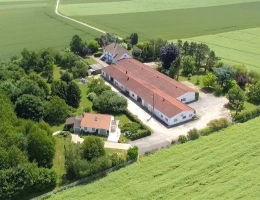
Finding a market garden for sale in Hauts-de-Seine is very much the exception: this is one of the most densely built departments in the country, and cultivated ground survives only in a few pockets. What actually changes hands is most often an ornamental site under glass, a plant nursery, a cultivable plot enclosed by the urban fabric, or a going concern sold with its customer base. These files reach us from the owners themselves, from agencies handling both commercial and rural property and from local notaries, with details of areas, installations and consents. They appear in our wider list of market gardens and nurseries for sale.
This page helps you read a market with no real equivalent: what ground is worth where farming use sits beside the city, the communes where plant production still survives, how to inspect glasshouses wedged into the built environment, and the legal points specific to a sale in a dense area. To shape your project, open our white paper « Créer une exploitation agricole » (in French).
Land value drives much of the asking price for a market garden or nursery. This department has no rural communes in the statistical sense, so the figures below are those of the Île-de-France region. French tax transfer statistics (DVF, vineyards excluded) show, for 2025, a median of €7,465/ha in the region, an average of €7,932/ha and 214 sales; 80% of transactions settle between €5,253 and €10,940/ha, against a national median of €5,307/ha.
The SAFER benchmark is not compiled at this scale; use the national figures instead, €6,460/ha for vacant land and pasture and €5,350/ha for let land.
Value is almost never read per hectare in this department. What counts is the use assigned by the planning document, any development potential, access and delivery logistics, the condition of the glass, the heating, the watering and the cold store, the sales area open to the public, and finally the goodwill and the clientele attached to the place. A greenhouse business backed by a shop and a steady order book compares with no ordinary farm parcel. Set these elements against our land price observatory and our financial calculators.
The installations met here are compact and often long established. You will come across glasshouses inherited from an ornamental trade once firmly rooted locally, supplementary tunnels, benching, sub-irrigation, a potting area, container beds and sometimes a room open for selling. Check the frame and the glazing, the heat generator, its fuel and its connection, the water and electricity supplies, the presence of asbestos on buildings of a certain age, how rainwater is handled and how much storage genuinely exists. On a site raising young plants, examine the standing stock in the ground and in containers as well.
Most of the value lies in the business rather than in the soil. A base of private customers, an order book from florists, a listing with landscapers or with municipal parks departments, a long-standing local reputation: that is the real asset. Ask for accounts covering several years, the split between own production and bought-in trade, and the share of sales made on site. If premises come with the activity, separate the property value clearly from the goodwill: the two follow quite different funding logics.
In the north, the Seine loop from Gennevilliers through Colombes to Nanterre long carried vegetable growing before industry, the port and housing took it over; little survives beyond urban farming schemes and a few converted sites. In the south, Châtenay-Malabry, Sceaux, Antony and Fontenay-aux-Roses still bear the mark of a celebrated ornamental tradition, recorded today in parks, arboretums and the green corridor. To the west, Rueil-Malmaison, Garches, Vaucresson and Marnes-la-Coquette border wooded land and open, through the neighbouring Yvelines, onto the Versailles plain.
In such a setting, the search is rarely confined to the department alone. Many buyers keep their outlet in the capital, markets, shops, boxes delivered in town, while placing production further out where land remains within reach. Conversely, a plant trading business, a nursery or a garden centre keeps its full sense here, carried by population density and by orders from public bodies.
The first examination bears on the planning document: how the parcel is zoned, building rules, reserved sites, development schemes and easements. Ground currently cultivated may be earmarked for another use, which changes both its value and your prospects entirely. In a department shaped by a long industrial history, soil quality deserves genuine attention: ask for any surveys available, trace how the site was occupied over time and, where doubt remains, have analyses carried out before committing, particularly for anything grown for food.
Legally, a sale bearing on farmland remains subject to the structures control, the authorisation required before farming, and SAFER may exercise its pre-emption right, periurban areas included. Where the deal includes goodwill and a commercial lease, the rules differ from those governing a rural lease: have the nature of the contract precisely established. Finally check where the water comes from, the connection and its cost, the consents attached to the glasshouses, and the conditions for access and deliveries in a dense environment.
What is gathered here comes from private owners, from property professionals and from notarial offices in the department; such offers are few and go quickly. Save an alert so you hear as soon as one is published, set the area and the budget that suit you, and carry your watch on to the market gardens for sale in Île-de-France.