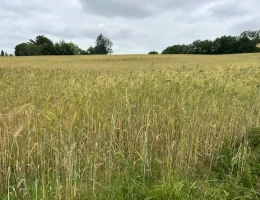
Looking for farms for sale in Gers means looking at one of the most diversified farming departments in south-west France: mixed crop-and-livestock holdings sit alongside arable farms on the clay-limestone ridges, fattened duck and poultry units, the Armagnac vineyard, and one of the densest networks of organic farms in the country. The properties shown here are entrusted to us by farmers organising their handover, by agencies specialising in rural property, by local notaries and by succession advisers. Each listing states the usable agricultural area, the soil type, whether the land is owned or let, the condition of the buildings and the working assets included. They belong to our national picture of farms for sale in France.
Beyond the listings, this page gathers what decides a purchase: what land is actually worth here, where supply comes up, which productions shape the department and what to verify before signing. If your project is still at the idea stage, our white paper « Créer une exploitation agricole » (in French) sets out the legal and funding steps.
Land forms the base of a farm's value. DVF, the property sales database published by the French tax administration (vineyards excluded), records a 2025 median of €6,897 per hectare in Gers (32), an average of €6,763 and 248 sales; four transactions in five fall between €4,063 and €9,500, against a national median of €5,307.
The SAFER land value benchmark sets €7,100 per hectare for vacant land and pasture offered for sale in the same year, -2.1% over one year and +6.4% over ten, against €6,460 nationally. SAFER publishes no local figure for let land, too few sales being recorded; nationally, land sold with a farm tenancy in place trades at a discount of about 17%.
Against the Occitanie region, whose median is €7,015 per hectare, this department sits 2% lower. For commune-level detail and comparisons with neighbouring areas, see our land price observatory, then cost your purchase with our financial calculators.
Gers cannot be reduced to one production. Arable holdings dominate the clay-limestone ridges of the north and east, with durum wheat, sunflower, oilseed rape and irrigated maize wherever water is secured. Mixed farming remains the most common model, combining cash crops, forage area and a livestock enterprise; it is also the most accessible entry point for a first purchase. Units producing fattened ducks and free-range poultry, backed by well-established quality schemes, sit on small areas and shift value from the land towards the building and the contract.
Add a vineyard geared to brandy and regional wines, sheep and beef enterprises on the southern slopes, and a strong organic sector: a working farm already certified saves the buyer the conversion period, and that premium shows in the price. On a diversified holding, ask for the split between cash crops, the livestock enterprise and any processing or direct-selling activity — those three blocks are not financed the same way.
The Lomagne, to the north-east around Lectoure and Fleurance, is the country of deep soils, white garlic and melon, with frequently irrigated arable structures and some of the dearest land in the department. To the west, the Bas-Armagnac and the Ténarèze, around Eauze, Nogaro and Condom, mix vines, duck units and mixed farming on tawny sands and boulbène soils. The centre, around Auch and Vic-Fezensac, offers the most balanced profile. To the south, the Astarac and the Rivière-Basse, more rolling, belong to livestock and grassland systems, with noticeably lower entry prices.
To the east, the Savès and the approaches to L'Isle-Jourdain feel the pull of the Toulouse conurbation: land is contested, parcels rarely lie in one block and residential competition is real. Most opportunities therefore sit along the central and southern diagonal of the department, where area comes free more readily and where an agricultural property stays within reach of a buyer who is not starting from an inherited estate.
In a department where irrigation makes the difference between a secured maize crop and a yield left to the weather, the water file comes first: where the resource comes from, whether the holding is connected to the network fed from the Neste system, whether a hillside reservoir is declared and a borehole authorised, what volumes are allocated and what restrictions were imposed during recent low-flow periods. A farm without a secure resource does not compare with a served one, even at identical area and soil.
Then come the three filters, which should not be confused. SAFER is notified of the sale by the notary and holds a pre-emption right. The authorisation to farm falls under structural control and the Occitanie regional farm structure plan, whose thresholds and priorities are assessed department by department. Finally, let land stays occupied by its tenant, who holds a priority right to buy: that is the first point to have verified, because it determines how much land your project can actually use.
Retiring farmers, rural estate agencies and notaries in Gers list their properties here as handovers come up. Narrow your search by production, area, budget or district, then set up an e-mail alert so a matching property reaches you the day it is listed. To widen the search, browse farms for sale in Occitanie.