
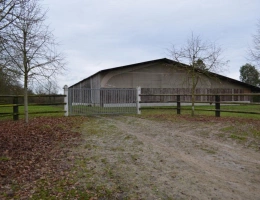
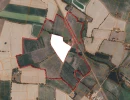

Taking over a goat farm for sale in Loire-Atlantique means settling in a department where caprine herds stay a minority next to cattle and vines, but where a dense population opens an unusually strong retail outlet. The properties gathered on this page come from breeders preparing to stop, from estate agencies specialising in rural land and from notaries in the Nantes country, the vineyard and the pays de Retz; they set out herd size, how the shed is designed, the milking equipment fitted, the forage area and the marketing route. You will find them again in our national selection of goat farms for sale.
This page adds what weighs in a purchase: the level of local farmland values, the districts where a caprine unit comes forward, the quality of buildings and milking equipment, and the checks attached to processing. Our white paper « Créer une exploitation agricole » (in French) sheds light on legal structures, permits and funding arrangements.
Land weighs heavily on the budget for a goat farm. Transfers published by the French tax authorities (DVF, excluding vineyards) put the median for farmland in Loire-Atlantique (44) at €2,200/ha in 2025, with an average of €2,476/ha over 380 sales. Eight transactions in ten settle between €1,596 and €3,533/ha, where the national median is €5,307/ha.
No SAFER land value is published for this territory, so the benchmark stays national: €6,460/ha for vacant land and pasture and €5,350/ha where a tenant is in place.
The price of a caprine unit never comes down to area alone: it rests on the shed and its ventilation, the parlour, the bulk tank, the storage buildings and effluent works, to which a farmhouse enterprise adds the make room, the drying room, the cellar and the selling space. The animals, their breeds, their health record and how replacements are reared complete the inventory, as do the nature of the outlet and the quality of the access. Measure the whole against our land price observatory and our financial calculators.
Many caprine enterprises here have moved into buildings designed for cattle or into converted farm sheds, which makes it essential to examine the headroom, the width of the bedded areas, where the feed passage runs and how much air actually moves under a mild but damp climate. Damp calls for checks on air intake, roof drainage and the keeping quality of stored forage. The visit then takes in the milk line, its washing system, its metering, the tank capacity, and finally the slurry store and muck pad, whose compliance sets the works budget.
A processing unit changes the equation: make room, drying room, ripening cellar, cold store and shop are valued on the approval held, on volumes and above all on the customer base built up, which is robust within reach of Nantes and the coast. A herd that delivers is assessed differently, on the regularity of collection and the clauses of the contract. As soon as a dwelling, outbuildings and land make up the property, ask for a breakdown of the price: residential pressure runs high right across the department.
The north-east of the department, around Châteaubriant, Nozay and Derval, offers the most affordable grass and livestock buildings, in hedgerow country that is still well knit. The Ancenis country and the Loire slopes carry mixed holdings where a caprine enterprise often sits alongside another activity. The pays de Retz, from Machecoul to Sainte-Pazanne and out to the edges of the marais breton, combines meadow, crops and medium-sized farms. The communes of the Nantes vineyard around Vallet and Clisson, and the belts around Nantes and Saint-Nazaire, keep their land for vines, building and market gardening, at noticeably firmer values.
No caprine cheese designation applies across this territory: value comes from regional collection, from a strongly established organic sector and from direct selling, supported by the markets of Nantes and Saint-Nazaire and of the coastal resorts, by producers' shops and by community box schemes. That urban demand is the chief asset of a farm that makes cheese, but it also lifts the price of properties near the conurbations.
By herd size, a caprine unit falls under declaration, registration or authorisation within the French classified installations regime, with any change of operator notified to the prefecture, while smaller herds remain subject to the departmental health regulation and its distances from neighbours. Wetlands, numerous in the pays de Retz as around the Brière, make it necessary to check easements, the rules governing upkeep of parcels and any agri-environmental commitments still running. Ask as well where the water comes from, whether an abstraction permit exists and which summer restrictions applied recently.
The herd's health status is documented through CAEV monitoring, the caprine arthritis-encephalitis virus, paratuberculosis screening and cell counts; where milk is processed, the food safety plan, the approval or derogation covering direct supply and the self-monitoring results should all be handed over. An organic conversion is verified with the certifying body. Rented parcels stay under a rural lease, which continues with the buyer once the landlord agrees, and the deal passes through the structures control, the French authorisation regime for taking over farmland, then through SAFER, much called upon here.
The sales gathered here are entrusted by private owners, rural estate agencies and notarial offices in Nantes, Ancenis and Châteaubriant. Select on area, on budget or on how the milk is marketed, then trigger an e-mail alert: buyers here outnumber the holdings put on the market. Is your own unit changing hands this year? Post the listing. From there, run through the goat farms for sale in Pays de la Loire.