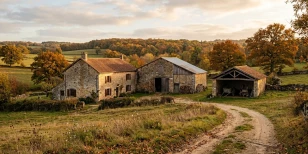

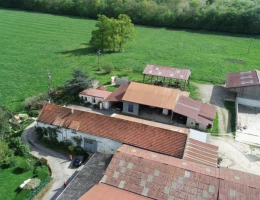
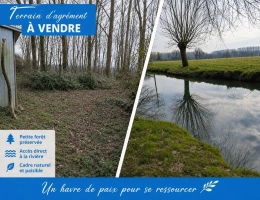
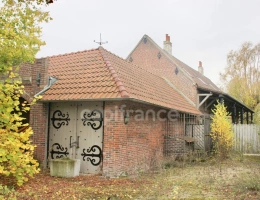
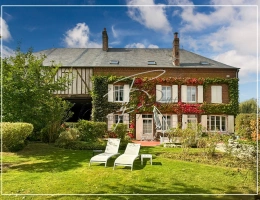
Finding a mill for sale in Hauts-de-France means looking at one of the last regions in France where windmills are still part of the landscape, alongside watermills along the Somme, Authie and Canche valleys. On this page, ma-propriete.fr brings together the mills for sale in Hauts-de-France: Flanders windmills to restore, Picardy watermills at the bottom of valleys, former flour mills and millers' houses.
You will also find price benchmarks based on actual sales, an overview of the areas by department, and the specific points to check before buying a mill. To prepare your project, read our white paper on setting up a rural gîte, useful for converting a mill's outbuildings.
There are no official statistics dedicated to mills: sales are too rare and too varied (a ruin to restore, a habitable mill, a flour mill with a turbine). The most reliable market benchmark remains the price of country houses, which a habitable mill resembles, with a premium for the water, the character and the water rights, and a discount for the work required.
How much does a country house cost in Hauts-de-France? According to DVF data (notarised sales) analysed by the ma-propriete.fr observatory, the median price of a country house in Hauts-de-France stood at €175,000 in 2025, with an average price of €183,979 and a median price of €1,686/m² of living space (11,950 house sales in rural municipalities over the year). 10% of houses sold for less than €90,000 (floor price, 1st decile) and 10% for more than €290,000 (ceiling price, 9th decile). The typical country house offers 108 m² of living space on an average plot of 1,942 m², i.e. around 0.2 ha.
The region is below the national median (€189,200). Since the second half of 2020, the regional median price has risen from €164,000 to €175,000, i.e. +6.7%; over one year (2024-2025) the change is +2.9%.
| 2025 indicator | Hauts-de-France | France |
|---|---|---|
| Median price | €175,000 | €189,200 |
| Average price | €183,979 | €207,100 |
| Floor price (1st decile) | €90,000 | €90,000 |
| Ceiling price (9th decile) | €290,000 | €340,000 |
| Median price per m² of living space | €1,686/m² | €1,830/m² |
| Average living space | 108 m² | 108 m² |
| Average plot size | 1,942 m² | 3,181 m² |
| Number of sales in 2025 | 11,950 | 150,313 |
Differences between departments are significant: the median ranges from €139,000 in Aisne (02) to €200,000 in Oise (60). The table below compares 2025 prices and their change since 2020.
| Department | Median price 2025 | Average price 2025 | Median price per m² | Change 2020-2025 | Sales 2025 |
|---|---|---|---|---|---|
| Aisne (02) | €139,000 | €142,076 | €1,356/m² | +6.9% | 2,139 |
| Nord (59) | €192,000 | €202,949 | €1,729/m² | +6.7% | 2,388 |
| Oise (60) | €200,000 | €206,280 | €2,034/m² | +0.0% | 2,530 |
| Pas-de-Calais (62) | €186,000 | €195,185 | €1,747/m² | +12.7% | 2,578 |
| Somme (80) | €159,000 | €166,279 | €1,565/m² | +9.7% | 2,315 |
A regional average also hides large gaps between municipalities. A smallholding to renovate, a restored longère with its outbuildings, a farmhouse on several hectares of land or a manor house with parkland do not sell at the same price, and the location matters as much as the building: coastline, tourist area, peri-urban countryside close to a job market or deep countryside. The table below shows the median price of country houses in Hauts-de-France by type of municipality (cumulative sales from mid-2020 to 2025) and its change between 2021 and 2025.
| Type of municipality | Median price 2020-2025 | Median price per m² | Change 2021-2025 | Sales 2020-2025 |
|---|---|---|---|---|
| Tourist coastline | €215,000 | €2,324/m² | +14.1% | 990 |
| Residential coastline | €190,000 | €1,980/m² | +14.5% | 547 |
| Inland tourist areas (hinterland, mountains) | €155,000 | €1,580/m² | +12.0% | 337 |
| Peri-urban countryside (city catchment area) | €187,000 | €1,792/m² | +2.2% | 47,512 |
| Deep countryside (outside urban influence) | €140,500 | €1,380/m² | +7.6% | 22,233 |
These benchmarks help you assess a listing, estimate a property before putting it up for sale, or set your budget, whether you are looking for a holiday home, a permanent move to the French countryside or a property to turn into a rural gîte. To go further, see our observatory of country house prices in France (national, regional and departmental analysis, downloadable annual report) and work out the full cost of your purchase, including French notary fees, with our notary fees calculator.
Nord and part of Pas-de-Calais keep a tradition rare in France: the windmill, inherited from the windy plains of Flanders and Artois (around Cassel, Le Cateau-Cambrésis and the Audomarois). Few of these mills remain in a sellable state, but some restored former windmills or their adjoining houses occasionally come onto the market. Along the Somme, Authie and Canche rivers, it was watermills that dominated instead, driving flour mills in the wide, marshy Picardy valleys. Some of these Picardy watermills were also once used for pressing rapeseed oil, a traditional crop of the Santerre and Vermandois plains.
In Oise, the Thérain, the Automne and the Oise itself powered numerous flour mills, often built of brick and limestone, typical of the Beauvaisis and Valois areas. Pas-de-Calais also has mills on the Liane, Course and Aa rivers, between the Boulonnais bocage and the Artois plain. Some of these mills also kept traces of an older river-trade activity, before the arrival of the railway reduced its importance. A handful of these mills also still show traces of their original grinding stones, a detail worth checking during a visit.
The Somme valley, between Amiens, Abbeville and the Somme bay, offers the widest choice of watermills, with easy access via the Haute-Picardie TGV station. The Authie and Canche valleys, between Hesdin and Montreuil-sur-Mer, attract buyers seeking calm close to the coast. In Nord, the area around Cassel and the Flanders hills remains the most iconic for a former windmill or its house, not far from Lille and Dunkirk. The Lille-Europe TGV station also gives quick access to Paris and Brussels from the northernmost parts of Nord.
The closer you get to Lille, the Opal Coast or Compiègne, the higher the price for character properties. Conversely, rural Aisne around Laon, Vervins and the Thiérache, as well as the Cambrésis area, remain among the most affordable parts of Hauts-de-France for a mill to renovate. The Bray area, straddling Oise and Seine-Maritime, also offers a few isolated mills at intermediate prices. A local surveyor familiar with the region's mills can also help estimate restoration costs before an offer is made.
A watermill is bought together with its water: check the water rights (a mill fondé en titre or holding an authorisation), the condition of the millrace, the weir and the sluice gates, and the ecological-continuity obligations on classified Picardy rivers. For a windmill, the main issue is usually the tower structure, the timber frame and the drive mechanism, which is often incomplete. A hydroelectric project (a turbine on a watermill) requires a prior study with the relevant authorities. The local planning authority can usefully provide the administrative history of the water rights attached to the property.
The Somme and Authie valleys are partly in flood zoning or marshland: check this point systematically, along with drainage. Outbuildings (miller's house, shed, drying room) often make it possible to plan a gîte, an activity in demand close to the coast and the Somme bay. Finally, check the condition of the roof and joinery, which are often tested by the damp, windy climate of both the coast and the inland areas.
On ma-propriete.fr, mill listings in Hauts-de-France are published by private sellers, estate agents and notaries. Filter by budget, living space and land area, set up an email alert to be told of new listings, and browse all rural properties for sale if your search extends beyond mills. Do not hesitate to compare several properties before committing, since supply of this type of heritage property remains limited.