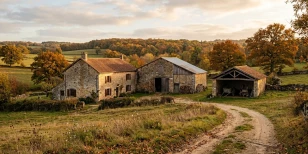

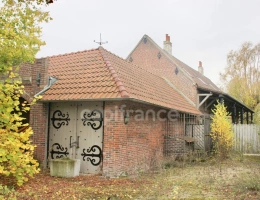
A mill for sale in Nord (59) can be either a windmill from the Flemish plain or a former watermill from the Scarpe, Escaut or Lys valleys: the department combines both traditions, with a strong identity for the windmills of the Cassel area and inland Flanders. On this page, ma-propriete.fr brings together the mills for sale in Nord: a windmill to restore, a former watermill or a miller's house with outbuildings.
You will also find price benchmarks based on actual sales, an overview of the areas where these properties are concentrated, and the specific points to check before buying a mill. To prepare your project, read our white paper on creating a rural gîte, whose advice also applies to converting a mill. Technical surveys (roof timbers, mechanism, utilities) remain an essential first step before costing a restoration budget for this type of property.
There are no official statistics dedicated to mills: sales are too rare and too varied (a ruin to restore, a habitable mill, a flour mill with a turbine). The most reliable market benchmark remains the price of country houses, which a habitable mill resembles, with a premium for the water, the character and the water rights, and a discount for the work required.
How much does a country house cost in Nord (59)? According to DVF data (notarised sales) analysed by the ma-propriete.fr observatory, the median price of a country house in Nord (59) stood at €192,000 in 2025, with an average price of €202,949 and a median price of €1,729/m² of living space (2,388 house sales in rural municipalities over the year). The price range is wide: 10% of houses sold for less than €94,560 (floor price, 1st decile) and 10% for more than €326,720 (ceiling price, 9th decile). The typical country house here offers 116 m² of living space on an average plot of 2,233 m², i.e. around 0.2 ha.
This market is above the regional median (Hauts-de-France: €175,000) and close to the national median (€189,200). Since the second half of 2020, the median price has risen from €180,000 to €192,000, i.e. +6.7%; over one year (2024-2025) the change is -0.4%.
| 2025 indicator | Nord | Hauts-de-France | France |
|---|---|---|---|
| Median price | €192,000 | €175,000 | €189,200 |
| Average price | €202,949 | €183,979 | €207,100 |
| Floor price (1st decile) | €94,560 | €90,000 | €90,000 |
| Ceiling price (9th decile) | €326,720 | €290,000 | €340,000 |
| Median price per m² of living space | €1,729/m² | €1,686/m² | €1,830/m² |
| Average living space | 116 m² | 108 m² | 108 m² |
| Average plot size | 2,233 m² | 1,942 m² | 3,181 m² |
| Number of sales in 2025 | 2,388 | 11,950 | 150,313 |
A departmental average hides large gaps. A smallholding to renovate, a restored longère with its outbuildings, a farmhouse on several hectares of land or a manor house with parkland do not sell at the same price, and the location matters as much as the building: coastline, tourist area, peri-urban countryside close to a job market or deep countryside. The table below shows the median price of country houses in Nord (59) by type of municipality (cumulative sales from mid-2020 to 2025) and its change between 2021 and 2025.
| Type of municipality | Median price 2020-2025 | Median price per m² | Change 2021-2025 | Sales 2020-2025 |
|---|---|---|---|---|
| Inland tourist areas (hinterland, mountains) * | €189,500 | €1,501/m² | +53.6% | 34 |
| Peri-urban countryside (city catchment area) | €207,000 | €1,855/m² | +0.1% | 9,758 |
| Deep countryside (outside urban influence) | €157,837 | €1,447/m² | +2.7% | 3,733 |
* Between 30 and 99 sales: indicative value.
These benchmarks help you assess a listing, estimate a property before putting it up for sale, or set your budget for a holiday home or a permanent move to the French countryside. To go further, see our observatory of country house prices in France (national, regional and departmental analysis, downloadable annual report) and work out the full cost of your purchase, including French notary fees, with our notary fees calculator.
Nord is one of the few French departments where the windmill remains a living feature of the landscape: the Flanders plain, between Cassel, Steenvoorde and Hondschoote, exposed to winds from the Westhoek, once had dozens of post and tower mills grinding flour or pressing oil. Many are now run by associations or municipalities, but houses attached to former mill sites occasionally come onto the market. A few brick tower mills, still topped with their conical roofs, bear witness to this collective milling activity that long shaped the department's Flemish identity.
In the Scarpe, Escaut and Sensée valleys, around Douai, Marchiennes and Cambrai, there are more watermills and former industrial flour mills, inherited from the region's textile and milling past. The Lys, near Armentières, also carried several mills linked to flax weaving. The shift to red brick, the dominant material in Flemish building, clearly sets these mills apart from the stone ones of the neighbouring Cambrésis and Avesnois.
The Cassel area and inland Flanders, near Steenvoorde, Terdeghem and Hazebrouck, remain the reference territory for a property tied to windmill history. Along the Scarpe, between Douai and Marchiennes, and in the Cambrésis around Cambrai, former flour mills and watermills offer larger building volumes. Near Avesnes-sur-Helpe, in the Avesnois bocage, the Sambre and the Helpe Majeure also supported rural mills. The Deûle canal and the former mining basin, between Lens and Lille, add a few industrial former flour-mill sites suitable for conversion, less well known than those on the Scarpe.
The Lille metropolitan area and its immediate surroundings push up prices for well-located character properties, while the more rural Avesnois and Cambrésis remain more affordable for a mill to renovate. The Pévèle and Douaisis areas, between farmland and the former mining basin, also offer opportunities for character industrial buildings to convert.
For a watermill, check the water rights (fondé en titre or authorised), the condition of the millrace, weir and sluice gates, and the ecological-continuity obligations on Nord's canalised rivers. For a windmill, the main question concerns the structure itself (pivot, roof, sails) rather than water: preserved but unmaintained machinery represents a significant restoration cost before any hydroelectric or visitor project. Always ask the town hall for the latest available flood records, as the plains of Nord are regularly affected by groundwater rises.
The regional building style, in brick under slate or tile, should be checked for damp and foundation condition in sometimes flood-prone plain areas. Outbuildings attached to a former mill often allow for a gîte project, well suited to the proximity of the Lille metropolitan area and Belgium. It is also worth checking for any rights of way linked to the former collective use of the millrace, common with this type of rural property in Nord.
On ma-propriete.fr, mill listings in Nord are published by private sellers, estate agents and notaries. Filter by budget, living space and land area, set up an email alert to be told of new listings, and browse all mills for sale in Hauts-de-France if your search extends beyond the department. Do not hesitate to ask the agent or notary for the site's administrative history, particularly in the case of any past collective use of the millrace or water rights.