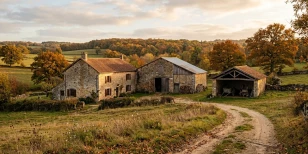

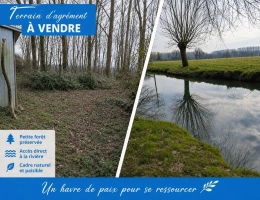
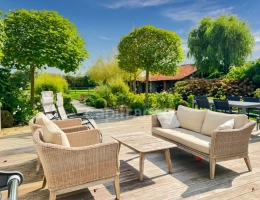
A mill for sale in Pas-de-Calais (62) can be found both in the valleys of the Boulonnais and Artois and on the polders of the coastal plain, where a few windmills once drained land reclaimed from the sea. On this page, ma-propriete.fr brings together the mills for sale in Pas-de-Calais: a watermill to renovate, a former windmill or a miller's house with outbuildings.
You will also find price benchmarks based on actual sales, an overview of the areas where these properties are concentrated, and the specific points to check before buying a mill. To prepare your project, read our white paper on creating a rural gîte, useful for making the most of a former mill's outbuildings. As with any mill, technical surveys (drainage, mechanism, utilities) are an essential first step before costing a works budget.
There are no official statistics dedicated to mills: sales are too rare and too varied (a ruin to restore, a habitable mill, a flour mill with a turbine). The most reliable market benchmark remains the price of country houses, which a habitable mill resembles, with a premium for the water, the character and the water rights, and a discount for the work required.
How much does a country house cost in Pas-de-Calais (62)? According to DVF data (notarised sales) analysed by the ma-propriete.fr observatory, the median price of a country house in Pas-de-Calais (62) stood at €186,000 in 2025, with an average price of €195,185 and a median price of €1,747/m² of living space (2,578 house sales in rural municipalities over the year). The price range is wide: 10% of houses sold for less than €102,000 (floor price, 1st decile) and 10% for more than €299,325 (ceiling price, 9th decile). The typical country house here offers 112 m² of living space on an average plot of 2,176 m², i.e. around 0.2 ha.
This market is above the regional median (Hauts-de-France: €175,000) and close to the national median (€189,200). Since the second half of 2020, the median price has risen from €165,000 to €186,000, i.e. +12.7%; over one year (2024-2025) the change is +6.3%.
| 2025 indicator | Pas-de-Calais | Hauts-de-France | France |
|---|---|---|---|
| Median price | €186,000 | €175,000 | €189,200 |
| Average price | €195,185 | €183,979 | €207,100 |
| Floor price (1st decile) | €102,000 | €90,000 | €90,000 |
| Ceiling price (9th decile) | €299,325 | €290,000 | €340,000 |
| Median price per m² of living space | €1,747/m² | €1,686/m² | €1,830/m² |
| Average living space | 112 m² | 108 m² | 108 m² |
| Average plot size | 2,176 m² | 1,942 m² | 3,181 m² |
| Number of sales in 2025 | 2,578 | 11,950 | 150,313 |
A departmental average hides large gaps. A smallholding to renovate, a restored longère with its outbuildings, a farmhouse on several hectares of land or a manor house with parkland do not sell at the same price, and the location matters as much as the building: coastline, tourist area, peri-urban countryside close to a job market or deep countryside. The table below shows the median price of country houses in Pas-de-Calais (62) by type of municipality (cumulative sales from mid-2020 to 2025) and its change between 2021 and 2025.
| Type of municipality | Median price 2020-2025 | Median price per m² | Change 2021-2025 | Sales 2020-2025 |
|---|---|---|---|---|
| Tourist coastline | €246,800 | €2,485/m² | +10.7% | 314 |
| Residential coastline | €200,000 | €2,016/m² | +23.4% | 350 |
| Inland tourist areas (hinterland, mountains) | €175,150 | €1,649/m² | +11.3% | 102 |
| Peri-urban countryside (city catchment area) | €190,000 | €1,766/m² | +7.6% | 9,577 |
| Deep countryside (outside urban influence) | €154,225 | €1,471/m² | +6.7% | 5,603 |
These benchmarks help you assess a listing, estimate a property before putting it up for sale, or set your budget for a holiday home or a permanent move to the French countryside. To go further, see our observatory of country house prices in France (national, regional and departmental analysis, downloadable annual report) and work out the full cost of your purchase, including French notary fees, with our notary fees calculator.
The Boulonnais and Artois, watered by the Canche, Authie and Liane rivers, carried many watermills for grinding grain, some of which operated as flour mills until the mid-20th century. Near Saint-Omer and the Audomarois marsh, the network of watergangs and the Aa canal also allowed for drainage and grinding mills. Some former mills in the Boulonnais kept their 19th-century metal wheel, which replaced the original wooden wheel during modernisation.
On the coastal plain, between Calais and the Belgian border, a few windmills completed this polder landscape, in keeping with the Flemish tradition also found in neighbouring Nord; they are however rare and often already protected or municipally owned. Window surrounds in locally quarried Marquise stone appear on several Boulonnais mills, a sign of carefully built structures.
The Canche valley, between Hesdin and Montreuil-sur-Mer, and the Authie valley near Doullens, concentrate former stone and brick mills in a preserved rural setting. The Saint-Omer area and the Audomarois marsh offer a distinctive landscape of canals and watergangs. Further south, Artois, around Arras and the Scarpe valley, retains former industrial flour mills. The Fruges area and the hillier Haut-Pays d'Artois also shelter a few isolated mills along small streams feeding the Canche.
Proximity to the coast, between Le Touquet and Montreuil-sur-Mer, pushes up prices for character mills, while inland Artois and the Ternois remain more accessible for a renovation project. The Ternois area, around Saint-Pol-sur-Ternoise, rounds out the offer with more modest farm mills, at prices noticeably lower than those on the coast.
Check the water rights (fondé en titre or authorised), the condition of the millrace, weir and sluice gates, and the ecological-continuity obligations on the Canche and Authie, classified salmon rivers. In the Audomarois marsh, water management also follows collective watergang rules that need to be understood before any hydroelectric or mechanism-restoration project. It is also worth checking the soil, which is clayey in some parts of Pas-de-Calais and can affect foundation stability at the bottom of a valley.
The building, in chalk, brick or flint depending on the area, should be checked for damp and flood zoning, common both at the bottom of valleys and on the coastal plain. Outbuildings often lend themselves to a gîte, an option in demand near the Opal Coast. Finally, check the planning rules applicable in marsh or polder zones, which can limit extensions or new outbuildings.
On ma-propriete.fr, mill listings in Pas-de-Calais are published by private sellers, estate agents and notaries. Filter by budget, living space and land area, set up an email alert to be told of new listings, and browse all mills for sale in Hauts-de-France if your search extends beyond the department. Do not hesitate to ask the agent or notary for the known flood history of the Canche or Authie before finalising your offer. A local surveyor familiar with coastal and valley mills can help estimate realistic renovation costs before an offer is made. Buyers should also factor in the cost of maintaining canal banks and marshland vegetation, a recurring task for properties near the Audomarois marsh, as well as ongoing upkeep of ageing sluice mechanisms found on several Boulonnais sites. Given how few tide-influenced mill sites remain in this coastal area, it is also worth acting quickly once a suitable property is listed.