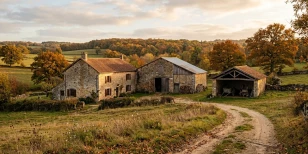

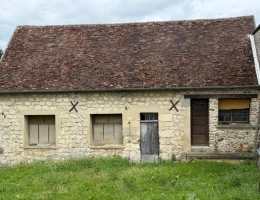
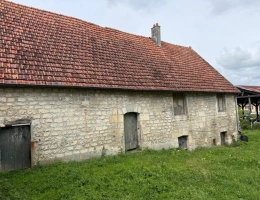
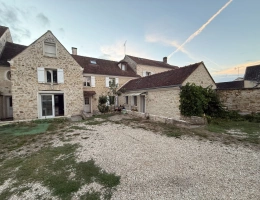
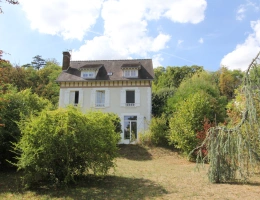
A mill for sale in Val-d'Oise (95) is mainly found in the valleys cutting through the Vexin français and the Oise valley, the only areas of the department where rural hydraulic buildings are still available on the market. The Viosne, Aunette, Esches and the Oise itself powered numerous watermills into the 20th century. Ma-propriete.fr brings together here the mills for sale in Val-d'Oise: restored or renovation-project watermills, former valley flour mills and millers' houses with outbuildings. A few former tanneries or paper mills converted from water power sometimes add to the supply of heritage-character properties.
This page also gives price benchmarks from actual sales, an overview of where these properties are concentrated, and the specific points to check before buying a mill in the outer Paris region. To prepare your project, see our white paper on setting up a rural gîte, useful for making the most of a former mill's outbuildings. These benchmarks apply equally to already-restored properties and to renovation projects, each with its own financial trade-offs. These figures reflect the wider variety of mill types found across the department, from small farmstead watermills to larger valley installations.
There are no official statistics dedicated to mills: sales are too rare and too varied (a ruin to restore, a habitable mill, a flour mill with a turbine). The most reliable market benchmark remains the price of country houses, which a habitable mill resembles, with a premium for the water, the character and the water rights, and a discount for the work required.
How much does a country house cost in Val-d'Oise (95)? According to DVF data (notarised sales) analysed by the ma-propriete.fr observatory, the median price of a country house in Val-d'Oise (95) stood at €333,000 in 2025, with an average price of €336,830 and a median price of €2,993/m² of living space (266 house sales in rural municipalities over the year). The price range is wide: 10% of houses sold for less than €220,750 (floor price, 1st decile) and 10% for more than €460,000 (ceiling price, 9th decile). The typical country house here offers 118 m² of living space on an average plot of 1,404 m², i.e. around 0.1 ha.
This market is well above the regional median (Île-de-France: €280,000) and well above the national median (€189,200). Since the second half of 2020, the median price has risen from €331,475 to €333,000, i.e. +0.5%; over one year (2024-2025) the change is +4.7%.
| 2025 indicator | Val-d'Oise | Île-de-France | France |
|---|---|---|---|
| Median price | €333,000 | €280,000 | €189,200 |
| Average price | €336,830 | €295,207 | €207,100 |
| Floor price (1st decile) | €220,750 | €171,000 | €90,000 |
| Ceiling price (9th decile) | €460,000 | €435,000 | €340,000 |
| Median price per m² of living space | €2,993/m² | €2,603/m² | €1,830/m² |
| Average living space | 118 m² | 116 m² | 108 m² |
| Average plot size | 1,404 m² | 1,590 m² | 3,181 m² |
| Number of sales in 2025 | 266 | 3,611 | 150,313 |
A departmental average hides large gaps. A smallholding to renovate, a restored longère with its outbuildings, a farmhouse on several hectares of land or a manor house with parkland do not sell at the same price, and the location matters as much as the building: coastline, tourist area, peri-urban countryside close to a job market or deep countryside. The table below shows the median price of country houses in Val-d'Oise (95) by type of municipality (cumulative sales from mid-2020 to 2025) and its change between 2021 and 2025.
| Type of municipality | Median price 2020-2025 | Median price per m² | Change 2021-2025 | Sales 2020-2025 |
|---|---|---|---|---|
| Peri-urban countryside (city catchment area) | €343,000 | €3,068/m² | -4.9% | 1,702 |
These benchmarks help you assess a listing, estimate a property before putting it up for sale, or set your budget for a holiday home or a permanent move to the French countryside. To go further, see our observatory of country house prices in France (national, regional and departmental analysis, downloadable annual report) and work out the full cost of your purchase, including French notary fees, with our notary fees calculator.
Val-d'Oise still has, in the Vexin français, a network of small rivers – the Viosne around Chars and Marines, the Aunette near Beaumont-sur-Oise, the Esches on the border with Oise – that fed a number of watermills and agricultural flour mills, often built of local limestone. The wide Oise valley, between Beaumont-sur-Oise and L'Isle-Adam, also carried larger industrial mills. The Vexin français regional nature park covers part of these valleys, with specific landscape rules that also apply to mill renovation projects.
Windmills, suited to the open Vexin plateau, are rarer but a few survive, notably around Théméricourt and Nucourt; there is no tide-mill tradition, the department being inland. These windmills, often restored for heritage rather than residential purposes, differ clearly from the watermill stock found elsewhere in the department. These are genuinely scarce properties, and most changes of ownership are handled through specialised heritage networks rather than the open market.
The Vexin français, around Marines, Chars and Théméricourt, offers the most rural and unspoilt setting, under an hour from Paris via the Pontoise or Chars stations. The Oise valley, between Beaumont-sur-Oise and L'Isle-Adam, combines historic buildings with direct rail links. The Persan and Oise-side area, more industrial in places, still has former mills converted for housing. Proximity to Cergy-Pontoise, the departmental capital, also allows a mill project to be combined with quick access to urban services.
The closer you get to the Oise valley and its direct stations to Paris, the higher prices climb; the heart of the Vexin français, more secluded, remains the most affordable area for a mill to renovate. Areas near L'Isle-Adam, valued for their riverside Oise setting, remain among the most sought-after in the department for this type of property. Buyers should also weigh in the availability of local services, schools and shops, which vary noticeably between the more urban Oise valley and the quieter Vexin villages.
Check the existence and scope of the water rights attached to the mill (status as fondé en titre or a formal authorisation), the condition of the millrace, sluice gates and weir, and the ecological-continuity obligations on classified Vexin rivers such as the Viosne. A hydroelectric project (turbine, micro-plant) requires a prior technical and administrative study. Some valleys falling within the Vexin français regional nature park may add landscape and heritage constraints to a renovation or extension project.
As for the building, these limestone constructions, often at the bottom of a valley, need checking for damp and flood zoning, particularly near the Oise. Outbuildings (mill house, barn) make it possible to plan a gîte, a popular option in this touristic area close to Paris. A structural survey is also advisable for the oldest buildings, some of which date back to the Middle Ages. Buyers should also budget time for consultation with the Architecte des Bâtiments de France where a mill sits within a protected heritage perimeter.
On ma-propriete.fr, mill listings in Val-d'Oise are published by private sellers, estate agents and notaries. Filter by budget, living space and land area, set up an email alert to be told of new listings, and browse all mills for sale in Île-de-France if your search extends beyond the department. It is also worth comparing with neighbouring Oise or Yvelines, which also have valleys suited to watermills.