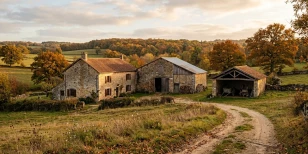

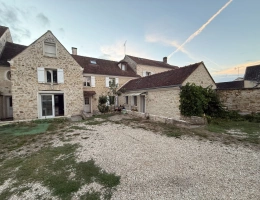
A mill for sale in Val-de-Marne (94) remains extremely rare: this inner-ring department, shaped by industrialisation along the Seine and Marne rivers and then by continuous urbanisation, has lost almost all the watermills that once stood at Charenton, Créteil and along the Marne at Joinville. Ma-propriete.fr lists the rare identified mills for sale opportunities and points you towards nearby areas where mill buildings still exist. Local place names (the Île du Moulin-Brûlé in Choisy-le-Roi, for instance) recall this history, though no matching property is for sale today.
This page gives price benchmarks for the Paris-region market and the alternatives worth considering. Our white paper on setting up a rural gîte remains useful if your search widens to a property with outbuildings outside the department. We prefer transparency here over a promise the local market cannot keep. We set out below the reasons for this scarcity and concrete options for widening your search towards more rural areas.
There are no official statistics dedicated to mills: sales are too rare and too varied (a ruin to restore, a habitable mill, a flour mill with a turbine). The most reliable market benchmark remains the price of country houses, which a habitable mill resembles, with a premium for the water, the character and the water rights, and a discount for the work required.
Val-de-Marne has virtually no rural municipalities as defined by INSEE: the statistics below cover country houses across the whole Île-de-France region, where the closest properties to this department are located.
How much does a country house cost in Île-de-France? According to DVF data (notarised sales) analysed by the ma-propriete.fr observatory, the median price of a country house in Île-de-France stood at €280,000 in 2025, with an average price of €295,207 and a median price of €2,603/m² of living space (3,611 house sales in rural municipalities over the year). 10% of houses sold for less than €171,000 (floor price, 1st decile) and 10% for more than €435,000 (ceiling price, 9th decile). The typical country house offers 116 m² of living space on an average plot of 1,590 m², i.e. around 0.2 ha.
The region is well above the national median (€189,200). Since the second half of 2020, the regional median price has risen from €274,325 to €280,000, i.e. +2.1%; over one year (2024-2025) the change is +3.6%.
| 2025 indicator | Île-de-France | France |
|---|---|---|
| Median price | €280,000 | €189,200 |
| Average price | €295,207 | €207,100 |
| Floor price (1st decile) | €171,000 | €90,000 |
| Ceiling price (9th decile) | €435,000 | €340,000 |
| Median price per m² of living space | €2,603/m² | €1,830/m² |
| Average living space | 116 m² | 108 m² |
| Average plot size | 1,590 m² | 3,181 m² |
| Number of sales in 2025 | 3,611 | 150,313 |
Differences between departments are significant: the median ranges from €250,600 in Seine-et-Marne (77) to €346,650 in Yvelines (78). The table below compares 2025 prices and their change since 2020.
| Department | Median price 2025 | Average price 2025 | Median price per m² | Change 2020-2025 | Sales 2025 |
|---|---|---|---|---|---|
| Seine-et-Marne (77) | €250,600 | €259,889 | €2,368/m² | +2.3% | 2,149 |
| Yvelines (78) | €346,650 | €378,718 | €2,966/m² | -1.0% | 763 |
| Essonne (91) | €284,600 | €297,767 | €2,741/m² | +3.5% | 433 |
| Val-d'Oise (95) | €333,000 | €336,830 | €2,993/m² | +0.5% | 266 |
A regional average also hides large gaps between municipalities. A smallholding to renovate, a restored longère with its outbuildings, a farmhouse on several hectares of land or a manor house with parkland do not sell at the same price, and the location matters as much as the building: coastline, tourist area, peri-urban countryside close to a job market or deep countryside. The table below shows the median price of country houses in Île-de-France by type of municipality (cumulative sales from mid-2020 to 2025) and its change between 2021 and 2025.
| Type of municipality | Median price 2020-2025 | Median price per m² | Change 2021-2025 | Sales 2020-2025 |
|---|---|---|---|---|
| Inland tourist areas (hinterland, mountains) | €250,000 | €2,369/m² | -1.3% | 135 |
| Peri-urban countryside (city catchment area) | €289,000 | €2,645/m² | -5.6% | 22,270 |
These benchmarks help you assess a listing, estimate a property before putting it up for sale, or set your budget, whether you are looking for a holiday home, a permanent move to the French countryside or a property to turn into a rural gîte. To go further, see our observatory of country house prices in France (national, regional and departmental analysis, downloadable annual report) and work out the full cost of your purchase, including French notary fees, with our notary fees calculator.
Val-de-Marne once had watermills along the Marne, notably near Joinville-le-Pont and Nogent-sur-Marne, as well as at the confluence with the Seine at Charenton, but riverside industrialisation followed by residential urbanisation wiped out this building stock from the early 20th century onwards. Practically no millrace, water wheel or former mill remains in a condition to be sold as a habitable mill. The Île du Moulin-Brûlé in Choisy-le-Roi, or former sites in Villeneuve-Saint-Georges, recall this past activity, now fully absorbed into the urban fabric.
Windmills were never a significant tradition in this department, which has no notable relief; the market for mills here is therefore, in practice, almost non-existent. A buyer attached to proximity to Paris can look towards neighbouring Seine-et-Marne, where the Marne retains a more intact milling heritage. Successive redevelopments of the Marne riverbanks, between sports facilities and residential areas, have finished erasing the last industrial remains along the water. Some agents occasionally use the word 'moulin' loosely for a converted industrial building here as well, so it is worth checking the true origin of any property marketed this way.
The Marne valley further upstream, towards Lagny-sur-Marne and neighbouring Seine-et-Marne, still holds former watermills converted into homes, less than an hour away. Southern Essonne, along the Essonne and Juine rivers, also offers a more authentic building stock and a larger market. These areas offer a balance between rural calm and reasonable links to Paris via RER or Transilien lines.
Prices in Val-de-Marne, across all property types, remain well above those of the rural areas of Seine-et-Marne or Essonne where a mill can actually be found. Southern Essonne, further away, also offers mill buildings at more accessible budgets. A realistic budget for a mill therefore means, in almost every case, moving out of the department towards more rural areas. Travel time by car, RER or regional train should be weighed into any comparison, since a slightly longer commute opens up a far wider choice of genuine mill properties.
If you extend your search into Seine-et-Marne or Essonne, check the water rights attached to the property (status as fondé en titre or a formal authorisation), the condition of the millrace and sluice gates, and the ecological-continuity rules on the relevant rivers. A hydroelectric project requires a prior technical study. Guidance from a professional familiar with the specifics of mills (water rights, rights of way) is advisable for this type of purchase outside the department.
Also check exposure to flood zoning along the riverbank and the state of the outbuildings, a key factor for a gîte project once you move out of the Paris conurbation. Also check whether the property is listed as a historic monument, fairly common for former flour mills in the Marne valley. Preparing the sale file can also take longer for a heritage property located outside the inner Paris ring.
On ma-propriete.fr, property listings in Val-de-Marne are published by private sellers, estate agents and notaries. Filter by budget, living space and land area, set up an email alert to be told of new listings, and browse all mills for sale in Île-de-France to widen your search to neighbouring departments. Our team can help you target the most relevant areas in Seine-et-Marne or Essonne for your budget. A local agent covering both Val-de-Marne and the wider Île-de-France can help coordinate a search across department lines.