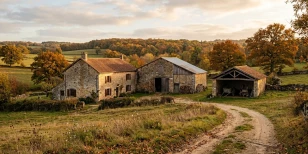

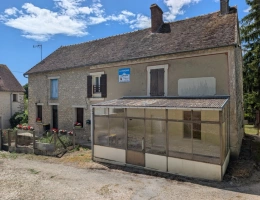
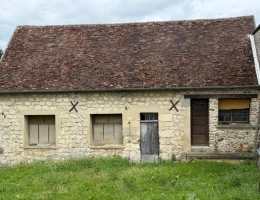
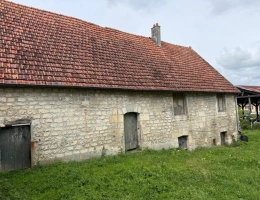
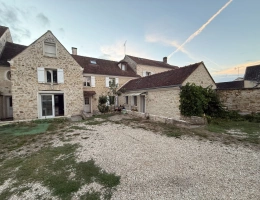
A mill for sale in Essonne (91) is most often found along the valleys cutting through the farmland plateau south of Paris: the Essonne, Orge, Juine and École rivers carried a string of watermills and flour mills since the Middle Ages. Ma-propriete.fr brings together here the mills for sale in Essonne: restored or renovation-project watermills, former valley flour mills and millers' houses with their outbuildings. A few former tanneries or paper mills converted from water power, a legacy of light industry south of Paris, also occasionally appear on the market.
This page also gives price benchmarks from actual sales, an overview of where these properties are concentrated, and the specific points to check before buying a mill in the outer Paris region. To prepare your project, see our white paper on setting up a rural gîte, whose advice applies fully to a mill with outbuildings. These points apply equally to properties awaiting renovation and to those already restored, each with its own set of constraints.
There are no official statistics dedicated to mills: sales are too rare and too varied (a ruin to restore, a habitable mill, a flour mill with a turbine). The most reliable market benchmark remains the price of country houses, which a habitable mill resembles, with a premium for the water, the character and the water rights, and a discount for the work required.
How much does a country house cost in Essonne (91)? According to DVF data (notarised sales) analysed by the ma-propriete.fr observatory, the median price of a country house in Essonne (91) stood at €284,600 in 2025, with an average price of €297,767 and a median price of €2,741/m² of living space (433 house sales in rural municipalities over the year). The price range is wide: 10% of houses sold for less than €200,000 (floor price, 1st decile) and 10% for more than €410,000 (ceiling price, 9th decile). The typical country house here offers 114 m² of living space on an average plot of 1,471 m², i.e. around 0.1 ha.
This market is close to the regional median (Île-de-France: €280,000) and well above the national median (€189,200). Since the second half of 2020, the median price has risen from €275,000 to €284,600, i.e. +3.5%; over one year (2024-2025) the change is +1.6%.
| 2025 indicator | Essonne | Île-de-France | France |
|---|---|---|---|
| Median price | €284,600 | €280,000 | €189,200 |
| Average price | €297,767 | €295,207 | €207,100 |
| Floor price (1st decile) | €200,000 | €171,000 | €90,000 |
| Ceiling price (9th decile) | €410,000 | €435,000 | €340,000 |
| Median price per m² of living space | €2,741/m² | €2,603/m² | €1,830/m² |
| Average living space | 114 m² | 116 m² | 108 m² |
| Average plot size | 1,471 m² | 1,590 m² | 3,181 m² |
| Number of sales in 2025 | 433 | 3,611 | 150,313 |
A departmental average hides large gaps. A smallholding to renovate, a restored longère with its outbuildings, a farmhouse on several hectares of land or a manor house with parkland do not sell at the same price, and the location matters as much as the building: coastline, tourist area, peri-urban countryside close to a job market or deep countryside. The table below shows the median price of country houses in Essonne (91) by type of municipality (cumulative sales from mid-2020 to 2025) and its change between 2021 and 2025.
| Type of municipality | Median price 2020-2025 | Median price per m² | Change 2021-2025 | Sales 2020-2025 |
|---|---|---|---|---|
| Peri-urban countryside (city catchment area) | €296,350 | €2,745/m² | -6.1% | 2,551 |
These benchmarks help you assess a listing, estimate a property before putting it up for sale, or set your budget for a holiday home or a permanent move to the French countryside. To go further, see our observatory of country house prices in France (national, regional and departmental analysis, downloadable annual report) and work out the full cost of your purchase, including French notary fees, with our notary fees calculator.
Essonne has long been one of the most mill-rich departments of the Paris region. The Essonne river, between Étampes and Corbeil-Essonnes, the Orge around Arpajon and Saint-Chéron, the Juine near Étampes and Lardy, and the École in the south of the department powered numerous watermills and flour mills, some of which survived as industrial sites into the 20th century. Many have been converted into homes, keeping a millrace, water wheel or remains of millstones. Some of these sites still have a partial mechanism, an original millstone or sluice gate, which is a genuine heritage asset for a carefully managed restoration project.
Windmills are marginal on this open farmland plateau, where the milling tradition stayed hydraulic; there is no tide mill either, Essonne being an inland department. What comes to market is therefore almost exclusively former watermills and millers' houses. Most of the available stock therefore lies within thirty to forty kilometres of Paris, an advantage for a second home or regular remote work. Buyers should expect a long search here, as the number of listings each year remains modest compared with more mill-dense departments further west.
The Juine and Essonne valleys, around Étampes and Milly-la-Forêt, offer the most rural setting, served by the Étampes TGV/RER station. The Orge valley, between Arpajon and Dourdan, combines historic buildings with RER C access. The southern part of the department, towards the Gâtinais français and Fontainebleau forest, remains the most unspoilt area for a renovation project. The nearby Fontainebleau forest to the south adds a notable natural and tourism appeal to these areas.
The closer you get to the north of the department, towards Corbeil-Essonnes and the Évry-Courcouronnes conurbation, the more urban pressure pushes prices up; the south, around Étampes and Milly-la-Forêt, remains notably more affordable for a mill to renovate. Towns along the RER D line, closer to the capital, also see stronger land pressure than the rural south of the department.
Check the existence and scope of the water rights attached to the mill (status as fondé en titre or a formal authorisation), the condition of the millrace, sluice gates and weir, and the ecological-continuity obligations on classified rivers such as the Orge or the Juine. A hydroelectric project (turbine, micro-plant) requires a prior technical and administrative study, often a lengthy one in the Paris region. Administrative approvals for a mill in Essonne can involve several bodies (the local planning authority, the Seine-Normandy water agency), which lengthens the timeline for a renovation or hydroelectric project.
As for the building, these meulière stone or rubble-limestone constructions, often at the bottom of a valley, need checking for damp and flood zoning. Outbuildings (mill house, barn) make a gîte project possible, a popular option given the proximity to Paris. A structural survey of the old building, often a century or more old, is advisable before any purchase, particularly to assess foundations close to water. Given the age of much of this stock, a full survey covering roof, timber frame and masonry is strongly advisable before committing.
On ma-propriete.fr, mill listings in Essonne are published by private sellers, estate agents and notaries. Filter by budget, living space and land area, set up an email alert to be told of new listings, and browse all mills for sale in Île-de-France if your search extends beyond the department. It is also worth comparing with neighbouring Seine-et-Marne or Yvelines, where the supply of rural mills is sometimes wider.