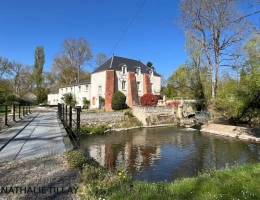
Buying a mill for sale in Loiret (45) means finding a department both crossed by the Loire and shaped by the windswept Gâtinais plateau: the Loing, around Montargis, once powered numerous watermills linked to the local canal network, while the Orléans Gâtinais area, towards Pithiviers and Puiseaux, holds one of the highest concentrations of windmills in central France. On this page, ma-propriete.fr brings together the mills for sale in Loiret: watermills on the Loing, windmills of the Gâtinais and millers' houses.
You will also find price benchmarks based on actual sales, an overview of the areas where these properties are concentrated, and the points to check before buying a mill. To prepare your project, read our guide to buying a country house in France, whose advice on old buildings, outbuildings and financing applies fully to a mill. Proximity to the Paris region and the dense canal network explain steady demand, driven by buyers looking for a country base under two hours from the capital.
There are no official statistics dedicated to mills: sales are too rare and too varied (a ruin to restore, a habitable mill, a flour mill with a turbine). The most reliable market benchmark remains the price of country houses, which a habitable mill resembles, with a premium for the water, the character and the water rights, and a discount for the work required.
How much does a country house cost in Loiret (45)? According to DVF data (notarised sales) analysed by the ma-propriete.fr observatory, the median price of a country house in Loiret (45) stood at €162,000 in 2025, with an average price of €167,803 and a median price of €1,649/m² of living space (2,128 house sales in rural municipalities over the year). The price range is wide: 10% of houses sold for less than €92,000 (floor price, 1st decile) and 10% for more than €250,000 (ceiling price, 9th decile). The typical country house here offers 104 m² of living space on an average plot of 2,740 m², i.e. around 0.3 ha.
This market is above the regional median (Centre-Val de Loire: €150,000) and below the national median (€189,200). Since the second half of 2020, the median price has risen from €153,000 to €162,000, i.e. +5.9%; over one year (2024-2025) the change is +2.5%.
| 2025 indicator | Loiret | Centre-Val de Loire | France |
|---|---|---|---|
| Median price | €162,000 | €150,000 | €189,200 |
| Average price | €167,803 | €157,230 | €207,100 |
| Floor price (1st decile) | €92,000 | €75,000 | €90,000 |
| Ceiling price (9th decile) | €250,000 | €251,580 | €340,000 |
| Median price per m² of living space | €1,649/m² | €1,519/m² | €1,830/m² |
| Average living space | 104 m² | 103 m² | 108 m² |
| Average plot size | 2,740 m² | 2,999 m² | 3,181 m² |
| Number of sales in 2025 | 2,128 | 10,907 | 150,313 |
A departmental average hides large gaps. A smallholding to renovate, a restored longère with its outbuildings, a farmhouse on several hectares of land or a manor house with parkland do not sell at the same price, and the location matters as much as the building: coastline, tourist area, peri-urban countryside close to a job market or deep countryside. The table below shows the median price of country houses in Loiret (45) by type of municipality (cumulative sales from mid-2020 to 2025) and its change between 2021 and 2025.
| Type of municipality | Median price 2020-2025 | Median price per m² | Change 2021-2025 | Sales 2020-2025 |
|---|---|---|---|---|
| Peri-urban countryside (city catchment area) | €181,000 | €1,808/m² | +4.0% | 6,880 |
| Deep countryside (outside urban influence) | €140,000 | €1,478/m² | +0.0% | 6,683 |
These benchmarks help you assess a listing, estimate a property before putting it up for sale, or set your budget for a holiday home or a permanent move to the French countryside. To go further, see our observatory of country house prices in France (national, regional and departmental analysis, downloadable annual report) and work out the full cost of your purchase, including French notary fees, with our notary fees calculator.
The Loing, paralleled by the Briare canal and the Loing canal around Montargis, once carried a significant number of watermills, some linked to former tanneries or paper mills. The Ouanne river, further south near Courtenay, adds smaller mills to this network. The Orléans canal, no longer used for commercial navigation, remains a strong landscape marker for locating several mills in the north of the department.
On the Gâtinais plateau, between Pithiviers and Puiseaux, the lack of relief and exposure to wind favoured the building of stone windmills, several of which survive, some restored with their sails, amid large-scale cereal farmland.
Around Montargis, on the Loing and its canals, the supply of watermills is the largest, under an hour from Paris-Bercy railway station. The Gâtinais area, towards Pithiviers and Puiseaux, offers isolated windmills amid open cereal farmland. Around Orléans, on the Loire, mills are rare but benefit from proximity to the prefecture city and its rail link to Paris. Immediate proximity to the Paris region, via the A10 and A6 motorways, makes this an attractive area for a second home under two hours from Paris. The Beaune-la-Rolande and Bellegarde area, at the heart of the cereal-growing Gâtinais, also has a few isolated windmills in reasonable condition.
Watermills in the Montargis area, well connected, sell for more than the isolated windmills of the Gâtinais, which are often sold with little land and needing a full restoration of the sails and machinery. Properties in the Montargis area, much in demand from Paris-region buyers, have moved noticeably closer to price levels seen in rural Yvelines in recent years.
For a watermill on the Loing, check the water rights, the condition of the millrace and sluice gates, and the ecological continuity constraints tied to the classified canal network. For a Gâtinais windmill, the key points are the soundness of the tower, the frame of the rotating cap, and whether original machinery parts survive, often incomplete. The departmental archives often hold the original plans of these mills, useful for documenting the machinery before any renovation work.
Land alongside the Loing and its canals exposes some watermills to flood zoning risk that should be checked before buying. Outbuildings, where they exist around a watermill, make a gîte project possible, something rarely available around a simple, isolated windmill. Restoring a windmill's sails, often the costliest part of such a project, deserves a detailed quote from a specialist carpenter before making any offer.
On ma-propriete.fr, mill listings in Loiret are published by private sellers, estate agents and notaries. Filter by budget, living space and land area, set up an email alert to be told of new listings, and browse all mills for sale in Centre-Val de Loire if your search extends beyond the department. As Gâtinais mills rarely change hands, it is worth following new listings regularly rather than expecting a large stock to choose from. Local estate agents in Montargis and Pithiviers often have the clearest overview of which mills are quietly changing hands. Booking a visit after a period of heavy rain gives a much clearer picture of how well a Loing-side mill actually copes with high water.