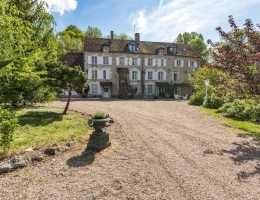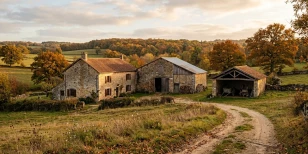
Buying a mill for sale in Loir-et-Cher (41) means choosing a department crossed by two quite different milling rivers: the Loir, in the north, between Vendôme and Montoire-sur-le-Loir, once powered dozens of flour and paper mills, while the Cher, in the south, around Saint-Aignan and Selles-sur-Cher, and the Sauldre in the Sologne region carried flour mills and pond-fed mills. On this page, ma-propriete.fr brings together the mills for sale in Loir-et-Cher: watermills to renovate, restored mills with a water wheel and millrace, flour mills and millers' houses.
You will also find price benchmarks based on actual sales, an overview of the areas where these properties are concentrated, and the points to check before buying a mill. To prepare your project, read our guide to buying a country house in France, whose advice on old buildings, outbuildings and financing applies fully to a mill. Foreign buyers, particularly from the United Kingdom and the Netherlands, remain numerous in this market, which explains a relatively stable supply from one year to the next.
There are no official statistics dedicated to mills: sales are too rare and too varied (a ruin to restore, a habitable mill, a flour mill with a turbine). The most reliable market benchmark remains the price of country houses, which a habitable mill resembles, with a premium for the water, the character and the water rights, and a discount for the work required.
How much does a country house cost in Loir-et-Cher (41)? According to DVF data (notarised sales) analysed by the ma-propriete.fr observatory, the median price of a country house in Loir-et-Cher (41) stood at €145,000 in 2025, with an average price of €152,715 and a median price of €1,485/m² of living space (1,924 house sales in rural municipalities over the year). The price range is wide: 10% of houses sold for less than €80,000 (floor price, 1st decile) and 10% for more than €240,000 (ceiling price, 9th decile). The typical country house here offers 102 m² of living space on an average plot of 2,895 m², i.e. around 0.3 ha.
This market is close to the regional median (Centre-Val de Loire: €150,000) and well below the national median (€189,200). Since the second half of 2020, the median price has risen from €133,000 to €145,000, i.e. +9.0%; over one year (2024-2025) the change is +2.5%.
| 2025 indicator | Loir-et-Cher | Centre-Val de Loire | France |
|---|---|---|---|
| Median price | €145,000 | €150,000 | €189,200 |
| Average price | €152,715 | €157,230 | €207,100 |
| Floor price (1st decile) | €80,000 | €75,000 | €90,000 |
| Ceiling price (9th decile) | €240,000 | €251,580 | €340,000 |
| Median price per m² of living space | €1,485/m² | €1,519/m² | €1,830/m² |
| Average living space | 102 m² | 103 m² | 108 m² |
| Average plot size | 2,895 m² | 2,999 m² | 3,181 m² |
| Number of sales in 2025 | 1,924 | 10,907 | 150,313 |
A departmental average hides large gaps. A smallholding to renovate, a restored longère with its outbuildings, a farmhouse on several hectares of land or a manor house with parkland do not sell at the same price, and the location matters as much as the building: coastline, tourist area, peri-urban countryside close to a job market or deep countryside. The table below shows the median price of country houses in Loir-et-Cher (41) by type of municipality (cumulative sales from mid-2020 to 2025) and its change between 2021 and 2025.
| Type of municipality | Median price 2020-2025 | Median price per m² | Change 2021-2025 | Sales 2020-2025 |
|---|---|---|---|---|
| Inland tourist areas (hinterland, mountains) | €122,500 | €1,223/m² | +17.4% | 314 |
| Peri-urban countryside (city catchment area) | €164,897 | €1,656/m² | +5.6% | 4,506 |
| Deep countryside (outside urban influence) | €130,000 | €1,350/m² | +4.0% | 7,316 |
These benchmarks help you assess a listing, estimate a property before putting it up for sale, or set your budget for a holiday home or a permanent move to the French countryside. To go further, see our observatory of country house prices in France (national, regional and departmental analysis, downloadable annual report) and work out the full cost of your purchase, including French notary fees, with our notary fees calculator.
The Loir, between Vendôme, Montoire-sur-le-Loir and Château-Renault, holds most of the department's watermills: former flour, oil and paper mills, built in tuffeau stone, line its gentle course. The wider Cher, between Saint-Aignan, Selles-sur-Cher and Noyers-sur-Cher, once carried large flour mills, now often converted into flats or into a house with outbuildings. Some of these mills have kept their complete milling machinery, including flint millstones and bolting equipment, making them sought after by heritage-industry enthusiasts.
In the Sologne region, the Sauldre and the Beuvron feed a network of ponds and slow rivers that also drove mills, generally smaller and linked to a private millpond. Windmills are rare in Loir-et-Cher, as the plateau relief made them less useful than the many rivers.
The Loir valley, between Vendôme and Montoire-sur-le-Loir, with its TGV station, remains the most sought-after area for a habitable tuffeau-stone mill under an hour from Paris. Around Blois, on the Loire and its small tributaries, mills are rarer but benefit from proximity to the châteaux and the railway station. In Sologne, near Romorantin-Lanthenay and Salbris, pond-side mills appeal to buyers keen on hunting and fishing. Rail links to Paris and Tours add to the appeal of this area for city-based buyers looking for a second home. The Loire riverbanks near Blois also offer occasional opportunities for converted mills on lesser-known small tributaries.
Mills in the Loir valley, well connected and close to Vendôme, sell above the departmental average, while those to the south, around Selles-sur-Cher or Saint-Aignan, remain more affordable for a renovation project. A mill near a listed château may be subject to visual-easement rules affecting its value, worth checking with the local heritage architect.
The water rights and their age — a mill fondé en titre or holding an authorisation — should be checked first, along with the condition of the millrace, weir and sluice gates. Ecological continuity particularly concerns the Loir and the Cher, classified for migratory fish, which can constrain maintenance of the weir or a turbine project. Asbestos and lead surveys, common in converted industrial buildings, deserve particular attention on former flour mills.
Buildings in tuffeau or limestone, often at the bottom of a valley, require checking for damp and flood zoning risk. Outbuildings — a former flour mill, drying shed or barn — lend themselves well to a gîte project, in a department already geared towards Loire château tourism. The high-ceilinged lofts typical of former flour mills lend themselves well to converting extra bedrooms for a gîte project.
On ma-propriete.fr, mill listings in Loir-et-Cher are published by private sellers, estate agents and notaries. Filter by budget, living space and land area, set up an email alert to be told of new listings, and browse all mills for sale in Centre-Val de Loire if your search extends beyond the department. Because demand from Paris and from abroad overlaps here, a well-priced watermill in good condition rarely stays listed for long. A mill agent familiar with the Loir-et-Cher market can also help identify off-market opportunities before they are formally listed. Booking a visit early in the process, before the wettest months, also makes it far easier to judge how the millrace and the surrounding land actually behave.