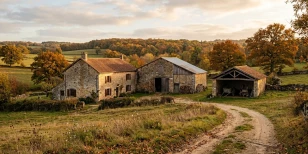

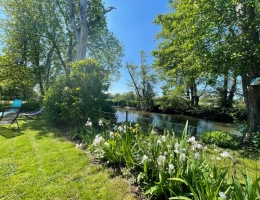
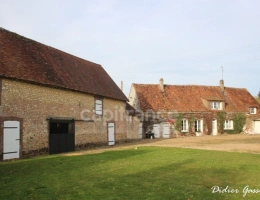
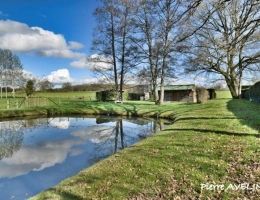
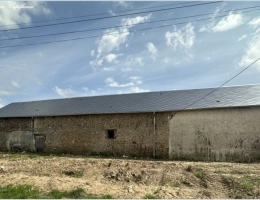
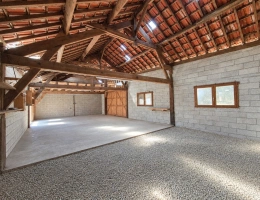
Looking for a mill for sale in Eure-et-Loir (28) means exploring a department split between the vast Beauce grain plains and the hedgerow valleys of the Perche: it has former watermills along the Eure, Loir and Huisne rivers, flour mills inherited from Beauce's wheat-growing tradition, and a handful of rare windmills that once dotted the plateau, in an open landscape where village church spires can be seen from far away. On this page, ma-propriete.fr brings together the mills for sale in Eure-et-Loir: watermills to restore, former flour mills or millers' houses with their millrace.
You will also find price benchmarks based on actual sales, an overview of the areas where these properties are concentrated, and the specific points to check before buying a mill, from water rights to old flour-milling machinery. To prepare your project, read our white paper on setting up a rural gîte, whose advice applies fully to a mill in the Perche or Beauce, from planning permission to seasonal marketing.
There are no official statistics dedicated to mills: sales are too rare and too varied (a ruin to restore, a habitable mill, a flour mill with a turbine). The most reliable market benchmark remains the price of country houses, which a habitable mill resembles, with a premium for the water, the character and the water rights, and a discount for the work required.
How much does a country house cost in Eure-et-Loir (28)? According to DVF data (notarised sales) analysed by the ma-propriete.fr observatory, the median price of a country house in Eure-et-Loir (28) stood at €178,000 in 2025, with an average price of €184,180 and a median price of €1,769/m² of living space (2,009 house sales in rural municipalities over the year). The price range is wide: 10% of houses sold for less than €105,000 (floor price, 1st decile) and 10% for more than €275,000 (ceiling price, 9th decile). The typical country house here offers 105 m² of living space on an average plot of 1,973 m², i.e. around 0.2 ha.
This market is well above the regional median (Centre-Val de Loire: €150,000) and below the national median (€189,200). Since the second half of 2020, the median price has risen from €166,000 to €178,000, i.e. +7.2%; over one year (2024-2025) the change is +2.3%.
| 2025 indicator | Eure-et-Loir | Centre-Val de Loire | France |
|---|---|---|---|
| Median price | €178,000 | €150,000 | €189,200 |
| Average price | €184,180 | €157,230 | €207,100 |
| Floor price (1st decile) | €105,000 | €75,000 | €90,000 |
| Ceiling price (9th decile) | €275,000 | €251,580 | €340,000 |
| Median price per m² of living space | €1,769/m² | €1,519/m² | €1,830/m² |
| Average living space | 105 m² | 103 m² | 108 m² |
| Average plot size | 1,973 m² | 2,999 m² | 3,181 m² |
| Number of sales in 2025 | 2,009 | 10,907 | 150,313 |
A departmental average hides large gaps. A smallholding to renovate, a restored longère with its outbuildings, a farmhouse on several hectares of land or a manor house with parkland do not sell at the same price, and the location matters as much as the building: coastline, tourist area, peri-urban countryside close to a job market or deep countryside. The table below shows the median price of country houses in Eure-et-Loir (28) by type of municipality (cumulative sales from mid-2020 to 2025) and its change between 2021 and 2025.
| Type of municipality | Median price 2020-2025 | Median price per m² | Change 2021-2025 | Sales 2020-2025 |
|---|---|---|---|---|
| Inland tourist areas (hinterland, mountains) | €152,550 | €1,502/m² | +34.6% | 206 |
| Peri-urban countryside (city catchment area) | €197,000 | €1,934/m² | -0.3% | 8,008 |
| Deep countryside (outside urban influence) | €141,000 | €1,487/m² | +4.1% | 4,522 |
These benchmarks help you assess a listing, estimate a property before putting it up for sale, or set your budget for a holiday home or a permanent move to the French countryside. To go further, see our observatory of country house prices in France (national, regional and departmental analysis, downloadable annual report) and work out the full cost of your purchase, including French notary fees, with our notary fees calculator.
In Eure-et-Loir, grain has always been king: the Beauce, a vast wheat plain with open horizons stretching south and east of Chartres, gave rise to many flour mills, often on the edge of a town, along the plateau's few streams such as the Conie or the Aigre. Historically, Beauce's flatness and wind also favoured a few windmills, now extremely rare and mostly preserved only as remnants or heritage curiosities maintained by local associations, occasionally restored to working order for open days organised by local heritage groups.
The Perche, hillier and more wooded to the west of the department, has more watermills, on the Huisne around Nogent-le-Rotrou and on the Loir near Bonneval and Châteaudun. Water wheels and flint-stone buildings typical of the Perche can still be found there, often next to a small stud farm or equestrian property, a nod to the region's Percheron draught-horse tradition, a breed recognised across France, and its rolling, hedge-lined countryside dotted with small orchards.
The Eure valley, between Chartres and Maintenon, and the Loir valley, around Bonneval and Châteaudun, hold most of the department's habitable mills, with buildings often well preserved and generous plots along the valley floor. The Perche, around Nogent-le-Rotrou, and the Thymerais near Dreux, round out the offer for buyers seeking a hillier, more wooded setting away from the open Beauce plain and its long, straight roads. Proximity to Chartres station and the regional line to Paris-Montparnasse makes access from the capital easy for a second home.
Mills within thirty minutes of Chartres or near the Eure valley are clearly above the department average, while properties on the Beauce plateau or in the southern Perche, further from main roads, remain more affordable for an equivalent renovation budget, at the cost of a longer drive back to Chartres and its shops.
Check the water rights attached to the mill, the condition of the millrace and sluice gates, and the ecological-continuity obligations that apply on the Eure, Loir and Huisne, partly classified as migratory-fish rivers. Original flour-mill machinery (millstones, sifting bolters, bucket elevators), where it survives, is a technical heritage worth preserving but costly to maintain and rarely brought back into working order, except for a museum or heritage-association project run with local volunteers and occasional public funding support.
The building, in flint or limestone, is often set at the bottom of a valley: check for damp and flood zoning, a real concern in winter along the Eure and its tributaries. Outbuildings (grain-drying shed, barn, miller's house) lend themselves to a gîte project, a growing activity in the touristic Perche and its regional nature parks, provided visitors can be given independent access away from the main house and adequate parking on site.
On ma-propriete.fr, mill listings in Eure-et-Loir are published by private sellers, estate agents and notaries. Filter by budget, living space and land area, set up an email alert to be told of new listings, and browse all mills for sale in Centre-Val de Loire if your search extends beyond the department, for instance towards Loiret or Indre-et-Loire, which share a similar agricultural heritage.