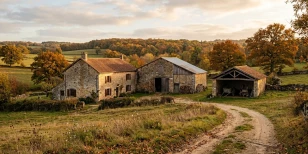

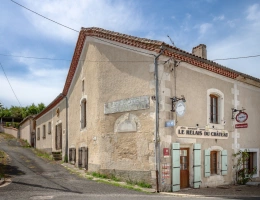
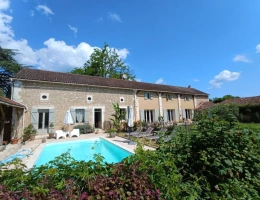
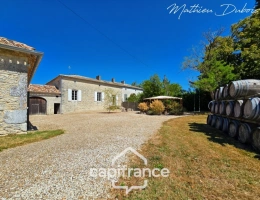
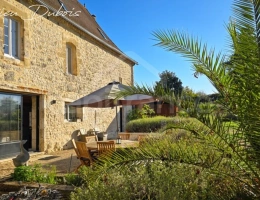
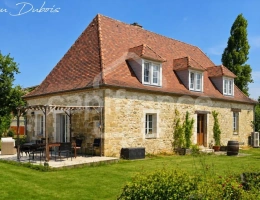
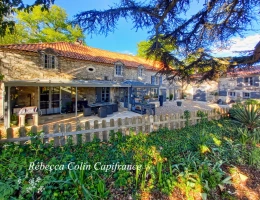
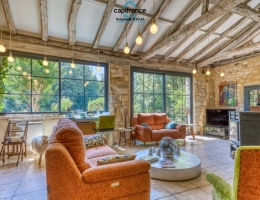
Buying a mill for sale in Dordogne (24) means choosing a department crossed by the Dordogne, the Vézère, the Isle, the Dronne and the Auvézère, whose waters once drove hundreds of watermills, for grinding grain but also, around Couze-et-Saint-Front, for making paper. On this page, ma-propriete.fr brings together the mills for sale in Dordogne: watermills to renovate, restored former mills with their water wheel, paper mills or walnut-oil mills, and converted flour mills.
You will also find price benchmarks based on actual sales, an overview of the areas where these properties are concentrated, and the specific points to check before buying a mill. To prepare your project, read our guide to creating a rural gîte, particularly relevant in a department that lives largely off rural tourism. A former Périgord mill can also retain a fishing right attached to the property, a welcome asset on these classified rivers.
There are no official statistics dedicated to mills: sales are too rare and too varied (a ruin to restore, a habitable mill, a flour mill with a turbine). The most reliable market benchmark remains the price of country houses, which a habitable mill resembles, with a premium for the water, the character and the water rights, and a discount for the work required.
How much does a country house cost in Dordogne (24)? According to DVF data (notarised sales) analysed by the ma-propriete.fr observatory, the median price of a country house in Dordogne (24) stood at €162,300 in 2025, with an average price of €176,682 and a median price of €1,650/m² of living space (3,105 house sales in rural municipalities over the year). The price range is wide: 10% of houses sold for less than €86,000 (floor price, 1st decile) and 10% for more than €285,720 (ceiling price, 9th decile). The typical country house here offers 108 m² of living space on an average plot of 6,114 m², i.e. around 0.6 ha.
This market is close to the regional median (Nouvelle-Aquitaine: €170,000) and below the national median (€189,200). Since the second half of 2020, the median price has risen from €149,000 to €162,000, i.e. +8.7%; over one year (2024-2025) the change is -0.3%.
| 2025 indicator | Dordogne | Nouvelle-Aquitaine | France |
|---|---|---|---|
| Median price | €162,300 | €170,000 | €189,200 |
| Average price | €176,682 | €188,636 | €207,100 |
| Floor price (1st decile) | €86,000 | €83,000 | €90,000 |
| Ceiling price (9th decile) | €285,720 | €315,785 | €340,000 |
| Median price per m² of living space | €1,650/m² | €1,657/m² | €1,830/m² |
| Average living space | 108 m² | 110 m² | 108 m² |
| Average plot size | 6,114 m² | 4,005 m² | 3,181 m² |
| Number of sales in 2025 | 3,105 | 26,126 | 150,313 |
A departmental average hides large gaps. A smallholding to renovate, a restored longère with its outbuildings, a farmhouse on several hectares of land or a manor house with parkland do not sell at the same price, and the location matters as much as the building: coastline, tourist area, peri-urban countryside close to a job market or deep countryside. The table below shows the median price of country houses in Dordogne (24) by type of municipality (cumulative sales from mid-2020 to 2025) and its change between 2021 and 2025.
| Type of municipality | Median price 2020-2025 | Median price per m² | Change 2021-2025 | Sales 2020-2025 |
|---|---|---|---|---|
| Inland tourist areas (hinterland, mountains) | €185,000 | €1,725/m² | -4.8% | 2,647 |
| Peri-urban countryside (city catchment area) | €171,025 | €1,676/m² | +5.3% | 5,898 |
| Deep countryside (outside urban influence) | €152,475 | €1,508/m² | +3.3% | 11,358 |
These benchmarks help you assess a listing, estimate a property before putting it up for sale, or set your budget for a holiday home or a permanent move to the French countryside. To go further, see our observatory of country house prices in France (national, regional and departmental analysis, downloadable annual report) and work out the full cost of your purchase, including French notary fees, with our notary fees calculator.
The Dordogne, between Bergerac and Sarlat, the Vézère near Montignac and Les Eyzies, the Isle around Périgueux, and above all the Dronne at Brantôme, nicknamed the 'Venice of Périgord', hold a very large number of watermills, many of which have kept their millrace and water wheel. Périgord also retains a few mixed-use mills, able to grind grain or run an oil press depending on the season. The golden Dordogne stone facades, much sought after, stand out from the greyer stone found in neighbouring departments.
Périgord also developed specialised mills: the former paper mills of Couze-et-Saint-Front, on the Couze river, remain a national rarity, as do the walnut-oil mills of the Périgord Noir. Windmills, by contrast, are very rare, Dordogne being a land of rivers rather than windswept plateaus. These paper-mill sites, often clustered in small, steep valleys, have kept distinctive drying buildings, unlike ordinary grain mills. Several former mills have been converted into upmarket guest rooms, benefiting from Périgord's tourist reputation.
For a habitable mill with land, the Dronne valley around Brantôme and Bourdeilles offers the most sought-after setting. The Périgord Noir, around Sarlat and the Vézère valley, also holds former milling sites near the prehistoric sites. Towards Bergerac, served by regional trains, and the Couze valley, former paper mills attract distinctive renovation projects. The Périgord Blanc, around Périgueux, offers a more urban market, with mills close to the amenities of the prefecture. The Périgueux area, a well-served prefecture, adds properties closer to urban amenities to this offering.
The most touristic areas, around Sarlat, Brantôme and the Vézère valley, sell well above the regional average. The Périgord Vert, further north, and parts of the Isle valley, remain more affordable areas for a mill to renovate. The Périgord Pourpre, around Bergerac and its vineyards, sits between wine heritage and traditional mill buildings. The most remote valleys of the Périgord Vert remain the most affordable for a full renovation project.
Check the existence and scope of the water rights (a mill fondé en titre or holding an authorisation), the condition of the millrace, weir and sluice gates, and ecological-continuity obligations on the Dordogne, Vézère and Dronne, classified along many stretches. A hydroelectric turbine project, feasible on some sites, requires a prior technical and administrative study. Heavy tourist traffic in some valleys, especially the Vézère, can also create access constraints during the summer season. Checking the stability of the riverbanks, sometimes weakened by erosion, is advisable before buying any riverside property.
These Périgord limestone buildings, often at the bottom of a valley, call for checking flood zoning, damp and drainage, especially for former paper mills whose structures can be more fragile. Outbuildings suit a gîte project particularly well, an activity already highly developed in this tourist department. Flat-tile or stone-slab roofs, typical of Périgord, require a specific survey as part of any pre-purchase inspection. Working with a heritage architect makes it easier to obtain permits in areas protected as classified sites.
On ma-propriete.fr, mill listings in Dordogne are published by private sellers, estate agents and notaries. Filter by budget, living space and land area, set up an email alert to be told of new listings, and browse all mills for sale in Nouvelle-Aquitaine if your search extends beyond the department. Mills near the major tourist sites of the Périgord Noir see particularly strong demand.