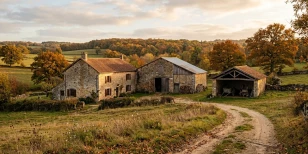
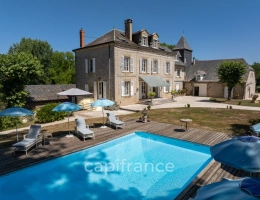
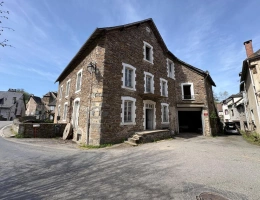
Buying a mill for sale in Corrèze (19) means choosing a granite department where water is never scarce: the Corrèze, the Vézère, the Dordogne at Argentat and the countless streams of the Plateau de Millevaches once drove hundreds of watermills, most for grinding grain but, distinctively here, some for pressing walnut oil. On this page, ma-propriete.fr brings together the mills for sale in Corrèze: watermills to renovate, former oil mills, converted flour mills and millers' houses with outbuildings.
You will also find price benchmarks based on actual sales, an overview of the areas where these properties are concentrated, and the specific points to check before buying a mill. To prepare your project, read our guide to creating a rural gîte, whose advice applies fully to converting a Corrèze mill. A former Corrèze mill can also retain a fishing right attached to the property, worth checking precisely before buying.
There are no official statistics dedicated to mills: sales are too rare and too varied (a ruin to restore, a habitable mill, a flour mill with a turbine). The most reliable market benchmark remains the price of country houses, which a habitable mill resembles, with a premium for the water, the character and the water rights, and a discount for the work required.
How much does a country house cost in Corrèze (19)? According to DVF data (notarised sales) analysed by the ma-propriete.fr observatory, the median price of a country house in Corrèze (19) stood at €139,000 in 2025, with an average price of €144,076 and a median price of €1,409/m² of living space (1,320 house sales in rural municipalities over the year). The price range is wide: 10% of houses sold for less than €65,940 (floor price, 1st decile) and 10% for more than €232,685 (ceiling price, 9th decile). The typical country house here offers 101 m² of living space on an average plot of 4,969 m², i.e. around 0.5 ha.
This market is well below the regional median (Nouvelle-Aquitaine: €170,000) and well below the national median (€189,200). Since the second half of 2020, the median price has risen from €123,080 to €139,000, i.e. +12.9%; over one year (2024-2025) the change is +6.9%.
| 2025 indicator | Corrèze | Nouvelle-Aquitaine | France |
|---|---|---|---|
| Median price | €139,000 | €170,000 | €189,200 |
| Average price | €144,076 | €188,636 | €207,100 |
| Floor price (1st decile) | €65,940 | €83,000 | €90,000 |
| Ceiling price (9th decile) | €232,685 | €315,785 | €340,000 |
| Median price per m² of living space | €1,409/m² | €1,657/m² | €1,830/m² |
| Average living space | 101 m² | 110 m² | 108 m² |
| Average plot size | 4,969 m² | 4,005 m² | 3,181 m² |
| Number of sales in 2025 | 1,320 | 26,126 | 150,313 |
A departmental average hides large gaps. A smallholding to renovate, a restored longère with its outbuildings, a farmhouse on several hectares of land or a manor house with parkland do not sell at the same price, and the location matters as much as the building: coastline, tourist area, peri-urban countryside close to a job market or deep countryside. The table below shows the median price of country houses in Corrèze (19) by type of municipality (cumulative sales from mid-2020 to 2025) and its change between 2021 and 2025.
| Type of municipality | Median price 2020-2025 | Median price per m² | Change 2021-2025 | Sales 2020-2025 |
|---|---|---|---|---|
| Residential coastline | €100,480 | €1,072/m² | +8.6% | 152 |
| Inland tourist areas (hinterland, mountains) | €110,000 | €1,186/m² | +6.5% | 1,813 |
| Peri-urban countryside (city catchment area) | €156,200 | €1,630/m² | +10.0% | 2,733 |
| Deep countryside (outside urban influence) | €123,054 | €1,283/m² | +10.4% | 3,392 |
Note: in Corrèze (19), the municipalities classified as "coastline" have no access to the sea. They are municipalities bordering lakes of more than 1,000 hectares (or, in Eure, the Seine estuary) covered by the 1986 Loi Littoral, which also applies to such inland lakes and estuaries.
These benchmarks help you assess a listing, estimate a property before putting it up for sale, or set your budget for a holiday home or a permanent move to the French countryside. To go further, see our observatory of country house prices in France (national, regional and departmental analysis, downloadable annual report) and work out the full cost of your purchase, including French notary fees, with our notary fees calculator.
The Corrèze, between Tulle and Uzerche, the Vézère near Uzerche and Vigeois, and the Dordogne around Argentat, with its former timber-floating locks, once carried a great many watermills. On the Plateau de Millevaches, the many granite streams allowed for small, isolated mills, most now converted into homes. The rugged terrain of the Bas-Limousin allowed for wheels with a strong drop in level, more productive than those on the neighbouring plains. Some sites still have a gravity-fed water system, useful for domestic or complementary farming use.
A distinctive feature of the Bas-Limousin, walnut-oil mills, still visible around Beynat, Meyssac or the Brive area, reflect a local oil-pressing tradition separate from ordinary flour milling. Windmills, by contrast, are absent from the department, as water always sufficed to turn the millstones. Many of these oil mills have kept their press and vertical millstone, features prized by heritage-farming enthusiasts. Stone-slab roofs, heavier than slate, require a reinforced frame that should be checked before any purchase.
For a habitable mill with land, the Vézère valley between Uzerche and Vigeois, well served by Brive-la-Gaillarde's Intercités station, offers a much-appreciated wooded setting. The Dordogne gorges around Argentat and Beaulieu-sur-Dordogne hold former milling and floating mills. The Millevaches plateau, around Meymac and Bugeat, remains a land of small, isolated mills in open countryside. The Tulle area, around the well-served prefecture, adds mills closer to urban services to this offering. Proximity to the A20 motorway, which crosses the department from north to south, makes access from Paris or Toulouse straightforward.
The most sought-after areas, around Beaulieu-sur-Dordogne and the Dordogne valley, ranked among the most beautiful villages in France, sell well above the departmental average. The Millevaches plateau, more remote and with a harsher climate, remains the most affordable area for a mill to renovate. The most remote properties on the plateau, without direct access to a paved road, sell well below the area's average. The most isolated hamlets on the plateau mainly attract buyers seeking self-sufficiency and absolute quiet.
Check the existence and scope of the water rights (a mill fondé en titre or holding an authorisation), the condition of the millrace and sluice gates, and ecological-continuity obligations, particularly strict on the Vézère and Dordogne, both classified salmon rivers. A small hydroelectric turbine project is sometimes feasible but requires a thorough prior study. The high rainfall on the Millevaches plateau also exposes some sites to fast-rising water after heavy rain. The cost of bringing electrics and plumbing up to standard is often underestimated in a first renovation estimate.
The buildings, in granite under stone slate or slate roofs, often need substantial renovation: original machinery, water wheel or millstones, roofing and drainage all deserve close inspection. Outbuildings lend themselves well to a gîte project, an activity already well established in this rural, tourist-friendly department. For remote sites, check the electricity supply, phone network and winter access carefully. A precise assessment of the roof, usually the most expensive item of work, is strongly advised.
On ma-propriete.fr, mill listings in Corrèze are published by private sellers, estate agents and notaries. Filter by budget, living space and land area, set up an email alert to be told of new listings, and browse all mills for sale in Nouvelle-Aquitaine if your search extends beyond the department. Mills near the tourist sites of the Dordogne valley see steady demand year-round.