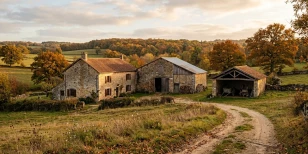

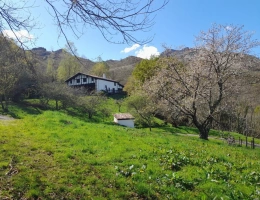
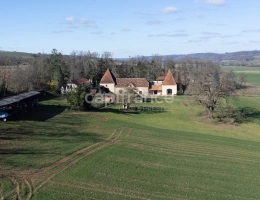
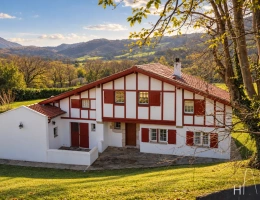
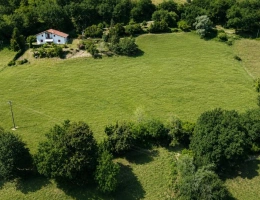
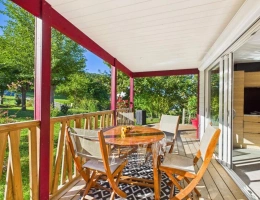
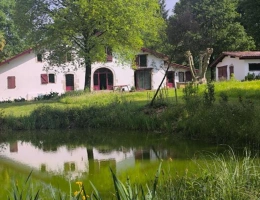
A mill for sale in Pyrénées-Atlantiques (64) can be found both in Béarn, along the Gave de Pau and the Gave d'Oloron, and in the Basque Country, on the Nive, Nivelle and their Pyrenean tributaries: these mountain streams and rivers powered former grain and maize mills deep into the valleys. On this page, ma-propriete.fr brings together the mills for sale in Pyrénées-Atlantiques: a watermill to renovate, a former flour mill or a miller's house with outbuildings.
You will also find price benchmarks based on actual sales, an overview of the areas where these properties are concentrated, and the specific points to check before buying a mill. To prepare your project, read our white paper on creating a rural gîte, useful in a region where mountain tourist accommodation is much sought after. As with any mountain mill, technical surveys (roof timbers, mechanism, utilities) are an essential first step before costing a budget.
There are no official statistics dedicated to mills: sales are too rare and too varied (a ruin to restore, a habitable mill, a flour mill with a turbine). The most reliable market benchmark remains the price of country houses, which a habitable mill resembles, with a premium for the water, the character and the water rights, and a discount for the work required.
How much does a country house cost in Pyrénées-Atlantiques (64)? According to DVF data (notarised sales) analysed by the ma-propriete.fr observatory, the median price of a country house in Pyrénées-Atlantiques (64) stood at €237,400 in 2025, with an average price of €254,839 and a median price of €2,095/m² of living space (1,557 house sales in rural municipalities over the year). The price range is wide: 10% of houses sold for less than €132,000 (floor price, 1st decile) and 10% for more than €407,140 (ceiling price, 9th decile). The typical country house here offers 121 m² of living space on an average plot of 3,853 m², i.e. around 0.4 ha.
This market is well above the regional median (Nouvelle-Aquitaine: €170,000) and well above the national median (€189,200). Since the second half of 2020, the median price has risen from €200,750 to €237,000, i.e. +18.1%; over one year (2024-2025) the change is +3.0%.
| 2025 indicator | Pyrénées-Atlantiques | Nouvelle-Aquitaine | France |
|---|---|---|---|
| Median price | €237,400 | €170,000 | €189,200 |
| Average price | €254,839 | €188,636 | €207,100 |
| Floor price (1st decile) | €132,000 | €83,000 | €90,000 |
| Ceiling price (9th decile) | €407,140 | €315,785 | €340,000 |
| Median price per m² of living space | €2,095/m² | €1,657/m² | €1,830/m² |
| Average living space | 121 m² | 110 m² | 108 m² |
| Average plot size | 3,853 m² | 4,005 m² | 3,181 m² |
| Number of sales in 2025 | 1,557 | 26,126 | 150,313 |
A departmental average hides large gaps. A smallholding to renovate, a restored longère with its outbuildings, a farmhouse on several hectares of land or a manor house with parkland do not sell at the same price, and the location matters as much as the building: coastline, tourist area, peri-urban countryside close to a job market or deep countryside. The table below shows the median price of country houses in Pyrénées-Atlantiques (64) by type of municipality (cumulative sales from mid-2020 to 2025) and its change between 2021 and 2025.
| Type of municipality | Median price 2020-2025 | Median price per m² | Change 2021-2025 | Sales 2020-2025 |
|---|---|---|---|---|
| Residential coastline * | €430,000 | €4,027/m² | +21.9% | 53 |
| Inland tourist areas (hinterland, mountains) | €195,000 | €1,867/m² | +15.8% | 341 |
| Peri-urban countryside (city catchment area) | €241,120 | €2,095/m² | +8.4% | 5,556 |
| Deep countryside (outside urban influence) | €199,500 | €1,769/m² | +8.4% | 3,464 |
* Between 30 and 99 sales: indicative value.
These benchmarks help you assess a listing, estimate a property before putting it up for sale, or set your budget for a holiday home or a permanent move to the French countryside. To go further, see our observatory of country house prices in France (national, regional and departmental analysis, downloadable annual report) and work out the full cost of your purchase, including French notary fees, with our notary fees calculator.
Béarn, watered by the Gave de Pau and the Gave d'Oloron, as well as their Pyrenean tributaries in the Ossau, Aspe and Barétous valleys, carried many watermills used for wheat and above all maize, the region's historic crop. In the Basque Country, the Nive and Nivelle, as well as the Bidouze in Basse-Navarre, also drove grain mills, often attached to a traditional Basque farmhouse. Several Béarn mills have kept their original maize millstone, a reminder of how important this crop once was to the local rural economy.
Windmills are entirely absent from this mountain and foothill territory, where relief and abundant rivers have always favoured water power; some sites were in fact fitted very early with small turbines for rural electricity. Steeply pitched roofs, covered with tile or slate depending on altitude, respond to heavy Pyrenean rainfall and set these mountain mills apart.
The Ossau and Aspe valleys, south of Pau and Oloron-Sainte-Marie, offer mountain mills in local stone, isolated in a Pyrenean setting. The inland Basque Country, around Saint-Jean-Pied-de-Port, Espelette and the Nive valley, concentrates mills attached to Labourdine or Souletine farmhouses, with distinctive half-timbered buildings. The Béarn gaves area, between Orthez and Salies-de-Béarn, adds more accessible plain mills. The Barétous valley and Haut-Béarn, more remote, round out the offer with even more isolated mountain mills at contained prices.
The Basque Country, in high demand, shows prices well above the regional average, even for a mill to renovate; inland Béarn and the southern Pyrenean valleys remain comparatively more affordable. Soule, further south, offers a few isolated mountain mills, accessible at prices lower than those in the coastal Labourd area.
Check the water rights (fondé en titre or authorised), the condition of the millrace, weir and sluice gates, and the ecological-continuity obligations on the gaves and the Nive, among the most closely monitored salmon and trout rivers in France. An old turbine or a water wheel in good condition may allow for a hydroelectric project, but this requires a prior technical and regulatory study, particularly in Natura 2000 zones. It is also worth checking winter access to the site, as some mills in Pyrenean valleys can be difficult to reach in snowy conditions.
The building, in river cobbles or local stone under a steeply pitched roof, should be checked for damp and flash-flood risk at the bottom of a Pyrenean valley. Outbuildings lend themselves particularly well to a mountain gîte, an activity already well developed in both Béarn and the Basque Country. Finally, check the structures' resilience to flash floods, a frequent occurrence on Pyrenean gaves during snowmelt.
On ma-propriete.fr, mill listings in Pyrénées-Atlantiques are published by private sellers, estate agents and notaries. Filter by budget, living space and land area, set up an email alert to be told of new listings, and browse all mills for sale in Nouvelle-Aquitaine if your search extends beyond the department. Do not hesitate to ask the agent or notary for the known history of flash floods and any work already done on the millrace before finalising your offer. A local surveyor familiar with mountain properties can help estimate realistic renovation costs before an offer is made. Buyers should also factor in the cost of maintaining mountain access tracks, a recurring task on valley properties in the Pyrenees.