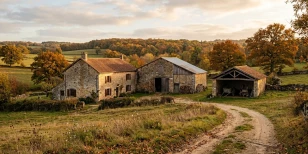
Buying a mill for sale in Bouches-du-Rhône (13) means stepping into a Provençal tradition in which the mistral wind long turned windmills for olive oil, while the Rhône, the Durance and their canals fed grain watermills. On this page, ma-propriete.fr brings together the mills for sale in Bouches-du-Rhône: Alpilles windmills to restore, former olive-oil mills, and watermills from the Durance valley.
You will also find price benchmarks based on actual sales, an overview of the areas where these properties are concentrated, and the specific points to check before buying a mill. To prepare your project, read our white paper on setting up a rural gîte, useful for considering tourist accommodation in this widely visited department. The department's strong tourist and property pressure makes some areas particularly contested as soon as a property comes to market.
There are no official statistics dedicated to mills: sales are too rare and too varied (a ruin to restore, a habitable mill, a flour mill with a turbine). The most reliable market benchmark remains the price of country houses, which a habitable mill resembles, with a premium for the water, the character and the water rights, and a discount for the work required.
How much does a country house cost in Bouches-du-Rhône (13)? According to DVF data (notarised sales) analysed by the ma-propriete.fr observatory, the median price of a country house in Bouches-du-Rhône (13) stood at €470,700 in 2025, with an average price of €516,457 and a median price of €4,310/m² of living space (545 house sales in rural municipalities over the year). The price range is wide: 10% of houses sold for less than €300,000 (floor price, 1st decile) and 10% for more than €817,072 (ceiling price, 9th decile). The typical country house here offers 118 m² of living space on an average plot of 3,383 m², i.e. around 0.3 ha.
This market is well above the regional median (Provence-Alpes-Côte d'Azur: €360,000) and well above the national median (€189,200). Since the second half of 2020, the median price has risen from €434,780 to €470,700, i.e. +8.3%; over one year (2024-2025) the change is +0.1%.
| 2025 indicator | Bouches-du-Rhône | Provence-Alpes-Côte d'Azur | France |
|---|---|---|---|
| Median price | €470,700 | €360,000 | €189,200 |
| Average price | €516,457 | €401,500 | €207,100 |
| Floor price (1st decile) | €300,000 | €215,000 | €90,000 |
| Ceiling price (9th decile) | €817,072 | €650,000 | €340,000 |
| Median price per m² of living space | €4,310/m² | €3,469/m² | €1,830/m² |
| Average living space | 118 m² | 112 m² | 108 m² |
| Average plot size | 3,383 m² | 3,324 m² | 3,181 m² |
| Number of sales in 2025 | 545 | 4,532 | 150,313 |
A departmental average hides large gaps. A smallholding to renovate, a restored longère with its outbuildings, a farmhouse on several hectares of land or a manor house with parkland do not sell at the same price, and the location matters as much as the building: coastline, tourist area, peri-urban countryside close to a job market or deep countryside. The table below shows the median price of country houses in Bouches-du-Rhône (13) by type of municipality (cumulative sales from mid-2020 to 2025) and its change between 2021 and 2025.
| Type of municipality | Median price 2020-2025 | Median price per m² | Change 2021-2025 | Sales 2020-2025 |
|---|---|---|---|---|
| Tourist coastline * | €552,070 | €5,900/m² | -9.8% | 33 |
| Residential coastline | €535,175 | €5,097/m² | -2.8% | 234 |
| Inland tourist areas (hinterland, mountains) | €544,839 | €4,707/m² | +29.3% | 208 |
| Peri-urban countryside (city catchment area) | €470,000 | €4,205/m² | +4.6% | 2,208 |
| Deep countryside (outside urban influence) | €405,000 | €3,746/m² | -0.5% | 618 |
* Between 30 and 99 sales: indicative value.
These benchmarks help you assess a listing, estimate a property before putting it up for sale, or set your budget for a holiday home or a permanent move to the French countryside. To go further, see our observatory of country house prices in France (national, regional and departmental analysis, downloadable annual report) and work out the full cost of your purchase, including French notary fees, with our notary fees calculator.
Bouches-du-Rhône is one of the few French departments where windmills hold a real place in local imagery, popularised by the Fontvieille mill linked to Alphonse Daudet. On the ridges of the Alpilles and around Salon-de-Provence, exposed to the mistral, these stone towers mostly ground wheat or pressed olives in former olive-oil mills. Original machinery is rare, and most properties for sale are towers to be rehabilitated. The mistral, which blows on more than a hundred days a year, explains why exposed ridges were chosen for windmills, while watermills, by contrast, sought out sheltered valleys.
Along the Rhône, the Durance around Barbentane and the irrigation canals of the Crau plain, a few former watermills survive, often converted into homes. The Camargue, flat and windswept but lacking suitable relief, retains virtually no traditional mills. Several windmill towers were also adapted over time into small dovecotes or garden follies once milling activity ceased.
The Alpilles, around Fontvieille, Maussane-les-Alpilles and Saint-Rémy-de-Provence, hold most of the identifiable windmills and olive-oil mills. The Barbentane and Tarascon area, on the Durance and the Rhône, has more watermills. Aix-en-Provence, served by a TGV station, and the Salon area round out the offering, with buildings often close in style to Provençal bastides. The Provençal bastides and mas farmhouses near these mills reinforce the area's architectural identity, much sought after by both French and international buyers.
Mills in the Alpilles, one of the most sought-after tourist areas in France, sell for considerably more than the regional average. The Salon area and the banks of the Durance remain comparatively more affordable while sharing the same Provençal character. Proximity to Marseille, Aix-en-Provence and the main motorway network reinforces the department's overall appeal for this type of property. Buyers should also factor in higher insurance costs typical of this fire-exposed, high-demand coastal hinterland.
For a windmill, the main points to check are the condition of the stone tower, the conical roof and, where it survives, the machinery (sails, millstones): many Provençal windmills have lost their mechanism and are now purely ornamental towers. For a watermill, check the water rights and the condition of the millrace and sluice gates on the irrigation canals, as well as ecological-continuity requirements on certain stretches of the Durance. Working with a professional familiar with the local water authority and Alpilles planning rules eases the process for any restoration project.
Provençal buildings in limestone under canal-tile roofs need particular attention to mistral exposure and to flood zoning near the Rhône and the Durance. Outbuildings (cabanon, sheepfold) often make it possible to plan a gîte in an area with very high tourist footfall. Wildfire risk, a real concern in the Alpilles massif, should also be taken into account when assessing the surrounding land. A surveyor experienced with Provençal stone buildings can help assess both the tower's structure and any surviving machinery.
On ma-propriete.fr, mill listings in Bouches-du-Rhône are published by private sellers, estate agents and notaries. Filter by budget, living space and land area, set up an email alert to be told of new listings, and browse all mills for sale in Provence-Alpes-Côte d'Azur if your search extends beyond the department. Comparing the Alpilles, the Salon area and the Durance valley helps buyers match the project to their budget and the level of tourist activity they want. Given the strength of demand in this department, buyers should be prepared to move quickly once a suitable property is listed.