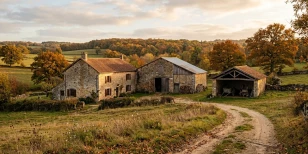

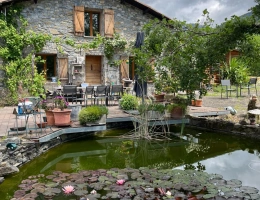
Buying a mill for sale in Alpes-Maritimes (06) means looking towards the Nice hinterland: the heavily urbanised coastal strip between Nice, Cannes and Antibes keeps virtually no mills, but the Var, Vésubie, Tinée and Estéron valleys hold several, both watermills and olive mills. ma-propriete.fr brings together on this page the mills for sale in the department: watermills in the mid-country to restore, former olive-oil mills, or miller's houses with their outbuildings.
You will also find price benchmarks based on actual sales, an honest picture of where these properties are actually found, and the points to check before buying. To prepare your project, read our guide to setting up a rural gîte, useful for turning a mill's outbuildings into guest accommodation. Our listings distinguish former olive mills from ordinary neighbouring farmhouses, a confusion that is common on this market.
There are no official statistics dedicated to mills: sales are too rare and too varied (a ruin to restore, a habitable mill, a flour mill with a turbine). The most reliable market benchmark remains the price of country houses, which a habitable mill resembles, with a premium for the water, the character and the water rights, and a discount for the work required.
How much does a country house cost in Alpes-Maritimes (06)? According to DVF data (notarised sales) analysed by the ma-propriete.fr observatory, the median price of a country house in Alpes-Maritimes (06) stood at €352,770 in 2025, with an average price of €362,860 and a median price of €3,537/m² of living space (360 house sales in rural municipalities over the year). The price range is wide: 10% of houses sold for less than €179,500 (floor price, 1st decile) and 10% for more than €559,050 (ceiling price, 9th decile). The typical country house here offers 104 m² of living space on an average plot of 3,212 m², i.e. around 0.3 ha.
This market is close to the regional median (Provence-Alpes-Côte d'Azur: €360,000) and well above the national median (€189,200). Since the second half of 2020, the median price has risen from €329,000 to €352,770, i.e. +7.2%; over one year (2024-2025) the change is +0.8%.
| 2025 indicator | Alpes-Maritimes | Provence-Alpes-Côte d'Azur | France |
|---|---|---|---|
| Median price | €352,770 | €360,000 | €189,200 |
| Average price | €362,860 | €401,500 | €207,100 |
| Floor price (1st decile) | €179,500 | €215,000 | €90,000 |
| Ceiling price (9th decile) | €559,050 | €650,000 | €340,000 |
| Median price per m² of living space | €3,537/m² | €3,469/m² | €1,830/m² |
| Average living space | 104 m² | 112 m² | 108 m² |
| Average plot size | 3,212 m² | 3,324 m² | 3,181 m² |
| Number of sales in 2025 | 360 | 4,532 | 150,313 |
A departmental average hides large gaps. A smallholding to renovate, a restored longère with its outbuildings, a farmhouse on several hectares of land or a manor house with parkland do not sell at the same price, and the location matters as much as the building: coastline, tourist area, peri-urban countryside close to a job market or deep countryside. The table below shows the median price of country houses in Alpes-Maritimes (06) by type of municipality (cumulative sales from mid-2020 to 2025) and its change between 2021 and 2025.
| Type of municipality | Median price 2020-2025 | Median price per m² | Change 2021-2025 | Sales 2020-2025 |
|---|---|---|---|---|
| Inland tourist areas (hinterland, mountains) | €260,000 | €2,875/m² | -1.3% | 947 |
| Peri-urban countryside (city catchment area) | €379,750 | €3,711/m² | +10.8% | 876 |
| Deep countryside (outside urban influence) | €439,782 | €3,938/m² | +3.5% | 389 |
These benchmarks help you assess a listing, estimate a property before putting it up for sale, or set your budget for a holiday home or a permanent move to the French countryside. To go further, see our observatory of country house prices in France (national, regional and departmental analysis, downloadable annual report) and work out the full cost of your purchase, including French notary fees, with our notary fees calculator.
In the Vésubie, Tinée and Estéron valleys, small watermills with their millstones served the perched villages, with a water wheel adapted to the torrential flow of these Alpine rivers. In the mid-country, around Grasse, Vence and the upper Nice hinterland, olive growing left many former communal olive mills, often built in stone, distinct from grain mills. The perched villages of the hinterland, such as Coaraze or Peille, add to the tourist appeal of the Nice hinterland, which favours a gîte business. Prices for such properties vary widely depending on the type of mill, its condition, and how close it lies to the coast.
On the coastal strip, from Nice to Menton, intense urbanisation has erased almost every mill: the rare remains have become heritage curiosities rather than properties for sale. Windmills are practically unknown in the department, as the mountainous terrain does not suit them. Some former olive mills have been bought by local communes and turned into small museums, which further reduces the number of properties genuinely available for sale.
The mid-country, around Vence, Le Bar-sur-Loup and the Loup valley, offers the best balance between hydraulic heritage, Mediterranean climate and proximity to the coast. Further north, the Vésubie valley around Saint-Martin-Vésubie and the Tinée valley keep a more rustic mountain character. Towards Sospel and the Roya valley, on the Italian border, former mills tied to olive oil and chestnuts still survive. The Mercantour National Park, covering part of the north of the department, imposes specific building rules within its boundaries.
Properties in the mid-country, between Vence and Grasse, sell well above the regional average because of pressure on Riviera land, while the Tinée and Roya valleys remain the most affordable areas for a mill to renovate. The proximity of Italy, only a few kilometres from Sospel and the Roya valley, also shapes the architectural style of some outbuildings.
Check the water rights attached to the property (fondé en titre or a formal authorisation), the condition of the millrace and sluice gates, and the ecological-continuity obligations on classified rivers such as the Var or the Vésubie. A hydroelectric project using a small turbine must account for the torrential regime of these rivers, with fast floods and marked low-water periods. The Var river, a classified coastal river, and its tributaries are subject to strict ecological-continuity rules, reinforced by the frequency of Mediterranean flash floods.
The buildings, in local stone under clay tile or slate-slab roofs at altitude, need checking for winter access in remote valleys, exposure to flood zoning risk, and the condition of the original machinery. The outbuildings, where present, make it possible to plan a gîte in a highly touristic area. The growing tourist appeal of the Nice hinterland makes a gîte project particularly worthwhile wherever the outbuildings allow it. Local agents in Vence and Grasse are familiar with these niche properties, distinct from the area's more common bastides.
On ma-propriete.fr, mill listings in Alpes-Maritimes are published by private sellers, estate agents and notaries. Filter by budget, living space and land area, set up an email alert to be told of new listings, and browse all mills for sale in Provence-Alpes-Côte d'Azur if your search extends beyond the department. It is also worth comparing mills with mid-country Nice-area farmhouses, often listed in the same areas.