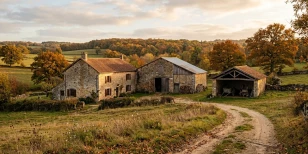

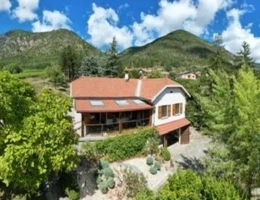
Buying a mill for sale in Hautes-Alpes (05) means looking at a niche market: the high-mountain terrain sharply limits the number of surviving watermills, concentrated in the lower valleys of the Durance, Buëch and Guisane rivers. ma-propriete.fr lists on this page the mills and country houses for sale in the department, for buyers whose project could extend to a former alpine farmhouse or stone-built sawmill.
You will also find price benchmarks based on actual sales, an honest overview of how rare these properties are in the department, and the points to check before buying. To prepare your project, read our guide to setting up a rural gîte, well suited to converting a former mill or mountain farmhouse. Our listings clearly flag when a property advertised as a mill is in fact a former farmhouse next to a vanished hydraulic site.
There are no official statistics dedicated to mills: sales are too rare and too varied (a ruin to restore, a habitable mill, a flour mill with a turbine). The most reliable market benchmark remains the price of country houses, which a habitable mill resembles, with a premium for the water, the character and the water rights, and a discount for the work required.
How much does a country house cost in Hautes-Alpes (05)? According to DVF data (notarised sales) analysed by the ma-propriete.fr observatory, the median price of a country house in Hautes-Alpes (05) stood at €305,225 in 2025, with an average price of €311,428 and a median price of €2,850/m² of living space (390 house sales in rural municipalities over the year). The price range is wide: 10% of houses sold for less than €147,697 (floor price, 1st decile) and 10% for more than €491,050 (ceiling price, 9th decile). The typical country house here offers 108 m² of living space on an average plot of 2,619 m², i.e. around 0.3 ha.
This market is well below the regional median (Provence-Alpes-Côte d'Azur: €360,000) and well above the national median (€189,200). Since the second half of 2020, the median price has risen from €258,000 to €304,450, i.e. +18.0%; over one year (2024-2025) the change is +3.8%.
| 2025 indicator | Hautes-Alpes | Provence-Alpes-Côte d'Azur | France |
|---|---|---|---|
| Median price | €305,225 | €360,000 | €189,200 |
| Average price | €311,428 | €401,500 | €207,100 |
| Floor price (1st decile) | €147,697 | €215,000 | €90,000 |
| Ceiling price (9th decile) | €491,050 | €650,000 | €340,000 |
| Median price per m² of living space | €2,850/m² | €3,469/m² | €1,830/m² |
| Average living space | 108 m² | 112 m² | 108 m² |
| Average plot size | 2,619 m² | 3,324 m² | 3,181 m² |
| Number of sales in 2025 | 390 | 4,532 | 150,313 |
A departmental average hides large gaps. A smallholding to renovate, a restored longère with its outbuildings, a farmhouse on several hectares of land or a manor house with parkland do not sell at the same price, and the location matters as much as the building: coastline, tourist area, peri-urban countryside close to a job market or deep countryside. The table below shows the median price of country houses in Hautes-Alpes (05) by type of municipality (cumulative sales from mid-2020 to 2025) and its change between 2021 and 2025.
| Type of municipality | Median price 2020-2025 | Median price per m² | Change 2021-2025 | Sales 2020-2025 |
|---|---|---|---|---|
| Tourist coastline | €351,550 | €3,153/m² | +26.0% | 148 |
| Residential coastline * | €338,650 | €3,220/m² | +37.8% | 75 |
| Inland tourist areas (hinterland, mountains) | €260,000 | €2,647/m² | +24.0% | 975 |
| Peri-urban countryside (city catchment area) | €279,650 | €2,666/m² | +20.3% | 742 |
| Deep countryside (outside urban influence) | €245,500 | €2,434/m² | +15.9% | 396 |
* Between 30 and 99 sales: indicative value.
Note: in Hautes-Alpes (05), the municipalities classified as "coastline" have no access to the sea. They are municipalities bordering lakes of more than 1,000 hectares (or, in Eure, the Seine estuary) covered by the 1986 Loi Littoral, which also applies to such inland lakes and estuaries.
These benchmarks help you assess a listing, estimate a property before putting it up for sale, or set your budget for a holiday home or a permanent move to the French countryside. To go further, see our observatory of country house prices in France (national, regional and departmental analysis, downloadable annual report) and work out the full cost of your purchase, including French notary fees, with our notary fees calculator.
Hautes-Alpes has far fewer watermills than lowland departments: every high valley once had its small millstone mill or water-powered sawmill, but few have survived in habitable condition, as the harsh climate and rural depopulation hastened their ruin or complete conversion. It is only fair to say that finding a genuine mill for sale here takes patience and a wider search. The department's ski resorts, such as Serre Chevalier and Vars, support a tourist economy that indirectly benefits character properties in the surrounding area. Prices for these rare properties vary widely depending on how much of the original structure and mechanism has survived.
The properties that remain are mostly found along the Durance, between Tallard and Embrun, and on the Buëch river around Serres, a watercourse with a steadier flow than high-mountain torrents. Windmills are entirely absent from the department. Many of these small structures lost their original mechanism over the decades, leaving only the building and sometimes the millrace.
The Gapençais area around Gap and the Embrunais area around Embrun and Lake Serre-Ponçon hold most of the few identifiable watermills, built in local stone. The Buëch valley, near Serres, has a milder climate and a handful of former grain mills that have been converted. In the Briançonnais and Queyras areas, by contrast, they are almost entirely absent: buyers are better off looking for a farmhouse or a former stone alpine chalet there. The Écrins National Park, which covers part of the territory, imposes stricter building and renovation rules within its boundaries.
The few well-located mills, close to Gap or Embrun with a view over the lake, sell at a high level for the department, while a more isolated property in the Buëch valley remains more accessible. Mountain communes, often sparsely populated, hold few archives on old water rights, which can lengthen the notarial research involved.
Check first the water rights (often old and sometimes poorly documented in mountain areas), the condition of the millrace and sluice gates, and the ecological-continuity rules on the Durance, a classified river along much of its course. A hydroelectric project using a micro-turbine remains possible but requires a serious technical study, given the torrential flow of many tributaries. Given the altitude, the building season is shorter than in the lowlands, a factor worth building into any renovation timeline.
The buildings, in thick stone under a slate-slab or metal roof depending on altitude, should be checked for insulation, winter access and flood zoning at the bottom of the valley. The outbuildings, where present, are well suited to a mountain gîte project, an activity well established in the department. The department's generous sunshine makes it an interesting area for supplementing any hydraulic output with solar panels. Local agents in Gap and Embrun can advise on the wider market of mountain farmhouses when a genuine mill is not available.
On ma-propriete.fr, mill and country-house listings in Hautes-Alpes are published by private sellers, estate agents and notaries. Filter by budget, living space and land area, set up an email alert to be told of new listings, and browse all mills for sale in Provence-Alpes-Côte d'Azur if your search extends beyond the department. It is also worth comparing these properties with alpine farmhouses and stone chalets listed in the same valleys.