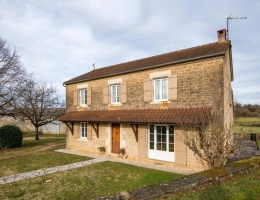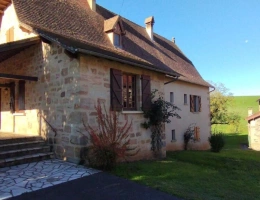
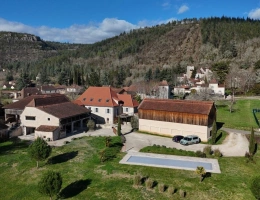
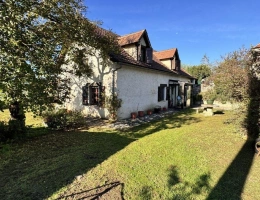
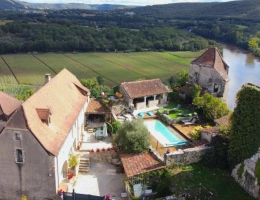
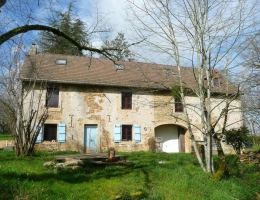
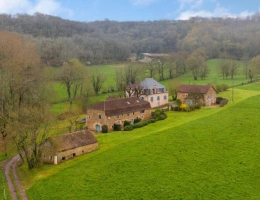
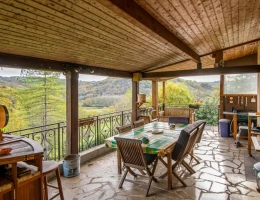
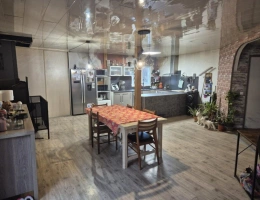

Looking for a country house for sale in Lot (46)? Between the limestone causse plateaus, the valleys of the Lot and Célé rivers and the Cahors vineyards, the department has a distinctly Quercy rural style: a house built of golden limestone, an isolated dovecote standing in the fields, or a farmhouse with a stone slate roof on the causse. This page brings together the country houses for sale in Lot published on ma-propriete.fr by private sellers, estate agents and notaries.
To help you decide, we present the actual prices of country houses in Lot (notarised sales 2020-2025), the areas worth knowing from Cahors to Figeac, and the criteria that determine the value of a house in the countryside. Our complete guide to buying a country house in France completes these benchmarks, from surveying an old building to financing.
How much does a country house cost in Lot (46)? According to DVF data (notarised sales) analysed by the ma-propriete.fr observatory, the median price of a country house in Lot (46) stood at €168,508 in 2025, with an average price of €179,607 and a median price of €1,685/m² of living space (1,295 house sales in rural municipalities over the year). The price range is wide: 10% of houses sold for less than €90,000 (floor price, 1st decile) and 10% for more than €285,081 (ceiling price, 9th decile). The typical country house here offers 108 m² of living space on an average plot of 5,857 m², i.e. around 0.6 ha.
This market is well below the regional median (Occitanie: €210,000) and below the national median (€189,200). Since the second half of 2020, the median price has risen from €150,000 to €168,508, i.e. +12.3%; over one year (2024-2025) the change is -2.9%.
| 2025 indicator | Lot | Occitanie | France |
|---|---|---|---|
| Median price | €168,508 | €210,000 | €189,200 |
| Average price | €179,607 | €220,462 | €207,100 |
| Floor price (1st decile) | €90,000 | €107,500 | €90,000 |
| Ceiling price (9th decile) | €285,081 | €347,000 | €340,000 |
| Median price per m² of living space | €1,685/m² | €1,987/m² | €1,830/m² |
| Average living space | 108 m² | 111 m² | 108 m² |
| Average plot size | 5,857 m² | 4,162 m² | 3,181 m² |
| Number of sales in 2025 | 1,295 | 14,163 | 150,313 |
A departmental average hides large gaps. A smallholding to renovate, a restored longère with its outbuildings, a farmhouse on several hectares of land or a manor house with parkland do not sell at the same price, and the location matters as much as the building: coastline, tourist area, peri-urban countryside close to a job market or deep countryside. The table below shows the median price of country houses in Lot (46) by type of municipality (cumulative sales from mid-2020 to 2025) and its change between 2021 and 2025.
| Type of municipality | Median price 2020-2025 | Median price per m² | Change 2021-2025 | Sales 2020-2025 |
|---|---|---|---|---|
| Inland tourist areas (hinterland, mountains) | €180,000 | €1,723/m² | -1.5% | 1,407 |
| Peri-urban countryside (city catchment area) | €178,000 | €1,723/m² | +4.8% | 1,714 |
| Deep countryside (outside urban influence) | €165,000 | €1,643/m² | +1.3% | 4,621 |
These benchmarks help you assess a listing, estimate a property before putting it up for sale, or set your budget for a holiday home or a permanent move to the French countryside. To go further, see our observatory of country house prices in France (national, regional and departmental analysis, downloadable annual report) and work out the full cost of your purchase, including French notary fees, with our notary fees calculator.
The Quercy-style house is recognisable above all by its golden limestone, sometimes topped with a half-timbered dovecote characteristic of the causse. On the Gramat, Limogne and Lauzès causses, the heavy, steeply pitched stone slate roof still protects some older farmhouses, alongside the flat tile more common elsewhere; the fields are also dotted with cazelles and gariottes, small dry-stone huts typical of the causse. In the valleys, around Cahors, the wine-grower's manor-style house built of dressed stone dominates, often set in a tree-lined park close to the Cahors AOC vineyards.
The land varies greatly between the dry, stony, water-poor causse, well suited to truffle oak woodland, and the Lot and Célé valleys, where a garden, an orchard and sometimes vines accompany the house. Stone outbuildings (barn, vaulted cellar, dovecote) are a strong marker of the local architecture, as are the wells and cisterns dug to make up for the lack of springs on the limestone plateaus. The dry-stone walls that mark out plots on the causse add to the charm of these properties but need regular upkeep, as do the stepped terraces found on the steepest valley slopes.
Around Cahors, the prefecture served by an Intercités line to Toulouse and Paris (the nearest TGV station is Brive-la-Gaillarde, in Corrèze, just under an hour's drive away), and its AOC vineyards, country houses sell for more, driven by tourism and holiday homes, including a long-standing British presence in the department. The Lot valley, towards Puy-l'Évêque and Saint-Cirq-Lapopie, combines listed heritage with high prices. Towards Figeac and the Célé valley, the market stays more accessible, with a well-preserved rural building stock set between limestone cliffs and old watermills.
The Lot causses (Gramat, Rocamadour, Limogne-en-Quercy), more remote and drier, offer the most affordable prices in the department for large stone properties to renovate, often without mains water or connected drainage, ideal for a move to the countryside or a gîte project. To the north, towards Souillac and Martel, near the Dordogne valley and the Padirac chasm, the market also benefits from strong summer tourist demand, while the Ségala area to the east, around Lacapelle-Marival, keeps a more modest building stock of granite and schist.
Three factors dominate: proximity to the Lot valley or Cahors, the condition of the roof (stone slate is costly to maintain and repair, on top of the timber frame and energy rating) and the size of the plot, especially on the causse where large wooded parcels are common. A renovated manor-style house in the Lot valley and a causse farmhouse to renovate can differ considerably in price.
Check the private drainage system, which can be tricky on karstic limestone ground where infiltration and the risk of sinkholes sometimes complicate soil surveys, the energy rating of limestone houses that are often poorly insulated, fibre-optic coverage for remote working, the higher radon risk towards the granitic Ségala area in the east of the department, and local planning rules in causse areas or near a protected site. On the causse, drinking water supply deserves particular attention, as some isolated houses still rely on a borehole or a cistern rather than the public network. A pond or a stretch of riverbank on the Lot or Célé also calls for checking flood exposure and any fishing or navigation easements attached to the land.
On ma-propriete.fr, filter Lot country houses by budget, living space and land area, set up an email alert so you never miss a new listing, and if needed widen your search to all country houses for sale in Occitanie.