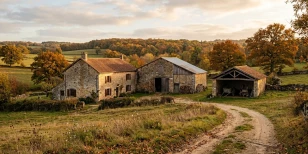

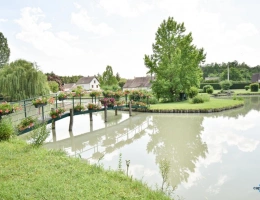
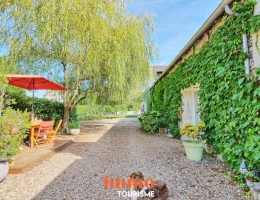
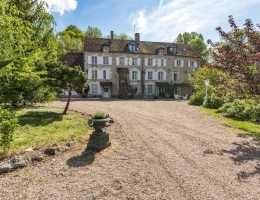
A farmhouse for sale in Loir-et-Cher (41), a Beauce farm building or a Sologne smallholding: this department sits between a cereal-growing plain and a forest of ponds, giving it two quite different farming faces. This page brings together the farmhouses, barns and mas for sale in Loir-et-Cher published on ma-propriete.fr: a large Beauce farm with sheds, a timber-framed brick Sologne smallholding, a stone barn to renovate, a farm building with outbuildings and land. Built area, the presence of ponds and distance to the Vendôme high-speed rail station are among the criteria that most set listings apart from one another.
Below you will find the actual prices of the Loir-et-Cher rural market, an overview of where to look, from Beauce to the Vendômois, and the points to check before buying a former farm building. If your project is tourism-related, our white paper on setting up a rural gîte will help you cost it. Local agents know this two-speed market well, split between the large plain and the land of ponds.
There are no statistics dedicated to farmhouses and barns: a renovated farmhouse sells like a country house with outbuildings and land, whereas a bare barn or a farm to renovate often sells well below. The most useful benchmark therefore remains the price of country houses.
How much does a country house cost in Loir-et-Cher (41)? According to DVF data (notarised sales) analysed by the ma-propriete.fr observatory, the median price of a country house in Loir-et-Cher (41) stood at €145,000 in 2025, with an average price of €152,715 and a median price of €1,485/m² of living space (1,924 house sales in rural municipalities over the year). The price range is wide: 10% of houses sold for less than €80,000 (floor price, 1st decile) and 10% for more than €240,000 (ceiling price, 9th decile). The typical country house here offers 102 m² of living space on an average plot of 2,895 m², i.e. around 0.3 ha.
This market is close to the regional median (Centre-Val de Loire: €150,000) and well below the national median (€189,200). Since the second half of 2020, the median price has risen from €133,000 to €145,000, i.e. +9.0%; over one year (2024-2025) the change is +2.5%.
| 2025 indicator | Loir-et-Cher | Centre-Val de Loire | France |
|---|---|---|---|
| Median price | €145,000 | €150,000 | €189,200 |
| Average price | €152,715 | €157,230 | €207,100 |
| Floor price (1st decile) | €80,000 | €75,000 | €90,000 |
| Ceiling price (9th decile) | €240,000 | €251,580 | €340,000 |
| Median price per m² of living space | €1,485/m² | €1,519/m² | €1,830/m² |
| Average living space | 102 m² | 103 m² | 108 m² |
| Average plot size | 2,895 m² | 2,999 m² | 3,181 m² |
| Number of sales in 2025 | 1,924 | 10,907 | 150,313 |
A departmental average hides large gaps. A smallholding to renovate, a restored longère with its outbuildings, a farmhouse on several hectares of land or a manor house with parkland do not sell at the same price, and the location matters as much as the building: coastline, tourist area, peri-urban countryside close to a job market or deep countryside. The table below shows the median price of country houses in Loir-et-Cher (41) by type of municipality (cumulative sales from mid-2020 to 2025) and its change between 2021 and 2025.
| Type of municipality | Median price 2020-2025 | Median price per m² | Change 2021-2025 | Sales 2020-2025 |
|---|---|---|---|---|
| Inland tourist areas (hinterland, mountains) | €122,500 | €1,223/m² | +17.4% | 314 |
| Peri-urban countryside (city catchment area) | €164,897 | €1,656/m² | +5.6% | 4,506 |
| Deep countryside (outside urban influence) | €130,000 | €1,350/m² | +4.0% | 7,316 |
These benchmarks help you assess a listing, estimate a property before putting it up for sale, or set your budget for a holiday home or a permanent move to the French countryside. To go further, see our observatory of country house prices in France (national, regional and departmental analysis, downloadable annual report) and work out the full cost of your purchase, including French notary fees, with our notary fees calculator.
In the north, the Beauce farm is recognisable by its closed, square courtyard, ringed by an imposing set of farm buildings: the dwelling, a cowshed, stables and large storage sheds suited to large-scale cereal farming. To the south, in Sologne, the buildings change completely: the Sologne smallholding, built of brick with a timber frame, is more modest and nestles near the ponds, between woodland and heath. Neither mas nor bastide is found here, those names staying specific to the south of France.
Beauce barns, often large and built of limestone, lend themselves to conversion into a home or several gîtes once a change of use is approved. In Sologne, farmland often gives way to ponds and game-rich woods, better suited to shooting than to keeping horses, though a permaculture project can work on the rare drained plots. Some rarer riverside longères along the Loir add a particular character linked to the local tuffeau stone.
Around Vendôme, in the Vendômois area and the Loir valley, the choice of barns and farms to renovate remains wide and affordable, helped by the high-speed rail link to Paris. Towards Romorantin-Lanthenay and Salbris, in vine- and forest-growing Sologne, smallholdings and hunting lodges sit alongside working farms. The Mondoubleau area, on the Vendôme edge of the Perche, is even more rural and offers older buildings at contained prices.
Near Blois and along the Loire, former farm buildings renovated in tuffeau stone are sought after and trade above the departmental average. In deep Sologne, around Chambord and Lamotte-Beuvron, properties with private ponds form a market of their own, clearly pricier than farming Beauce. Between the two, the Contres area and the Sologne side of the Cher mark a gradual shift towards large vineyard and forest estates.
Check the building's permitted use under the local zoning plan: in an agricultural zone, a Beauce shed can only become a home if it is specifically identified as eligible for a change of use. Examine the roof (flat tiles in Sologne, asbestos-cement sheets common on Beauce sheds), the timber frame and the drainage, often non-compliant on isolated buildings in the damp Sologne wetlands. An asbestos survey and a check for dry rot are recommended before buying an old barn in a damp area.
If farmland comes with the property, ask about any current farm lease and the pre-emption right of the Safer, particularly watchful in cereal-growing Beauce. Finally, cost the renovation carefully: a large Beauce barn often calls for a substantial building budget.
On ma-propriete.fr, filter Loir-et-Cher farms and barns by budget, built area and land area, set up an email alert to be told of new listings, and extend your search to all farmhouses, barns and mas for sale in Centre-Val de Loire. It is also worth comparing properties by whether ponds or woodland are attached, a criterion that weighs heavily on the project and its use.