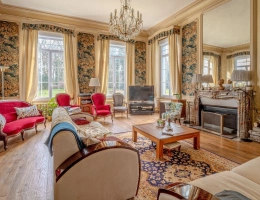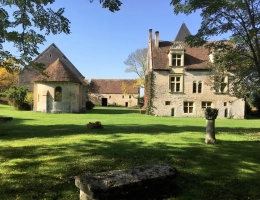
A manor house for sale in Centre-Val de Loire usually belongs to the wider Loire building tradition: white tuffeau stone or brick-and-stone walls, steeply pitched slate roofs, sometimes a corner turret inherited from Renaissance architecture. From Eure-et-Loir to Cher, by way of Loiret, Loir-et-Cher, Indre-et-Loire and Indre, the region holds a very large number of rural residences, often surrounded by woodland, ponds or vineyards. Browse the manor houses for sale listed by the region's private owners, agencies and notaries.
This page gives real price benchmarks for the region's large residences, the areas where manor houses are most numerous, what sets the building style apart across the traditional pays, and the checks specific to an old residence in tuffeau or brick. To approach the purchase of a character property as a whole, read our guide to buying prestige property in France.
DVF land registry data does not identify manor houses as such: the benchmarks below cover sales of houses over 300 m² of living space on 0.05 to 10 ha, above €1,000/m², tracked by our observatory. They frame the market for large residences without describing it entirely: an estate with 30 ha of parkland or a listed monument sold with its farmland falls outside this scope.
In Centre-Val de Loire, 52 sales were recorded in 2025, with a median price of €591,500*, a floor/ceiling range (P10–P90) of €400,000 to €1,098,900 and a median of €1,570/m² of living space (average 375 m² of living space on 16,826 m² of land). Over five years (2021-2025), the regional median comes to €588,900 across 314 sales. Nationally, the 2025 median stands at €822,000 across 981 sales, with a ceiling (P90) of €3,100,000.
| Scope | Sales | Median price | Floor – ceiling (P10–P90) | €/m² living space (median) |
|---|---|---|---|---|
| Centre-Val de Loire (2025) | 52 | €591,500* | €400,000 – €1,098,900 | 1,570 |
| Centre-Val de Loire (2021-2025) | 314 | €588,900 | €400,000 – €1,048,700 | 1,639 |
| France (2025) | 981 | €822,000 | €428,000 – €3,100,000 | 2,308 |
The breakdown by stratum (coastal, rural tourist, ordinary rural) and the five-year trend are in our observatory of prestige property prices in France (in French). Before making an offer, work out purchase costs and borrowing capacity with our financial tools and calculators.
Source: DVF (DGFiP), transactions from 1 January 2021 to 31 December 2025, processed by ma-propriete.fr; prices rounded to the nearest €100. * Fewer than 100 sales: read as an indication only.
In Touraine and the Blois area, white tuffeau, a soft limestone easy to carve, dominates the facades and allows sculpted detail, ornate dormers and moulded cornices inherited from the Renaissance. In the Sologne, pink brick combined with timber or stone gives houses a more rustic look, under steeply pitched roofs of flat tile or slate. In the Berry, around the Cher and Indre rivers, local limestone and occasionally sandstone form plainer houses, with squat volumes suited to long agricultural use. Roof lines tend to steepen from west to east across the region, a response to slightly heavier rainfall inland.
Outbuildings often reflect a hunting or farming past: ranges of buildings around a courtyard, dovecotes in the Sologne and the Berry, vaulted cellars in the Loir-et-Cher vineyard. A manor to renovate remains common in Indre and Cher, while already-restored houses cluster more along the Loire, between Blois, Amboise and Tours, an area where demand stays steady. Formal gardens or a walled kitchen garden often survive around these houses, even where the main building itself needs substantial work.
Eure-et-Loir, between the Perche and Beauce areas, offers houses often set in isolation near Chartres, Nogent-le-Rotrou and Châteaudun, amid broad arable farmland. Loiret, from the Sologne to the Gâtinais, around Orléans and Montargis, offers varied building styles between ponds and forest, many tied to a hunting past. Loir-et-Cher combines vineyard and the Cher valley around Blois, Vendôme and Romorantin, while Indre-et-Loire, the heart of Touraine, concentrates sought-after residences between Tours, Amboise, Chinon and Loches. Further south, Indre, between the Boischaut and the Brenne, around Châteauroux and Le Blanc, and Cher, from the Sancerre area to the deep Berry, offer more secluded and more affordable properties, often surrounded by hedged pasture or vineyards.
The stations at Saint-Pierre-des-Corps and Tours give fast TGV access from Paris, as does Vendôme-Villiers-sur-Loir; the region's other departments rely on Intercités and TER links to Paris. The most sought-after areas line the Loire, between Blois and Chinon; inland areas, in the Brenne, the Boischaut and the Sancerre district, stay more affordable for a manor of comparable size.
Some of the region's noble buildings, particularly along the World-Heritage-listed Loire, are registered historic monuments or sit within a designated heritage site: establish the exact status, since exterior works require the approval of the Architecte des Bâtiments de France. In the Loire valley, flood-risk prevention plans strongly restrict building and extensions close to the river and its tributaries, and any works to a riverside quay wall usually need a separate authorisation.
On the technical side, have the cellars carved into the tuffeau checked, since they are prone to collapse and water infiltration, along with the roof timbers of Sologne brick houses, often old. Private drainage deserves a systematic check in rural areas, as does the status of access tracks and rights of way specific to properties surrounded by ponds or private woodland. Also check the fishing and maintenance rights attached to private ponds, common in the Sologne, along with the environmental rules that apply to any body of water on the estate.
Manor house listings in Centre-Val de Loire come from private owners, specialist agencies and notaries; filter them by price, living space, land and outbuildings, and set an e-mail alert to follow new listings. To widen your search, browse prestige property for sale in Centre-Val de Loire.