


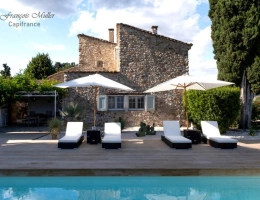
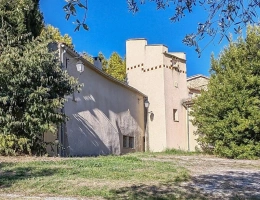
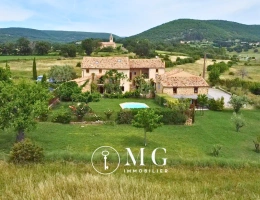
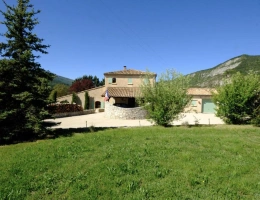
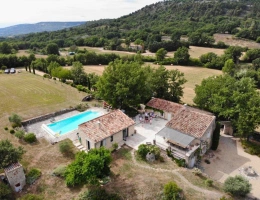
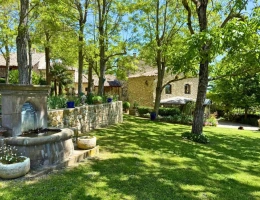
A manor house for sale in Alpes-de-Haute-Provence is closer to a stone bastide or a fortified farmhouse than to a timber-framed residence: the word manor is rarely used in this mid-mountain department, and the market mostly applies it to large old farming residences. From the Valensole plateau to the Forcalquier district, they stand out through dry-stone or soft limestone walls, shallow-pitched roofs and numerous farm outbuildings. Browse the manor houses for sale listed by the department's private owners, agencies and notaries.
You will find here real price benchmarks for these large Haute-Provence residences, the areas where they cluster, what characterises their stone construction and the checks specific to a mid-mountain property exposed to drought and frost. Distances between hamlets are considerable in this sparsely populated department, so factor in travel time to schools, shops and medical services when comparing two otherwise similar properties. To approach the purchase of a character property as a whole, read our guide to buying prestige property in France.
DVF land registry data does not identify manor houses as such: the benchmarks below cover sales of houses over 300 m² of living space on 0.05 to 10 ha, above €1,000/m², tracked by our observatory. They frame the market for large residences without describing it entirely: an estate with 30 ha of parkland or a listed monument sold with its farmland falls outside this scope.
The local market is too thin to publish a reliable department-level benchmark (19 sales in five years): we give the figures for the Provence-Alpes-Côte d'Azur region. Across the Provence-Alpes-Côte d'Azur region, the 2025 median stands at €2,520,000 (151 sales), against €822,000 in France in 2025 (981 sales).
| Scope | Sales | Median price | Floor – ceiling (P10–P90) | €/m² living space (median) |
|---|---|---|---|---|
| Provence-Alpes-Côte d'Azur (2025) | 151 | €2,520,000 | €1,002,000 – €5,800,000 | 6,914 |
| France (2025) | 981 | €822,000 | €428,000 – €3,100,000 | 2,308 |
The breakdown by stratum (coastal, rural tourist, ordinary rural) and the five-year trend are in our observatory of prestige property prices in France (in French). Before making an offer, work out purchase costs and borrowing capacity with our financial tools and calculators.
Source: DVF (DGFiP), transactions from 1 January 2021 to 31 December 2025, processed by ma-propriete.fr; prices rounded to the nearest €100.
The Haute-Provence fortified house is built of soft local limestone, with thick walls designed to regulate summer heat and winter cold, narrow openings and a roof of tiles or, more rarely, stone slabs in the higher areas. The plan stays plain: a rectangular main house, a vaulted ground-floor cellar, sometimes a bread oven against the gable wall. The most notable residences of the Forcalquier district or the Sisteron area keep a square dovecote or a dressed-stone gateway marking the entrance to the courtyard.
The outbuildings, often as large as the house itself, include vaulted sheepfolds linked to transhumance grazing, hay barns, a well and sometimes an olive press in the lower parts of the department. Most of these properties kept a farming or pastoral purpose until the twentieth century, leaving raw spaces to finish and old roofs to reinforce. Recent renovations favour lime renders and internal insulation compatible with the thickness of the walls.
The Valensole plateau, between Valensole, Puimoisson and Riez, offers large fortified farmhouses amid lavender fields, while the Forcalquier district, around Mane and Dauphin, holds gentry houses in a landscape of cultivated hills. Further east, the Sisteron area and the Durance valley offer residences set on hillsides with views of the surrounding ranges, and to the north, the Seyne district and the upper Verdon valleys remain more remote and markedly more affordable. Digne-les-Bains, the department's capital, concentrates services and the main transport routes.
The department has no TGV station; rail access runs through Intercités and TER connections to Marseille or Aix-en-Provence, and by road via the Durance valley and the RN85. The most sought-after areas remain the Valensole plateau and the Forcalquier district, while the Seyne district and the upper Verdon allow a residence of comparable size at a more moderate budget.
The contrasted climate of Alpes-de-Haute-Provence, with dry summers and harsh winters at altitude, calls for checking exposure to drought risk for dry-stone walls, which are prone to clay-shrinkage subsidence, and the condition of roofs against heavy snow in the higher areas. Near the listed towns of the Forcalquier district or the Sisteron area, exterior works require the approval of the Architecte des Bâtiments de France, and the local development plan limits new building in protected farmland.
On the technical side, check the private drainage system, almost universal outside the villages, the water supply, often dependent on a borehole or a captured spring, and the status of a rural track or right of way frequently crossing these large agricultural estates. The remoteness of some areas also calls for anticipating snow clearance and winter access upkeep.
Manor house and fortified farmhouse listings in Alpes-de-Haute-Provence are placed by private owners, agencies specialising in character properties and notaries from the department; filter them by price, living space, land, outbuildings and altitude, and set an e-mail alert to track new listings as they come onto the market across the plateau, the valleys and the Sisteron area. To compare with Hautes-Alpes, Var or Bouches-du-Rhône, browse the manor houses for sale in Provence-Alpes-Côte d'Azur.


